CCP's Clandestine Nuclear Tests: A Warning for War
Introduction: A Sobering Alert from U.S. Experts
In a stark warning issued on March 12, 2026, the Heritage Foundation's Allison Center for National Security highlighted alarming evidence suggesting that China is secretly conducting nuclear tests, potentially gearing up for nuclear warfare.
The article, authored by Senior Research Fellow Robert Peters, titled "China May Be Preparing for Nuclear War. Trump Can’t Ignore It," urges the United States to reevaluate its military posture.
This comes amid growing tensions, as U.S. officials accuse Beijing of violating international commitments under the 1996 Comprehensive Nuclear-Test-Ban Treaty (CTBT).
Drawing from intelligence assessments, seismic data, and historical context, the report paints a picture of a rapidly militarizing China that prioritizes warfighting capabilities over mere deterrence. As global nuclear dynamics shift, ignoring these developments could prove catastrophic for international security.
The Heritage Foundation, a prominent conservative think tank, has long advocated for robust U.S. defense strategies. Peters' analysis builds on recent U.S. government statements and independent verifications, emphasizing that China's actions are not isolated but part of a broader strategy to dominate in a potential nuclear conflict.
This report synthesizes the Heritage piece with additional details from U.S. officials and media reports, underscoring the urgency for policy responses under President Donald Trump.
Trump's Push for Nuclear Parity
The catalyst for renewed scrutiny was President Trump's directive last year to resume U.S. nuclear testing "on an equal basis" with China and Russia. This announcement shocked many, as the U.S. has not conducted a nuclear test since 1992, adhering to a self-imposed moratorium.
Trump's statement implied that adversaries were actively advancing their nuclear programs through testing, prompting widespread criticism. Detractors argued that resuming U.S. tests would provoke an arms race, while China vehemently denied any involvement and urged Washington to abandon the plan.
However, Trump's position found support in intelligence circles. Within days of his October announcement, Senate Intelligence Committee Chairman Tom Cotton (R-Arkansas) revealed that the Central Intelligence Agency (CIA) assessed both Russia and China as having conducted "super-critical nuclear weapons tests." This corroborated the president's concerns, shifting the debate from speculation to evidence-based alarm.
Peters argues that Trump's call was not provocative but a necessary response to asymmetric advancements by U.S. rivals. By demanding parity, Trump aimed to restore balance in nuclear capabilities, ensuring America does not fall behind in technological edge.
This move reflects a broader shift in U.S. strategy. During the Cold War, nuclear testing was routine for verifying weapon reliability and developing new designs. The U.S. moratorium relied on computer simulations and stockpile stewardship, but experts like Peters contend that without actual tests, the U.S. risks obsolescence against nations secretly advancing their arsenals.
Mounting Evidence of China's Secret Tests
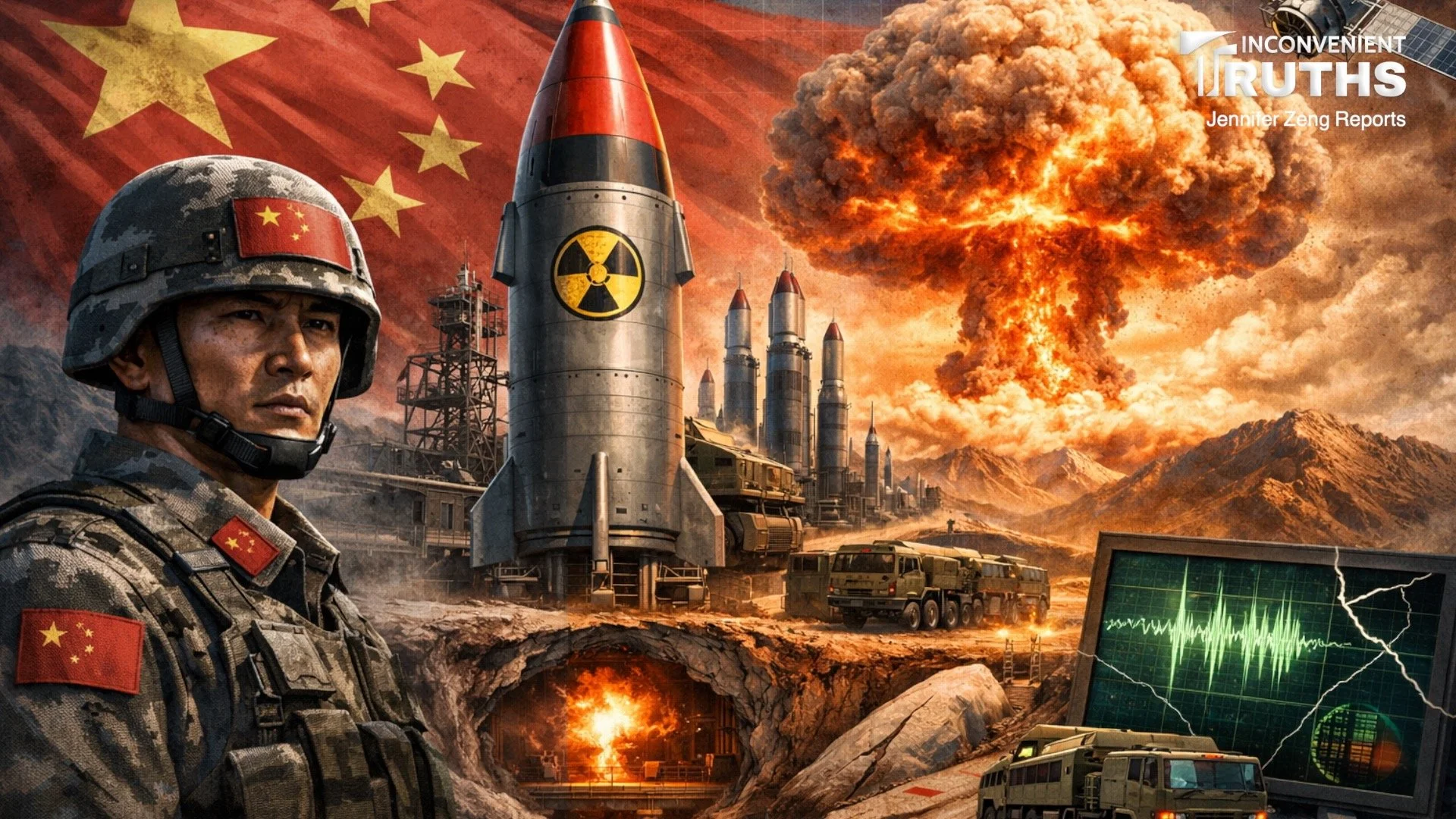
Central to the Heritage report is the accusation that China is conducting clandestine nuclear explosive tests, designed to evade international detection. These are described as very-low-yield tests, with yields in the hundreds of tons—far below the thresholds easily identifiable by global monitoring systems.
Peters cites U.S. intelligence indicating that China employs "decoupling" techniques, detonating devices in large underground cavities to muffle seismic waves, thus obscuring the explosions from the Comprehensive Nuclear-Test-Ban Treaty Organization's (CTBTO) International Monitoring System (IMS).
A pivotal event highlighted is a suspected test on June 22, 2020, near the Lop Nor nuclear test site in Xinjiang. Assistant Secretary of State for Arms Control and Nonproliferation Christopher Yeaw provided specifics: the event occurred at 9:18 Coordinated Universal Time, with a magnitude of 2.75, detected by seismic stations.
He described it as "supercritical" and "yield-producing," evident from seismic graphs.
This was not an isolated claim; on February 6, 2026, Undersecretary of State Thomas DiNanno explicitly stated in Geneva that "China has conducted nuclear explosive tests... with designated yields in the hundreds of tons." DiNanno accused the People's Liberation Army (PLA) of obfuscating these activities, marking the first direct U.S. accusation of CTBT violations by Beijing.
Further bolstering these claims, media reports from December 2023 revealed satellite imagery showing resumed drilling and infrastructure development at Lop Nor.
This activity, absent for years, suggests preparations for ongoing or expanded testing. China's denial rings hollow, as it has refused invitations for international observers to verify the site, fueling suspicions of a cover-up.
Seismic Confirmations and International Scrutiny
Independent data reinforces U.S. assertions. On February 17, 2026, the CTBTO's executive secretary noted two very small seismic events, 12 seconds apart, at the exact time and location cited by U.S. officials. While the CTBTO cautioned that events below 500 tonnes cannot be definitively characterized as nuclear, the consistency with American intelligence is striking. The organization emphasized that such low-yield events fall outside standard detection for treaty verification, highlighting a loophole China may be exploiting.
Norway's NORSAR seismic foundation added weight on February 19, 2026, identifying a weak signal from Lop Nor with characteristics of an explosion—stronger compressional waves relative to shear waves. Though NORSAR noted natural earthquakes could mimic this, the alignment with U.S. timelines and locations raises red flags. These third-party confirmations underscore that China's tests are not mere allegations but supported by scientific evidence.
Peters warns that this pattern of secrecy indicates deliberate intent to bypass global norms. By using decoupling, China minimizes seismic footprints, allowing tests that refine warhead designs without triggering international backlash. This evasion tactic, combined with China's refusal to engage in transparency measures, erodes trust in arms control frameworks like the CTBT, which China signed but has not ratified.
CCP's Nuclear Buildup: From Deterrence to Warfighting
Beyond testing, the Heritage analysis portrays China's nuclear expansion as aggressive and unprecedented. No longer content with a minimal deterrent arsenal of a few hundred warheads—as during the Cold War—China is now the world's fastest-growing nuclear power. It is constructing intercontinental ballistic missile (ICBM) silos at a pace surpassing the U.S., with capabilities to target Japan, Guam, Australia, and beyond.
Peters argues this buildup signals preparation for nuclear warfighting, not just deterrence. China rejects discussions on strategic stability, confidence-building, or arms control treaties, isolating itself from cooperative frameworks. Its arsenal includes advanced hypersonic missiles, submarine-launched weapons, and theater-range systems, enabling flexible use in conflicts. This shift aligns with PLA doctrine emphasizing "active defense," which could involve preemptive nuclear strikes.
U.S. officials echo this concern. DiNanno's Geneva speech revealed intelligence suggesting China is planning more tests with hundreds-of-ton yields, indicating ongoing refinement of tactical nuclear weapons. Such capabilities could lower the threshold for nuclear use in regional scenarios, like a Taiwan conflict, escalating risks for U.S. allies.
Implications for U.S. Security and Policy Recommendations
The revelations demand a U.S. response. Peters calls for updating military posture to counter China's advances, including modernizing the nuclear triad—bombers, submarines, and ICBMs—and enhancing missile defenses. Resuming limited testing could ensure U.S. warhead reliability, closing the gap created by decades of inaction.
Broader implications include strained alliances. Indo-Pacific partners like Japan and Australia face direct threats from China's expanding reach, necessitating stronger deterrence coalitions. Globally, China's actions undermine nonproliferation efforts, potentially inspiring other nations to pursue similar paths.
Trump's administration must prioritize intelligence sharing and diplomatic pressure, perhaps through the United Nations or bilateral talks, to compel Chinese transparency. Failing to act, Peters warns, risks a world where nuclear war becomes thinkable.
Conclusion: Ensuring Nuclear War Never Happens
China's secret nuclear tests and arsenal buildup represent a clear escalation, demanding vigilance from the U.S. and its allies. As Peters concludes, these developments should sober everyone, particularly America, which must adapt to prevent catastrophe. By heeding this warning, the U.S. can maintain strategic superiority and deter aggression, ensuring nuclear conflict remains an impossibility. The path forward requires bold leadership to match the gravity of the threat.
3/14/2026