Will It Hit a Wall? What Walls?
On June 12, 2026, Elon Musk’s SpaceX officially listed on the Nasdaq stock exchange in the United States, setting a new global record for the highest IPO fundraising in capital markets history. The AI community was in celebration. AI seemed like a train without brakes, only getting faster and faster, until it throws all of us off the tracks.
However, on the very same day, Reuters reported that Anthropic issued a statement announcing it had received export control directives from the U.S. government. Although the government did not disclose specific national security concerns, the company understood that U.S. officials appeared to have discovered methods to bypass safety restrictions and “jailbreak” Fable 5, leading to an immediate halt.
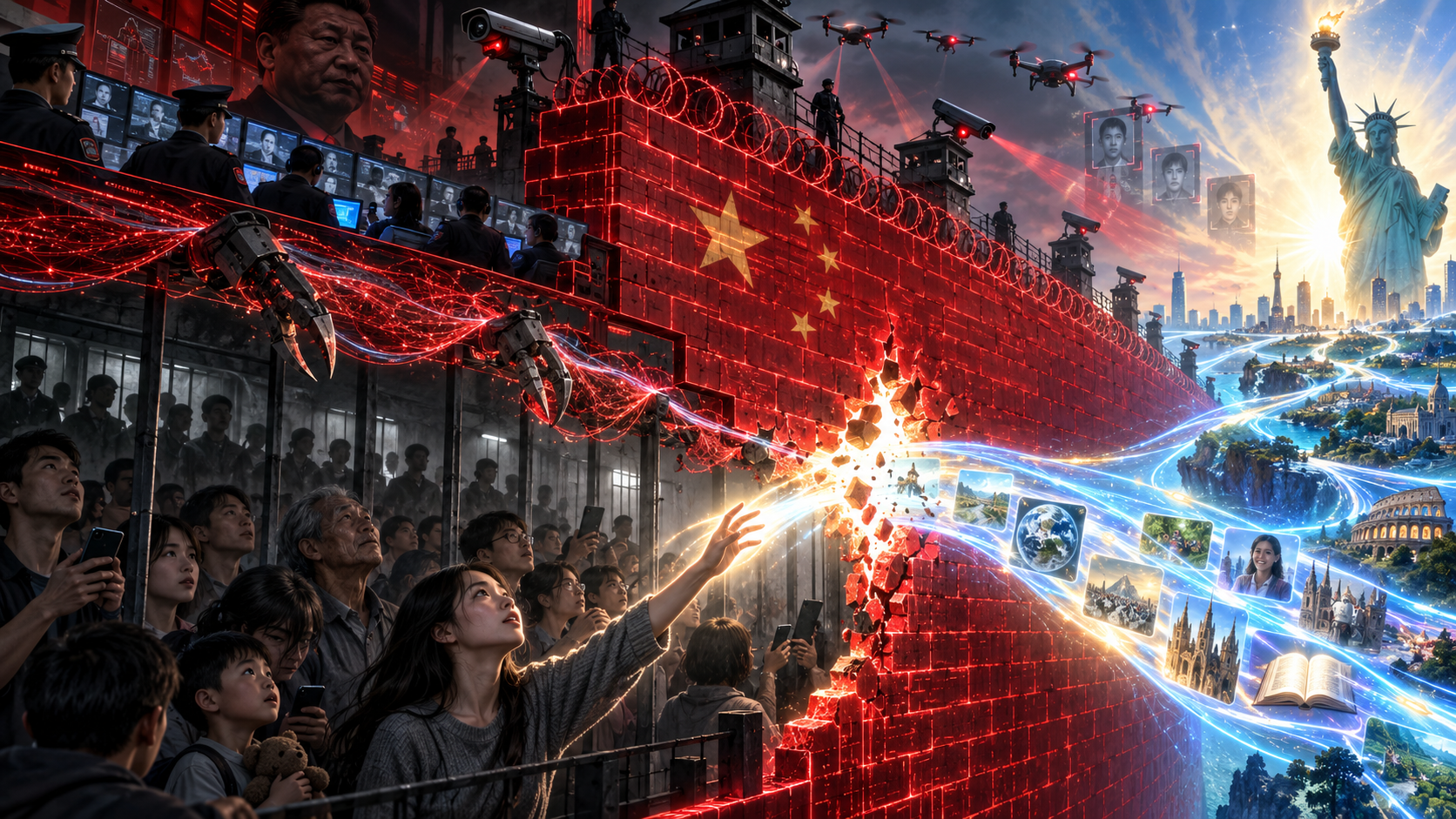
It seems AI has hit an invisible wall.
AI is not just a piece of infinitely replicable software code. It is a heavy industry that burns real money, electricity, and data.
There are at least four walls standing in front of it. Beyond these four, there is an even more hidden and taller wall — one built inside our own hearts.
The First Wall: Electricity
This is the hardest and most unavoidable wall, because it is governed by the laws of physics.
For AI to become stronger and models to become smarter, more chips must be stacked and larger data centers built. The more you stack, the more electricity it consumes — to an astonishing degree.
The scale has already become alarming. The International Energy Agency (IEA) predicts that by 2026, global electricity demand from data centers and the AI industry will double compared to previous levels. The U.S. Department of Energy is even more direct: by 2027, half of all new data centers in the United States are expected to face electricity supply shortages. By 2030, U.S. data centers alone will require about 35 gigawatts — nearly double the 2022 level.
What does 35 gigawatts mean? It is equivalent to the power generation of dozens of large nuclear power plants, just to feed the server rooms.
This explains a fascinating phenomenon: Microsoft, Google, and Amazon — these tech companies — have recently been doing something very un-tech-like: snapping up nuclear power, restarting decommissioned nuclear plants, and investing in building their own power plants. If there aren’t enough chips, you can make more by spending money. But power grids cannot be built in a day, and power stations even less so. This is the physical wall — problems money can solve are not real problems; what electricity cannot solve is the true bottleneck.
That is why Musk says we need to look to space for energy.
In one sentence: the limit of computing power is energy.
The Second Wall: Data Is Running Out
How do large models become smarter? Simply put, they “eat” massive amounts of text accumulated by humans on the internet and learn patterns from it. They are essentially voracious “reading machines.”
The problem is: the books are almost finished.
Multiple studies have delivered an unsettling prediction for the industry — between approximately 2026 and 2032, the publicly available high-quality text data on the internet may be completely “eaten up” by these models. Once the raw material runs out, what then?
There are two paths, both difficult. One is to feed AI with “synthetic data” generated by AI itself. But this is like inbreeding — quality may deteriorate and errors may snowball. The other is to mine unpublished professional data from various industries — medical, legal, industrial — but this data is expensive, messy, fragmented, and involves massive privacy and copyright issues.
Moreover, an increasing amount of content on the internet is now written by AI. What models “read” in the future may be second-hand knowledge produced by previous generations of AI. The very source feeding it is being polluted by itself — a significant hidden danger.
The Third Wall: Money and Returns Don’t Match
This one matters most to anyone concerned with investment.
The current playbook for the entire industry is: spend first. Hundreds of billions of dollars are poured in every year to buy chips, build server farms, and poach talent. Valuations keep getting more outrageous. But calmly ask: how many applications are actually making serious money with AI?
The answer is: very few. The vast majority of AI companies are still in the “spend money telling stories” stage, far from stable profitability. Investment flows like a bursting dam, while returns come out like toothpaste. This divergence cannot last forever. The market has already begun seriously discussing whether “AI will have a hard landing in 2026” — meaning the bubble bursts, valuations reset, and a wave of companies gets wiped out.
In fact, the recent case of Builder.ai— valued at $1.5 billion, claiming to be AI but exposed as using real humans typing code — is a classic specimen of the bubble era. In the frenzy where simply slapping on the letters “AI” could raise funds, even scammers could feast. When the tide recedes, such companies will be caught “swimming naked” in droves.
Capital’s patience is limited. When it realizes the story cannot be fulfilled, the retreat will be faster and more ruthless than the inflow.
The Fourth Wall: Rules Are Tightening
When technology races ahead, rules always lag behind. But once rules land, they become real reins.
Currently, AI regulation around the world varies wildly, making the situation even more complex. The EU has introduced a comprehensive AI Act with a strict approach. Under the Trump administration, the U.S. has shifted toward “light regulation, seize innovation” while elevating AI to a national security priority and strengthening government pre-testing for frontier models. However, Anthropic stated on June 12 that it had received export control directives from the U.S. government.
In China, all generative AI services for the public must complete algorithm filing (deadline by the end of June 2026), generated content must undergo prior security review, and user data cannot be arbitrarily used for model training.
For an AI company wanting to do global business, this means the same product must wear completely different compliance shackles in different markets. The fragmentation of rules itself is a cost and a speed bump.
The Final Wall: Will Humans Forget Who They Are First?
The previous walls are all outside AI’s body — electricity, data, money, and rules. But there is another wall, built inside our own hearts, and it may be the tallest one.
Let’s start with an uncomfortable truth: once capital pursues profit to the point of breaking moral boundaries, it will eventually be bitten back — bubbles bursting, giants collapsing, myths crashing to the ground.
A deeper unease comes from technology’s increasingly “miraculous” posture: restoring sight to the blind, hearing to the deaf. These things themselves are good and undeniable. But the issue is not “what is done,” but “in what spirit it is done.” When technology stops saying “I am helping” and begins subtly defining what a human is and what bodily limits should be surpassed, it shifts from a tool to an act of overreach. Wanting to play God — the second half of that myth rarely ends well.
Behind all this is the most fundamental question: humans have never been merely material beings, but also spiritual, emotional, and moral beings. Wealth, efficiency, and instant gratification have created too much noise, leaving people with less and less patience for the slow, indefinable, and non-monetizable inner experiences. Thus emerges the greatest paradox of this era: we have created countless things that make life more convenient, yet we have not created anything that brings peace to the heart. Today’s people are not necessarily happier — this even has data to support it: once income exceeds the basic subsistence level, wealth and happiness largely decouple.
So, will AI hit a wall?
My judgment is: it will not crash and die, but the myth of “infinite acceleration” will definitely break.
The train is indeed speeding. But no matter how fast the train, it needs tracks, fuel, and signal lights. For AI’s journey, ahead is not a cliff, but a road that increasingly requires rules.
And the real destination is not on the technology side, but on our side. Only a civilization that also accounts for spirit and emotion in its ledger will avoid living in the emptiest way precisely when technology is at its most glorious. Whether humans will lose themselves in the mad dash is the question that no one else can answer for us.
Author: Wang Zhiqing
Translated from the Chinese article at:
https://www.epochtimes.com/gb/26/6/15/n14789248.htm
6/16/2026