BREAKING: To Leave China, List Your Friends Abroad
Classified immigration notice, dated Aug. 31, tells border posts to log family, overseas contacts, social accounts, VPNs, assets — three days before new exit rules take effect.
A document presented as an internal circular of the National Immigration Administration, dated Aug. 31 and marked “Classified ★ 5 years” and “Urgent,” instructs every provincial exit-entry frontier inspection corps and every inspection station to “comprehensively strengthen” the collection and verification of traveler data.
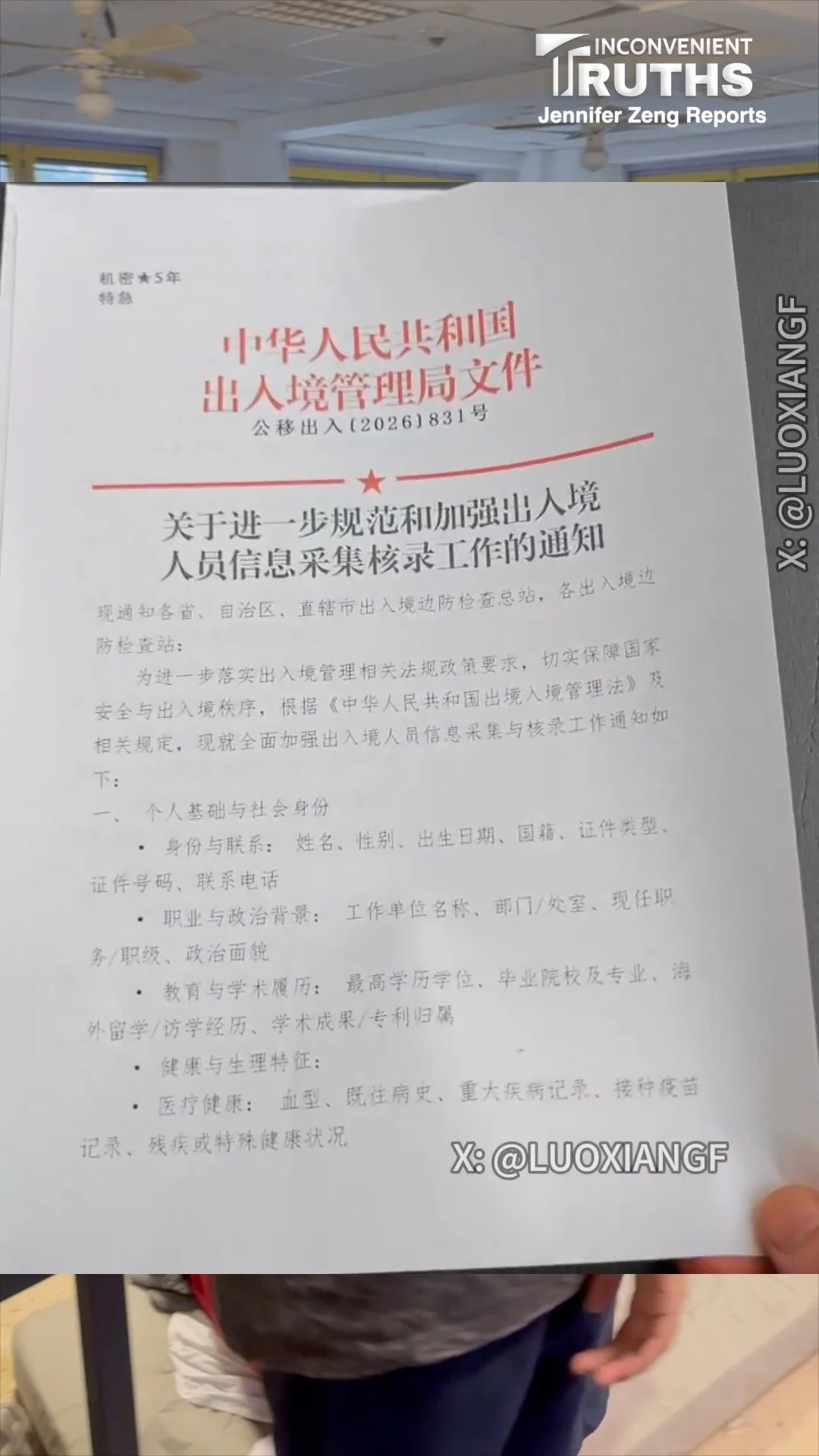
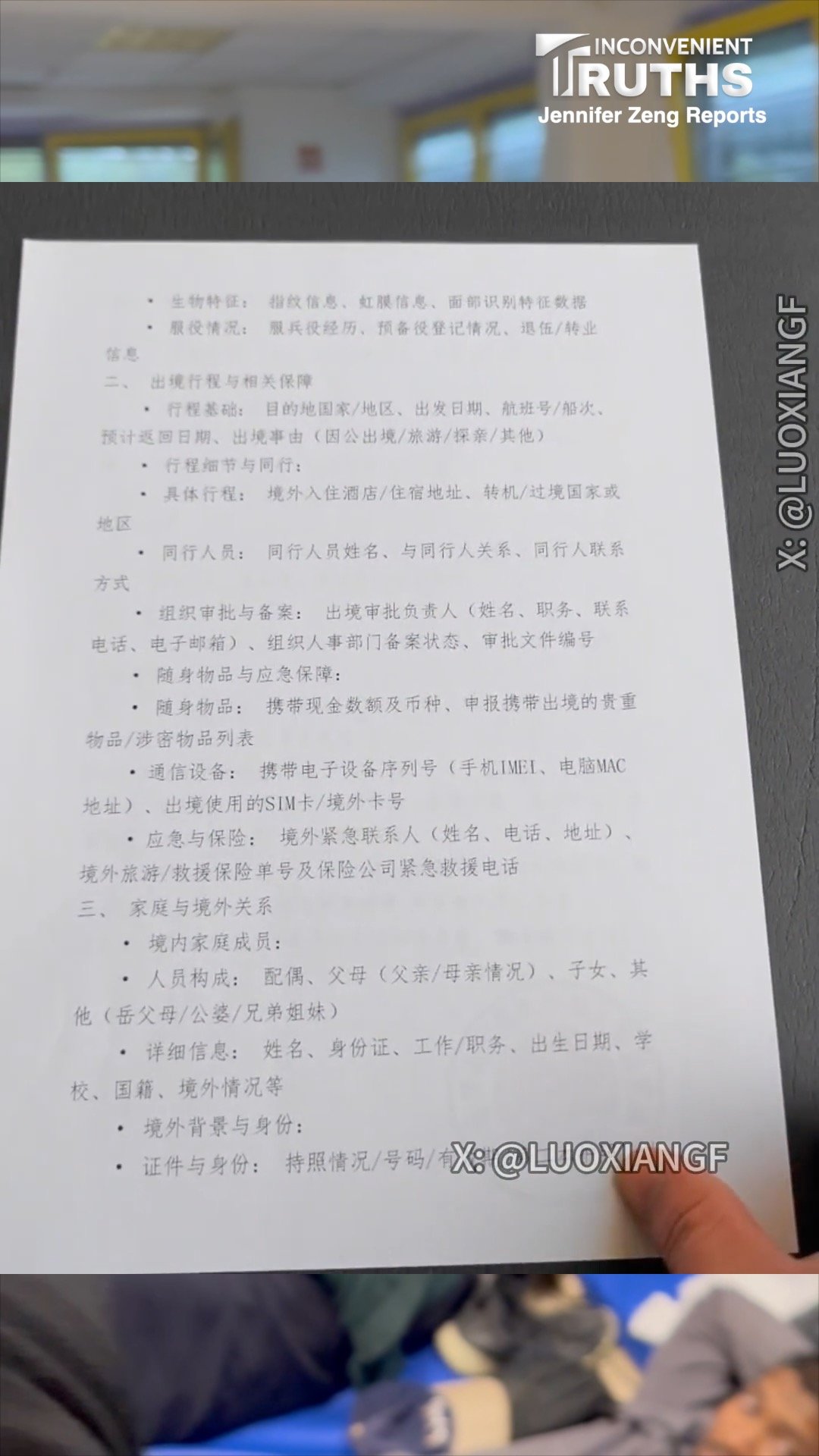
Page 1 of the classified document
The paper carries the document number Gong Yi Chu Ru (2026) No. 831. It was posted by the Chinese-language X account Luo Xiang (@LUOXIANGF), which has more than 350,000 followers and has spent the summer publishing traveler accounts of extra exit forms and phone searches at Chinese airports. The notice does not appear on the official government gazette. Its authenticity cannot be independently confirmed from public PRC websites. What it claims to implement, however, sits on a regulation that is public and binding.
On July 31, Chinese Premier Li Qiang promulgated State Council Order No. 841, the Regulations of the State Council on Exit and Entry Administration. The 19-article rule takes effect nationwide on Sept. 15. Article 3 already authorizes immigration and visa officers, when verifying identity and purpose of travel, to question travelers and demand “relevant documents, materials, electronic data and other information.” False materials or false statements can mean no passport, no exit, no entry.
The leaked circular reads like the field manual for that sentence.
Page 2 of the classified document
What the circular says travelers must surrender
The notice is organized in six blocks. None of them look like a tourist landing card.
Identity and politics. Name, sex, date of birth, nationality, document type and number, phone. Then work unit, department, current post and rank, and political affiliation. Highest degree, school and major, overseas study, academic work and patent ownership. Blood type, medical history, major illness, vaccinations, disability. Fingerprints, iris, facial-recognition data. Military service, reserve status, demobilization.
The trip itself. Destination, departure date, flight or ship number, expected return, reason for leaving — official business, tourism, family visit, or “other.” Hotel address abroad. Transit countries. Names, relationships and phone numbers of traveling companions. The official who approved the trip, that official’s title, phone and email, plus the personnel-department filing status and approval-file number. Cash and currency carried. A list of valuables and of anything classified. IMEI of the phone, MAC address of the computer, the SIM or foreign number that will be used outside China. An emergency contact abroad, and the policy number and rescue hotline of the overseas travel insurer.
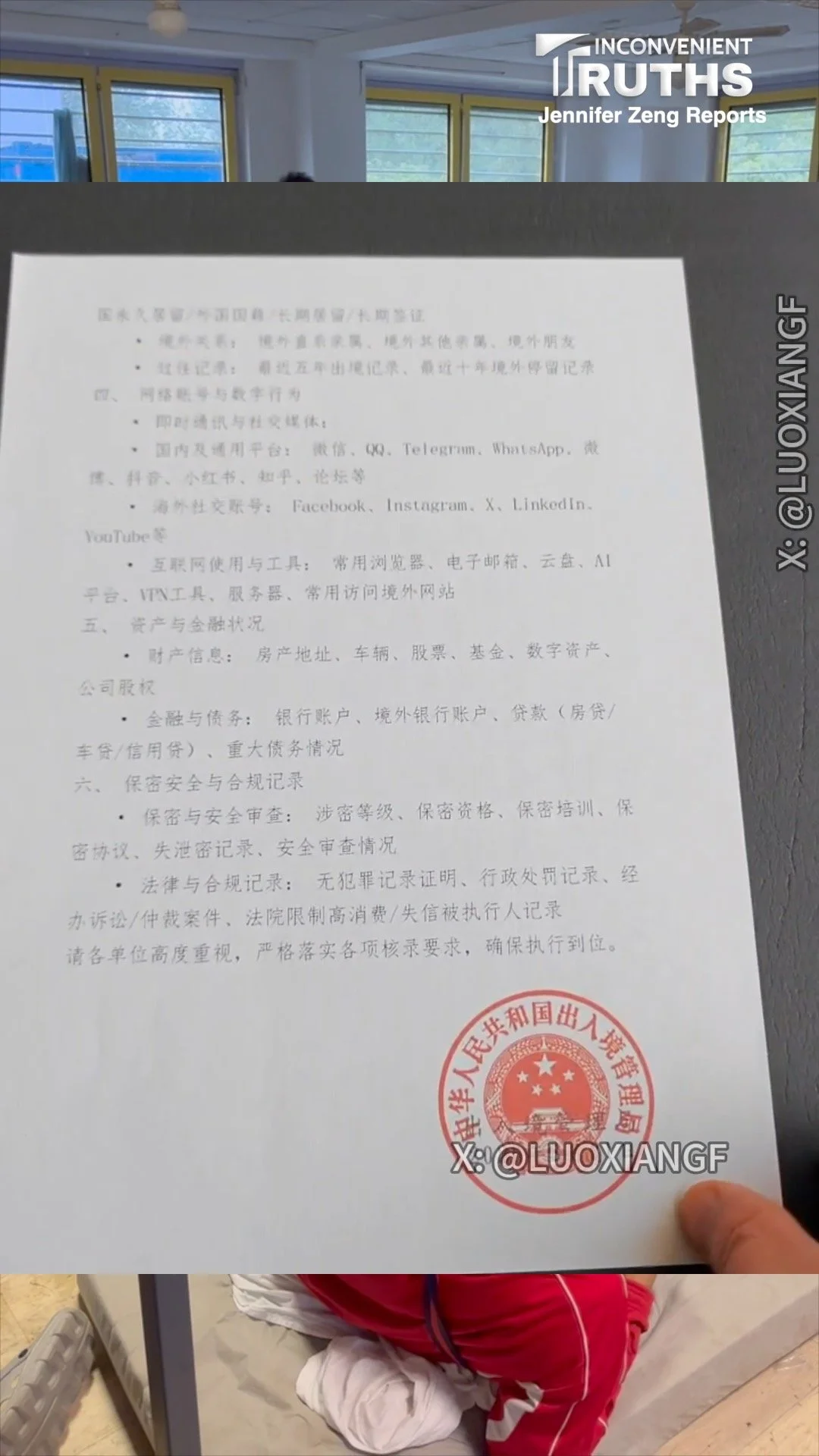
Page 3 of the classified document
Family, in China and out. Spouse, father, mother, children, in-laws, siblings — each with name, ID number, job and title, date of birth, school, nationality, and “overseas situation.” Then the traveler’s own second passport, foreign permanent residence, foreign nationality, long-term stay or long-term visa. “Overseas immediate relatives.” “Other overseas relatives.” “Overseas friends.” Five years of exit records. Ten years of time spent outside the country.
The digital life. WeChat, QQ, Telegram, WhatsApp, Weibo, Douyin, Xiaohongshu, Zhihu, forums. Facebook, Instagram, X, LinkedIn, YouTube. Everyday browser, email, cloud drive, AI platforms, VPN tools, servers, and “commonly visited overseas websites.”
Money. Home address, vehicles, stocks, funds, digital assets, company equity. Domestic bank accounts, overseas bank accounts, mortgages, car loans, consumer credit, “major debts.”
Secrets and the courts. Classification level, security clearance, secrecy training, secrecy agreements, leak records, security-review status. Certificate of no criminal record, administrative penalties, lawsuits and arbitrations, court consumption limits, and dishonest-judgment-debtor listings.
The last line tells every station to treat the list as a hard order: “All units shall attach great importance, strictly implement every verification requirement, and ensure it is carried out in full.” Stamped: National Immigration Administration of the People’s Republic of China. Date: Aug. 31, 2026.
Beijing’s public line, and the gap underneath it
Order No. 841 is not a rumor. It expands exit bans for document fraud and illegal border crossing (six months to three years after administrative detention), for “illegal or criminal activities abroad that endanger national security and interests” after a traveler returns, and — with no fixed time limit in the text — for export-control or technology-trade violations that “may endanger” industrial or technological security. Foreigners who lie on a visa or at the port can be barred for one to five years. Exit-entry agencies must register with immigration. Overseas firms are barred from selling those services inside China.
The Cyberspace Administration of China has spent the past two days calling talk of a “closed country” a “misreading.” Normal tourism, family visits and study, it says, are untouched; the targets are high-risk destinations, fraud, gambling, telecom scams and illegal technology transfer.
That is the press line. The circular, if genuine, is the intake sheet. A rule that says officers “may” demand electronic data is one thing. A classified checklist that names Telegram, VPN tools, overseas friends, iris scans and crypto wallets is another. Taiwan’s National Security Council secretary-general Joseph Wu has already warned that the September rule set turns border control into a political instrument and gives Beijing another legal hook for transnational pressure.
China’s government still says it is not closing the door. The form, as typed out this week, asks for the names of the people standing on the other side of it.
Commentary
Anyone who still plans to walk out through a Chinese checkpoint should read the list twice. This is not a customs declaration. It is a demand to account for your ancestors, your in-laws, your classmates, your “friends overseas,” the phone in your pocket, the VPN you used last year, the coins in a wallet, and the official who signed your leave slip.
Fill it in honestly and you will feel as if eighteen layers of skin have been peeled off. Fill it in dishonestly and Article 3 of the new State Council regulation is waiting: false materials, false statements, no exit.
After that exercise, how many people will still have the stomach — or the nerve — to leave?
Beijing’s answer, delivered with a straight face, remains the same: “We are not closing the country.”
— Jennifer Zeng
Full English translation of the document as published by Luo Xiang (@LUOXIANGF)
Classified ★ 5 years
URGENT
Document of the National Immigration Administration of the People’s Republic of China
Gong Yi Chu Ru (2026) No. 831
Notice on Further Standardizing and Strengthening the Collection and Verification of Information on Exit-Entry Personnel
All provincial, autonomous-region and municipality exit-entry frontier inspection corps, and all exit-entry frontier inspection stations, are hereby notified:
In order to further implement the relevant laws, regulations and policy requirements on exit-entry administration, and to earnestly safeguard national security and exit-entry order, and in accordance with the Exit and Entry Administration Law of the People’s Republic of China and related provisions, notice is hereby given on comprehensively strengthening the collection and verification of information on exit-entry personnel, as follows:
I. Personal Basics and Social Identity
Identity and contact: name, sex, date of birth, nationality, document type, document number, contact telephone number
Occupation and political background: name of work unit, department/office, current post/rank, political affiliation
Education and academic record: highest academic degree, institution of graduation and major, overseas study/visiting-scholar experience, attribution of academic achievements/patents
Health and physiological characteristics: Medical health: blood type, past medical history, records of major illness, vaccination records, disability or special health conditions
Biometric characteristics: fingerprint information, iris information, facial-recognition feature data
Military service: history of military service, reserve registration status, demobilization/transfer-to-civilian information
II. Exit Itinerary and Related Safeguards
Basic itinerary: destination country/region, date of departure, flight number/voyage number, expected date of return, reason for exit (exit on official business / tourism / visiting relatives / other)
Itinerary details and traveling companions: Specific itinerary: overseas hotel/lodging address, transit/stopover countries or regions
Traveling companions: names of traveling companions, relationship to the traveling companion, companion’s contact information
Organizational approval and filing: person responsible for exit approval (name, title, contact telephone, email), filing status with the organization and personnel department, approval-document number
Carry-on items and emergency safeguards: Carry-on items: amount of cash carried and currency, list of declared valuables/items involving secrets being taken out of the country
Communications devices: serial numbers of electronic devices carried (mobile-phone IMEI, computer MAC address), SIM card / overseas card number to be used while abroad
Emergency and insurance: overseas emergency contact (name, telephone, address), overseas travel/rescue insurance policy number and the insurer’s emergency-rescue telephone number
III. Family and Overseas Relationships
Family members inside the country: Composition of persons: spouse, parents (father’s/mother’s circumstances), children, others (parents-in-law/siblings)
Detailed information: name, national ID, work/post, date of birth, school, nationality, overseas circumstances, etc.
Overseas background and status: Documents and status: passport-holding status / number / validity / second passport / foreign permanent residence / foreign nationality / long-term residence / long-term visa
Overseas relationships: overseas immediate relatives, other overseas relatives, overseas friends
Past records: exit records for the most recent five years, records of stays outside the country for the most recent ten years
IV. Online Accounts and Digital Conduct
Instant messaging and social media: Domestic and general platforms: WeChat, QQ, Telegram, WhatsApp, Weibo, Douyin, Xiaohongshu, Zhihu, forums, etc. Overseas social accounts: Facebook, Instagram, X, LinkedIn, YouTube, etc.
Internet use and tools: commonly used browsers, email, cloud drives, AI platforms, VPN tools, servers, commonly visited overseas websites
V. Assets and Financial Condition
Property information: address of real estate, vehicles, stocks, funds, digital assets, company equity
Finance and debt: bank accounts, overseas bank accounts, loans (home mortgage/auto loan/consumer credit), major debt circumstances
VI. Secrecy, Security and Compliance Records
Secrecy and security review: classification level, secrecy credentials, secrecy training, secrecy agreements, records of loss or leakage of secrets, security-review circumstances
Legal and compliance records: certificate of no criminal record, records of administrative penalties, litigation/arbitration cases handled, court records of restricted high consumption / dishonest persons subject to enforcement
All units shall attach great importance, strictly implement every verification requirement, and ensure that implementation is carried out in full.
National Immigration Administration of the People’s Republic of China
August 31, 2026
— Translation of the Chinese text as typed by me and published in Chinese on my Chinese X account @jenniferzeng15. The original file was published in video form by Luo Xiang (@LUOXIANGF) as a confidential internal notice. It has not been posted on the official PRC government gazette.
9/12/2026