Leaked Top Secret PLA Court-Martial: Gen. Xu Qinxian Tried for Refusing Tiananmen Crackdown- Full Verbatim Transcript
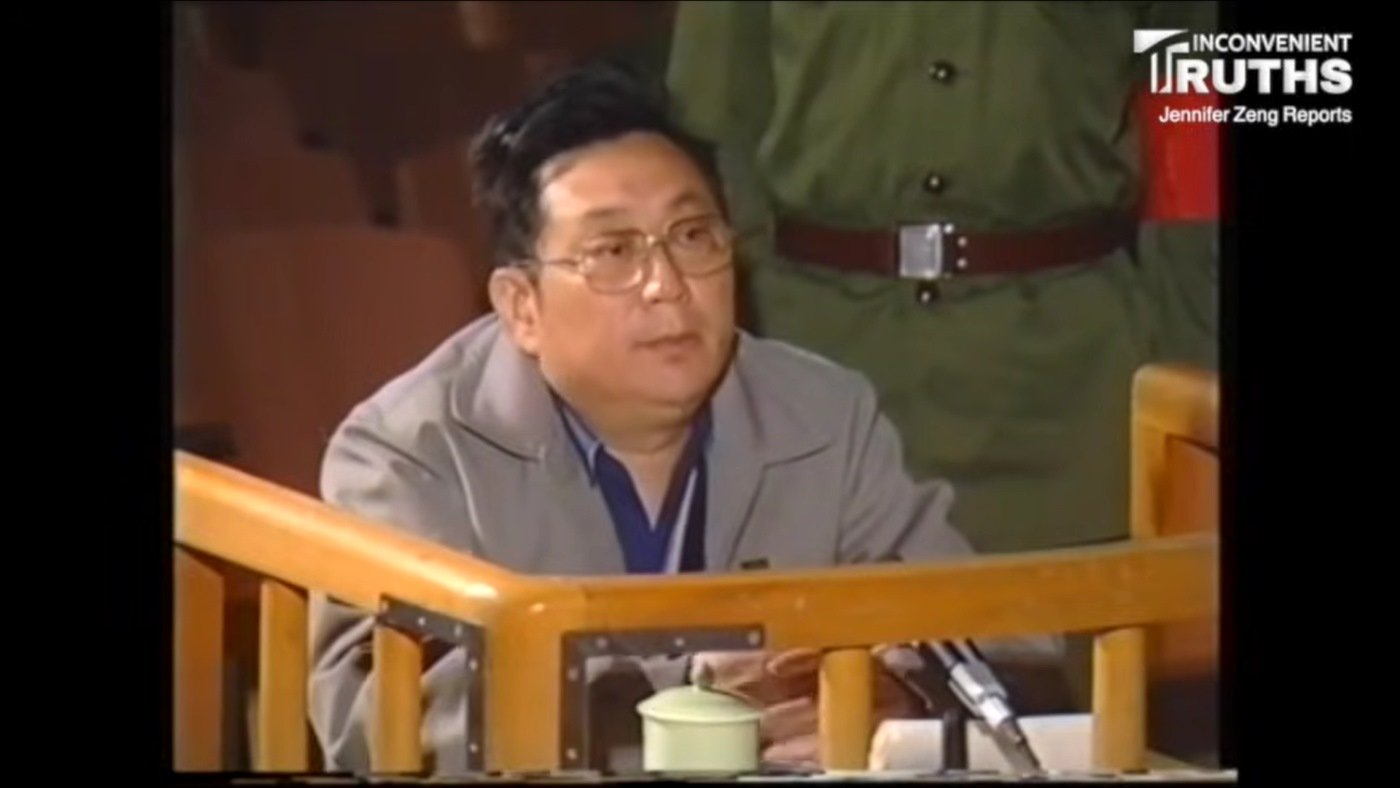
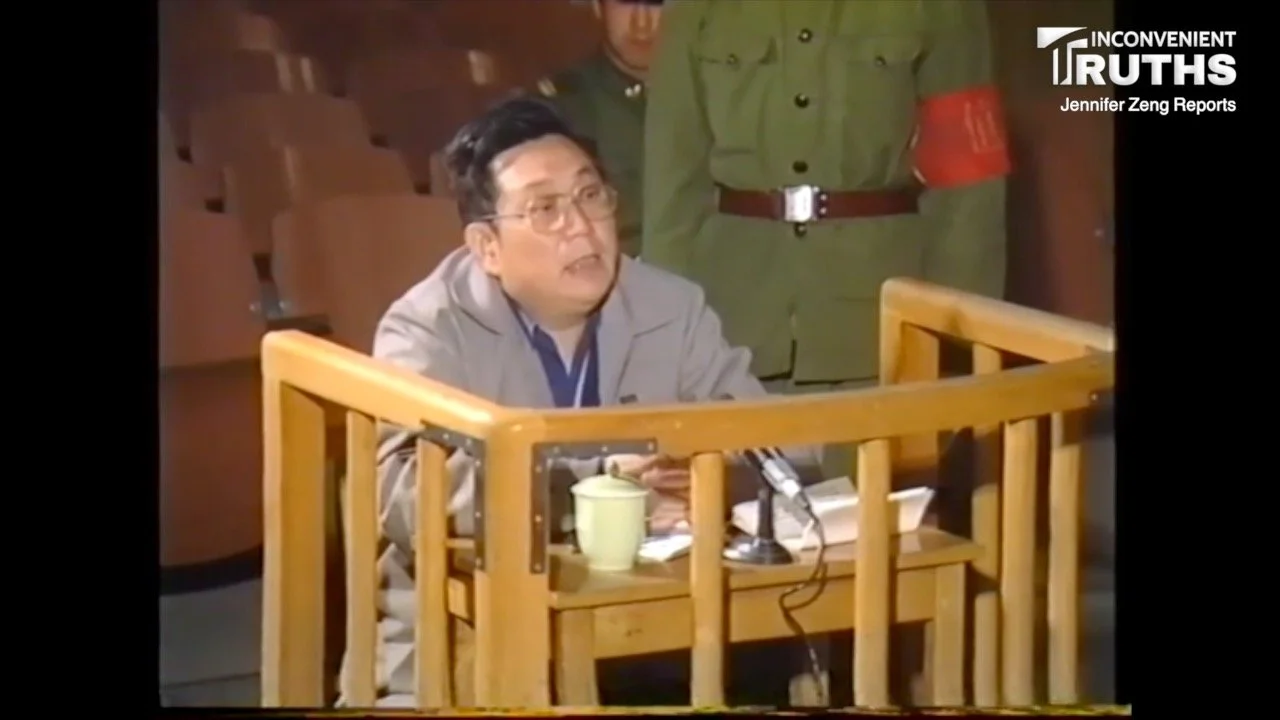
[Note: This English transcript with speakers is compiled based on the Chinese verbatim court record of the trial of General Xu Qinxian for “the crime of disobeying a martial law order.” The video indicates that the trial took place on March 17, 1990.]
(The Chinese version of the transcript of the entire 6-hour trial is here.)
(Court bell rings)
Clerk Zhao Yonghai: Public prosecutors and defense counsel, enter the courtroom. Presiding judge and judges, enter the courtroom.
Report to the presiding judge: the public prosecutors and defense counsel have entered the courtroom.
The defendant has been escorted to the waiting room to await trial. Preparations for the opening of the court are complete.
Presiding Judge Wei Shibin: The Military Court of the Beijing Military Region of the Chinese People’s Liberation Army is now in session.
Summon the defendant Xu Qinxian into the courtroom!
(The defendant Xu Qinxian is escorted into the courtroom by three soldiers and stands at the defendant’s seat)
Presiding Judge Wei Shibin: The Military Court of the Beijing Military Region, in accordance with Notice No. 11 (1989) issued under reference “Jun Jian Fa Zi” by the Military Court and the Military Procuratorate of the Chinese People’s Liberation Army, and pursuant to Article 111 of the Criminal Procedure Law of the People’s Republic of China, now conducts a non-public trial of the defendant Xu Qinxian, against whom the Military Procuratorate of the Beijing Military Region has instituted a public prosecution in the case of disobeying a martial law order. The reason for a non-public trial is that this case involves state secrets.
Judge Feng Zhaoshan: Defendant Xu Qinxian.
Xu Qinxian: Present!
Judge Feng Zhaoshan: Sit down. Do you have any other names?
Xu Qinxian: No.
Judge Feng Zhaoshan: How old are you this year?
Xu Qinxian: 55.
Judge Feng Zhaoshan: In what year and month were you born?
Xu Qinxian: August 1935.
Judge Feng Zhaoshan: What is your ethnic group?
Xu Qinxian: Han.
Judge Feng Zhaoshan: What is your native place?
Xu Qinxian: My native place counts as Shenyang, Liaoning. I was born in Shandong.
Judge Feng Zhaoshan: Born in Shandong, registered as from Shenyang City, Liaoning Province. Where do you currently reside?
Xu Qinxian: Babaoshan, Beijing.
Judge Feng Zhaoshan: Give the specific location and building number.
Xu Qinxian: No. 1 Shaojiapo, I think. Building 20, Unit 2.
Judge Feng Zhaoshan: What is your educational level?
Xu Qinxian: Junior college.
Judge Feng Zhaoshan: When did you enlist in the army?
Xu Qinxian: December 1950.
Judge Feng Zhaoshan: What positions have you held since enlisting?
Xu Qinxian: Cadet, signal operator, staff officer, deputy battalion commander, battalion commander, regimental chief of staff, section chief, division chief of staff, division commander, deputy army commander, army commander.
Judge Feng Zhaoshan: When did you assume the post of commander of the 38th Group Army?
Xu Qinxian: December 1987.
Judge Feng Zhaoshan: When were you conferred what military rank?
Xu Qinxian: In September 1988 I was conferred the rank of major general.
Judge Feng Zhaoshan: When were you placed under residential surveillance?
Xu Qinxian: 11 September 1989.
Judge Feng Zhaoshan: Where were you held under residential surveillance?
Xu Qinxian: At the Shangweidian Depot of the Beijing Garrison District.
Judge Feng Zhaoshan: Only that one place?
Xu Qinxian: Later I was transferred to the No. 492 Logistics Depot of the Military Region.
Judge Feng Zhaoshan: When, and for committing what crime, were you formally arrested according to law?
Xu Qinxian: On 9 January 1990. The arrest warrant states that it was because of “disobeying a martial law order.”
Judge Feng Zhaoshan: Where were you detained after your arrest?
Xu Qinxian: At the Beijing Military Region Detention Center.
Judge Feng Zhaoshan: Have you received any commendations in the past?
Xu Qinxian: I have been cited for merit and named an advanced worker, and have received some commendations. I can no longer remember them clearly.
Judge Feng Zhaoshan: What were the main reasons for those citations for merit?
Xu Qinxian: Working actively and diligently, bearing hardships without complaint.
Judge Feng Zhaoshan: Have you ever been disciplined in the past?
Xu Qinxian: I do not remember this very clearly. Later I never saw any written decision on sanctions. In any case I was definitely criticized, because I once lost a map. I do not know whether in the end a formal sanction was imposed or whether it ended with criticism. I am not very clear about it.
Judge Feng Zhaoshan: Have you ever received any criminal punishment in the past?
Xu Qinxian: No.
Judge Zhou Xinhua: Defendant Xu Qinxian.
Xu Qinxian: Present!
Judge Zhou Xinhua: Sit down. Do not move your hands about. Keep them in place, understood? We will now announce to you the members of the collegial panel and the clerk, and the list of public prosecutors and defense counsel, and inform you of the various procedural rights and obligations you enjoy in court.
Pursuant to Article 105 of the Criminal Procedure Law of the People’s Republic of China and paragraph 2 of Article 10 of the Organic Law of the People’s Courts of the People’s Republic of China, this collegial panel is composed of Senior Colonel Wei Shibin, deputy president of this court, Colonel Feng Zhaoshan, and Lieutenant Colonel Zhou Xinhua. Deputy President Wei Shibin serves as the presiding judge.
Major Zhao Yonghai acts as the clerk of the court, responsible for recording the court proceedings.
Pursuant to Article 112 of the Criminal Procedure Law, Senior Colonel Jiang Jichu, Deputy Chief Procurator of the Military Procuratorate of the Beijing Military Region, Lieutenant Colonel Jiang Jiguang, and Major Wang Changsheng appear in court to support the public prosecution and to supervise the legality of the court trial activities.
According to Article 26 of the Criminal Procedure Law, the legal advisers Yang Yunkai and Qu Hengdong from the Beijing Military Region Legal Advisory Office, whom you entrusted, will serve as your defense counsel.
Judge Feng Zhaoshan: Defendant Xu Qinxian, did you hear clearly the composition of the collegial panel, the clerk, and the list of public prosecutors and defense counsel just announced to you?
Xu Qinxian: I heard clearly.
Judge Feng Zhaoshan: Sit down.
Judge Zhou Xinhua: When you are required to stand, the presiding judge will instruct you to stand. Did you hear that?
Xu Qinxian: I heard.
Judge Zhou Xinhua: Defendant Xu Qinxian, pursuant to Articles 23, 24, and 25 of the Criminal Procedure Law, you enjoy the right to apply for recusal in court.
If you believe that any member of the collegial panel, the clerk, or any public prosecutor has an interest in this case that may affect the impartial handling of the case, you may state your reasons and apply for their recusal.
Did you hear clearly?
Xu Qinxian: I heard clearly.
Judge Zhou Xinhua: Do you apply for recusal of any member of the collegial panel, the clerk, or any public prosecutor?
Xu Qinxian: I do not apply. I agree to all.
Judge Zhou Xinhua: Defendant Xu Qinxian, pursuant to Article 26 of the Criminal Procedure Law, you enjoy the right of defense in court.
In addition to defense counsel defending you, you may yourself exercise your right of defense and make statements and arguments.
Did you hear clearly?
Xu Qinxian: I heard clearly.
Judge Zhou Xinhua: Defendant Xu Qinxian, pursuant to Article 118 of the Criminal Procedure Law, you also enjoy the right to make a final statement in court.
After the presiding judge announces the conclusion of the court debate, you may make your final remarks.
Did you hear clearly?
Xu Qinxian: I heard clearly.
Judge Zhou Xinhua: Defendant Xu Qinxian, pursuant to Article 119 of the Criminal Procedure Law and the provisions of the Rules of Court of the People’s Courts, you must observe court order in the courtroom, obey the direction of the court, and answer this court’s questions truthfully.
Did you hear clearly?
Xu Qinxian: I heard clearly.
Presiding Judge Wei Shibin: Defendant, stand up. We will now proceed to the court investigation.
First, the public prosecutor will read out the bill of indictment.
(Procurator Jiang Jichu reads the indictment)
Procurator Jiang Jichu: Bill of Indictment of the Military Procuratorate of the Beijing Military Region of the Chinese People’s Liberation Army (Reference No. 1, 1990, Jing Jun Jian Su Zi)
Defendant Xu Qinxian, male, Han ethnicity, 54 years of age, from Shenyang City, Liaoning Province, of petty trader background and student family class origin, junior college education, enlisted in December 1950, joined the Party in July 1956, appointed commander of the 38th Army Group in December 1987, and conferred the rank of major general on 1 September 1988.
Because he disobeyed a martial law order, on 23 May 1989, he was removed from his post as army commander. On 11 September of the same year, he was placed under residential surveillance. On 9 January 1990, he was arrested according to the law.
The case of defendant Xu Qinxian’s disobedience of a martial law order was investigated and concluded by the Military Procuratorate of the PLA.
On 8 December 1989, the procuratorate authorized this office to conduct a review for prosecution.
The following facts have now been ascertained:
At about 16:00 on 18 May 1989, Liu Zhenhua, Political Commissar of the Beijing Military Region, (at that time Commander Zhou Yibing was attending an emergency meeting convened by higher authorities), together with other leading comrades, in the conference room on the third floor of the main office building of the Military Region, conveyed to Xu Qinxian the order of the Central Military Commission to deploy the 38th Group Army to Beijing to carry out a martial law mission.
After Political Commissar Liu and the other leaders of the Military Region had conveyed the order of the Central Military Commission and made arrangements for the mission, Xu Qinxian immediately stated that he refused to lead the troops into Beijing to carry out the martial law mission.
He said: “A matter as serious as deploying the army, I suggest, should be discussed by the Standing Committee of the National People’s Congress and a plenary meeting of the State Council, to determine whether taking such action is right or wrong. Such an order ought to be issued by the state. It is inappropriate to issue it in the name of the Party.”
He also said, “Such an action must withstand the test of history. An event may not be clearly seen in the short term, but history can prove that carrying out such a mission may lead to military merit, or it may make one a criminal in history.”
He stated that he could not carry out such a mission with armed troops. “The Central Military Commission can appoint me as army commander, and it can also remove me from my post, but I cannot execute such an order. Please have the leaders find someone else.”
Under the severe criticism and instructions of the leaders of the Military Region, Xu Qinxian went to the operations duty office of the Military Region and used a secure telephone to convey the order of the Central Military Commission to Wang Fuyi, Political Commissar of the Group Army.
He told Wang, “I do not agree with this approach. I cannot carry out this order. I cannot command. As to who will command you, that is for others to decide.”
At about 19:00 that evening, in Room 213 of the No. 85 Guesthouse of the Military Region, Xu Qinxian called Political Commissar Liu of the Military Region and said, “I have passed on the order. From now on, do not come to me again about this matter.”
Thereafter, Xu Qinxian never again indicated to the leaders of the Military Region that he would carry out the order of the Central Military Commission.
The above criminal facts are clear and are corroborated by documentary evidence and witness testimony.
The conduct of Xu Qinxian in disobeying the martial law order of the Central Military Commission interfered with the deployment of the martial law mission by the leading organs, encouraged the arrogance of elements involved in turmoil and riot, increased the difficulties of the troops entering the city to carry out the martial law mission, and seriously damaged the political prestige of our army, causing extremely adverse political repercussions at home and abroad.
As commander of the Group Army, at a critical moment of life and death for the Party and the state, Xu Qinxian disobeyed orders at the critical moment, thereby gravely endangering the interests of the Party and the state.
The nature of his acts was vile, and the consequences serious.
According to Article 79 of the Criminal Law of the People’s Republic of China, and with reference to Article 17 of the Provisional Regulations of the People’s Republic of China on Punishing Crimes of Servicemen’s Breach of Duties, the conduct of defendant Xu Qinxian already constitutes the crime of disobeying a martial law order.
Pursuant to Article 100 of the Criminal Procedure Law of the People’s Republic of China, we hereby institute a public prosecution and request that he be punished according to law.
To: Military Court of the Beijing Military Region.
(From) Military Procuratorate of the Beijing Military Region. Deputy Chief Procurator: Jiang Jichu.
Procurators: Jiang Jiguang and Wang Changsheng.
10 January 1990.
Presiding Judge Wei Shibin: Defendant, sit down.
Defendant Xu Qinxian, the court will now, on the basis of the accusations in the bill of indictment, investigate the criminal facts of your disobedience of the martial law order.
Defendant Xu Qinxian, when and where did you receive notice, and from whom, to go to the Beijing Military Region headquarters to receive the mission?
Xu Qinxian: At noon on 18 May 1989, I received a phone call from Deputy Chief of Staff Tang Minghong of the army, asking me to go to the Military Region to receive the mission.
Presiding Judge Wei Shibin: How did Tang Minghong notify you?
Xu Qinxian: By telephone.
Presiding Judge Wei Shibin: What did you tell Tang Minghong?
Xu Qinxian: At that time, I was hospitalized due to illness. He asked, “Are you able to go?” I said that the stone had been passed the day before, and now, though barely, I could manage. I said I could go.
Presiding Judge Wei Shibin: You said you could go.
Xu Qinxian: Yes, I could go.
Presiding Judge Wei Shibin: When did you enter the General Hospital of the Beijing Military Region, and for what illness were you hospitalized?
Xu Qinxian: Around noon on 16 May 1989, I was transferred from the No. 280 Hospital in Fangshan to the General Hospital of the Military Region because of a urinary tract stone.
Presiding Judge Wei Shibin: In which department of the General Hospital were you hospitalized?
Xu Qinxian: Internal Medicine Department No. 5.
Presiding Judge Wei Shibin: Internal Medicine Department No. 5. When was the urinary tract stone passed?
Xu Qinxian: Around supper time on 17 May. It was passed before or after supper on 17 May. On the afternoon of the 17th—probably at supper, before or after supper—I do not remember very clearly.
Presiding Judge Wei Shibin: After the stone was passed, what was your physical condition at that time?
Xu Qinxian: I was weak, in pain, and without strength. Because beginning on 15 May, the onset of illness had tormented me for two or three days, so my energy was exhausted and my body very tired, and there were many parts of the body that hurt.
Presiding Judge Wei Shibin: Apart from the urinary tract stone, did you have any other illnesses when you were hospitalized?
Xu Qinxian: At that time, during a training session in mid-March, I had injured my foot. They checked that as well while I was there. The rest were just additional checks done in passing.
Presiding Judge Wei Shibin: All the others were only incidental examinations?
Xu Qinxian: Yes, incidentally.
Presiding Judge Wei Shibin: We will now read the testimony of Deputy Chief of Staff of the Headquarters of the 38th Group Army, Tang Minghong.
(Tang Minghong’s testimony read by Judge Feng Zhaoshan)
At 12:30 on 18 May, I received a telephone call from Comrade Peng Cuifeng of the Operations Department of the Military Region, informing me, “Please have your army commander come to the conference room on the third floor of the main office building of the Military Region at 3 p.m. for a meeting.”
I asked what it was about. He said there was a mission.
At the same time, he informed me to immediately dispatch a helicopter to Shijiazhuang to bring Commander Qin of the 27th Army to the Military Region for a meeting.
After receiving this call, since Xu was then hospitalized in the General Hospital of the Military Region with a urethral stone and not in the barracks, I immediately reported the situation to Political Commissar Wang and other leaders of the army who were at home.
I suggested that since the army commander was hospitalized, should we have Political Commissar Wang attend the meeting?
Political Commissar Wang instructed: “Consult with the Military Region as to whether I may go.”
I immediately telephoned Minister Peng to consult.
After Minister Peng consulted the leaders of the Military Region, he replied: “The political commissar may not go. The army commander must go.”
I reported the opinion of the Military Region to Political Commissar Wang, and immediately notified Army Commander Xu, who was hospitalized in the General Hospital of the Military Region, by telephone.
At that time Xu asked what it was about.
I said I did not know—probably a mission.
Xu then asked: “Must I go personally?”
I said I had already consulted the Military Region, and the Military Region said you must go.
Xu said: “Then I will go.”
28 July 1989. Tang Minghong.
Presiding Judge Wei Shibin: The testimony of Deputy Chief of Staff Tang Minghong just read out—did you hear it clearly?
Xu Qinxian: I heard clearly.
Presiding Judge Wei Shibin: Deputy Chief of Staff Tang Minghong testifies that at 12:39 at noon on 18 May, he received a telephone call from Director Peng Cuifeng of the Operations Department of the Military Region, informing the commander of the 38th Group Army to go at 3 p.m. to the conference room on the third floor of the main office building of the Military Region.
After reporting to Political Commissar Wang Fuyi of the 38th Group Army and consulting the Military Region, he then notified you, Army Commander Xu, by telephone at the General Hospital of the Military Region, and you agreed to go to the Military Region for the meeting yourself.
Defendant Xu Qinxian, what comments do you have on the testimony of Deputy Chief of Staff Tang Minghong?
Xu Qinxian: The testimony basically conforms to the facts. It is just that in the middle, when it comes to the end, he asked whether I could go.
I explained my physical condition and said I could go, because the stone had passed the previous day.
He was not all that clear about my condition at the time.
If it had been like the situation before supper on the 17th, then I could not have gone.
I briefly explained my condition and said I could go.
That was the situation.
As for the specific time, I no longer clearly remember it.
Presiding Judge Wei Shibin: Defense counsel, do you have any comments?
Defense counsel: No.
Presiding Judge Wei Shibin: Defendant Xu Qinxian, when you went to the Beijing Military Region headquarters to receive the mission, at what time did you leave the General Hospital of the Beijing Military Region?
Xu Qinxian: I do not clearly remember the specific time. After receiving the telephone call, I looked for a vehicle.
At that time the vehicle may have gone to the motor pool to take the head of the health station back to the barracks, and may not yet have returned.
I then asked the General Hospital to dispatch a vehicle, called several numbers but could not get through—to the president, to the administrative office—and in the end called the operations duty office of the Military Region.
I asked them to inform the logistics department of the Military Region to get in touch with the General Hospital again and send a vehicle for me.
This process took some time.
Afterwards, when the doctors learned that I had to go to the Military Region, several doctors came to examine and treat me, because after the illness my body was relatively weak and there were still quite a few problems.
They gave me injections, provided medicine, and treated me for quite a long time.
Afterwards the vehicle returned. When it came back—the specific time I do not clearly recall— it was probably between 14:00 and 15:00.
Presiding Judge Wei Shibin: Between 14:00 and 15:00.
Xu Qinxian: Between, I left the General Hospital. I did not look at my watch.
Presiding Judge Wei Shibin: When did you leave the General Hospital?
Xu Qinxian: Because time was taken up in finding a vehicle and receiving treatment.
Presiding Judge Wei Shibin: In whose vehicle did you finally go?
Xu Qinxian: In a vehicle from our army.
Presiding Judge Wei Shibin: Who was the driver?
Xu Qinxian: Ping Fakui.
Presiding Judge Wei Shibin: Ping Fakui. At about what time did you arrive at the Beijing Military Region headquarters?
Xu Qinxian: Around 16:00.
Presiding Judge Wei Shibin: Around 16:00. Where in the Military Region headquarters did you receive the mission?
Xu Qinxian: I remember it was a conference room on the west side of the third floor.
Presiding Judge Wei Shibin: Did you enter the main building?
Xu Qinxian: Yes, the main building.
Presiding Judge Wei Shibin: The conference room on the west side of the third floor of the main building.
Xu Qinxian: Yes, on the west side. I took the elevator on the east side up, and then walked west. The conference room was on the south side of the corridor.
Presiding Judge Wei Shibin: South side. Took the east elevator up, walked west, the door was on the south side.
Xu Qinxian: Yes.
Presiding Judge Wei Shibin: Which Military Region leaders and staff were present when you received the mission?
Xu Qinxian: Political Commissar Liu, Deputy Commander Li, Chief of Staff Zou, Logistics Minister Xu – I’m not sure if he was there from the beginning or came in during the meeting. Also the Operations Department minister and several staff members I recognized by face but couldn’t name.
Presiding Judge: Did Deputy Chief of Staff Huang Yunqiao of the Military Region Headquarters attend?
Xu Qinxian: Chief of Staff Zou, Deputy Chief of Staff Huang Yunqiao.
Presiding Judge: Deputy Chief of Staff Huang Yunqiao attended. Did Deputy Director of the Operations Department Dai Jingsheng attend?
Xu Qinxian: I don’t remember that very clearly.
Presiding Judge: Do you know him?
Xu Qinxian: Yes, I do.
Presiding Judge: But you don’t remember?
Xu Qinxian: I don’t remember it very clearly.
Presiding Judge: From what time did the Military Region start assigning the mission to you?
Xu Qinxian: I did not note down the exact time, and I cannot recall it now. Roughly around 16:00. After I went up, and after the Garrison Command leaders left, they briefed me. Around 16:00.
Presiding Judge: Which Military Region leaders were the ones who assigned the mission to you?
Xu Qinxian: Mainly three leaders spoke.
Presiding Judge: Which three?
Xu Qinxian: Political Commissar Liu, Deputy Commander Li, and Chief of Staff Zou. As I recall at the time… Political Commissar Liu first gave an overview of the situation. He said the demonstrations and marches in Beijing had developed further compared with some time earlier, and that the situation was somewhat serious. Deputy Commander Li mainly spoke about the specific martial law mission: which units would send how many men, and how much weaponry and equipment they would deploy. Chief of Staff Zou talked about some specific requirements. That is how I remember it at the time. There was a brief written record.
Presiding Judge: What was the main task these three leaders assigned to you?
Xu Qinxian: The martial law mission.
Presiding Judge: Where was this martial law mission to be carried out?
Xu Qinxian: To enter Beijing. Several locations were designated; we were to enter those points first. I don’t quite remember how many points now. Some were… to be billeted with artillery units, some with the Signal Troops. Several sites were designated. We were to reach those locations first. To enter Beijing and carry out the martial law mission. Yes.
Presiding Judge: Which troops were to be deployed to Beijing to enforce martial law?
Xu Qinxian: Our army was to send fifteen thousand men, and two to three hundred armored vehicles. Other weapons and ammunition were also to be carried.
Presiding Judge: By what time were you required—by what date and time were you required to arrive in Beijing?
Xu Qinxian: May 20. The twentieth. At what time?
Presiding Judge: I don’t remember the exact hour. In any case, it was the twentieth.
Presiding Judge: Think again.
Xu Qinxian: I really can’t remember.
Presiding Judge: You can’t remember?
Xu Qinxian: What I remember is simply that it was the twentieth. Perhaps the record that was kept at the time might show it. They did not stipulate a specific departure time either. Only that we were to arrive on the twentieth. The twentieth.
Presiding Judge: Once your troops arrived in Beijing, where was the assembly area?
Xu Qinxian: I don’t recall very clearly now. At the time there were several… the compound of the Central Military Commission Headquarters, I think.
Presiding Judge: Where was the army headquarters housed?
Xu Qinxian: At the General Staff Department’s Signal Troops.
Presiding Judge: Let me ask you again: What exactly did Political Commissar Liu Zhenhua say at the time?
Xu Qinxian: I do not recall it very precisely. My impression is rather vague. He said that Vice Chairman Yang—Vice Chairman Yang (Yang Shangkun) had convened several leading comrades of the CMC headquarters for a meeting. He spoke about how the demonstrations and marches in Beijing had further developed, that when we took a step back, they would advance a step forward, and that some pamphlets about Hu Yaobang had also appeared. They were attacking the central leadership… that sort of thing. There were some other points as well, which I no longer remember clearly. It has been nearly a year now. Roughly that was what he said about the situation.
Presiding Judge: Did Political Commissar Liu talk about the issue of martial law? How did he put it?
Xu Qinxian: I don’t remember that clearly. In any case, it was about martial law—whether it was Commissar Liu who said it, or Deputy Commander Li, or both leaders mentioned it, I don’t quite remember. My impression is that Political Commissar Liu mainly talked about the situation, and Deputy Commander Li explained the specific martial law mission.
Presiding Judge: Did anyone say which units were to be moved to Beijing to enforce martial law?
Xu Qinxian: I don’t remember which leader said it, but it was stated that there would be several units: the Beijing Garrison Command, the 27th Army, and at that time there was also the 65th Army, I believe. In total, either forty-five thousand or fifty thousand men were to be deployed. I don’t remember precisely. But the 27th Army was definitely included.
Presiding Judge: The 27th Army?
Xu Qinxian: Yes. The 65th Army was definitely included as well.
Presiding Judge: The 65th Army?
Xu Qinxian: The Garrison Command.
Presiding Judge: The Garrison Command. The 38th Army.
Xu Qinxian: The 38th Army.
Presiding Judge: Any others?
Xu Qinxian: I don’t remember the others very clearly.
Presiding Judge: Was it Political Commissar Liu who said this?
Xu Qinxian: I remember it as having been said by Deputy Commander Li.
Presiding Judge: You remember it as Deputy Commander Li who said it. Did Political Commissar Liu say anything else?
Xu Qinxian: I cannot recall now. There was a record at the time. There was a record at the time.
Presiding Judge: What did Deputy Commander Li mainly say?
Xu Qinxian: Deputy Commander Li spoke about the concrete martial law mission. All the details were given by him: how many men each unit was to send, how much weaponry and equipment, and at which locations they were to be billeted. Whether it was he who said it, or Chief of Staff Zou who said it, I don’t remember clearly. The number of personnel and the weapons and equipment to be carried by the martial law troops—these were all explained by Deputy Commander Li. Mm.
Presiding Judge: Who else spoke?
Xu Qinxian: Chief of Staff Zou talked about several requirements after the troops had entered and been stationed.
Presiding Judge: What requirements?
Xu Qinxian: Requirements concerning dress, and other matters. He mentioned six or seven points altogether, but I don’t recall them very clearly. There should be a record. There is a record of that as well.
Presiding Judge: Did any other leaders speak?
Xu Qinxian: I don’t remember. When comrades from the court came last time, they said that Minister Xu might also have spoken. Later when I thought it over, perhaps Minister Xu did say something—a few words, roughly. Originally I did not remember; I did not remember that he had spoken. If he did speak, it would have been about logistical and living support matters. He talked about logistical support. Mm.
Presiding Judge: Accused Xu Qinxian, the order to deploy the 38th Group Army to the Beijing area to carry out the martial law mission—whose order was that?
Xu Qinxian: At the time, it did not seem to be clearly stated which level was issuing the mission. But in my impression, this was an order from the CMC Headquarters. An order from the CMC Headquarters? Yes.
Presiding Judge: The decision to impose martial law in parts of Beijing—who made that decision?
Xu Qinxian: My impression of this is rather vague. What was said was that Vice Chairman Yang had convened several people for a meeting. As for what else was discussed, I no longer remember clearly. At that meeting it was stated that the situation had developed and that martial law would be implemented.
Presiding Judge: Was it stated whose decision it was to impose martial law in parts of Beijing?
Xu Qinxian: I don’t think that was said.
Presiding Judge: Do you now know whose decision it was?
Xu Qinxian: Of course, I know now. Whose? It was the Central Authorities—the Central Military Commission. And who else? It was promulgated by the State Council.
Presiding Judge: Accused Xu Qinxian, after the Beijing Military Region leaders delivered to you the Central Military Commission’s order to deploy the 38th Group Army to Beijing to carry out the martial law mission, you, as army commander of the 38th Group Army—how did you respond at the time? What attitude did you adopt toward implementing the order of the Central Military Commission?
Xu Qinxian: After these leading comrades finished speaking, I first raised several questions that were not very clear to me. Because the order had been delivered rather quickly, the notes taken were not very accurate, and there were several points I did not fully understand. So I asked for clarification on those unclear points.
One question that left a deeper impression on me was about the carrying of weapons and equipment. Regarding weapons and equipment, one thing mentioned was various light weapons—assault rifles, submachine guns—how many rounds of ammunition each was to carry, handguns, and other weapons, each carrying one basic load.
At the time the concept of “other weapons” was not very clear to me, so I asked what was included under “other weapons.” The leader answered that “other weapons” meant light and heavy machine guns, including anti-aircraft machine guns, and others. It may also have been at that time that the issue of armored vehicles was raised—whether six tank regiments would be enough.
I checked the abbreviated table of organization and equipment. I looked at the six tank regiments and saw that, excluding those under repair, the armored vehicles did not reach two to three hundred. That was mentioned as well. There were several other unclear points, and I raised all these unclear questions for instruction.
After the leaders had answered them all, I then said: I said that I had a different opinion on this matter.
I said this was a mass political incident, and that it should mainly be resolved by political means. If force were to be used, I said the Garrison Troops, the Public Security Police, and the People’s Armed Police would already be sufficient. If, nevertheless, field armies had to be used, I suggested that the field armies be deployed to the outskirts of Beijing to maintain deterrence.
I did not say the rest at the time—to maintain deterrence, to facilitate maneuvering, and to provide backing for a political solution. To let armed force serve as backing—I did not state that—only “maintain deterrence.” I said that for such a major matter, it ought to be thoroughly studied, to determine what would be an appropriate way to deal with it.
I said I recommended that the Politburo of the Central Committee and the State Council, as well as the Central Military Commission, hold a meeting to discuss the matter carefully, to decide what would be an appropriate way to handle it. I also said that bringing the army under the state system—I said that the National People’s Congress could also discuss this.
I said this mission, compared with going to the front line to fight a war, or with disaster relief work—was not the same. In combat operations, the fronts are relatively clear, and the missions are relatively clear. For this kind of mission, given the weapons and equipment carried, I said good people and bad people would be mixed together; the troops and the civilians would be mixed together.
I said, how could such a mission be carried out? Whom would we be firing at? I went on to say that for a mission of this sort—this order—it would be best if the Military Region directly conveyed it to the units. After that, the leaders said, “You should pass it on yourself. If you don’t transmit it, that would not be appropriate, would it?” At that time I said, “A higher level can appoint me, and can also remove me. If this mission is carried out successfully, one will be a hero.
If it is not, one may become a criminal in history.” In between I may also have said that the leaders kept saying, “You should still pass it on. It would not be appropriate for the order to bypass the army commander.” I said the army is under the absolute leadership of the Party; it does not listen to any individual person. I said whoever conveys it is the same.
Given the complexity of this mission—as I said earlier, good people and bad people would be mixed together and indistinguishable, troops and civilians would be mixed together—if conflict were to break out, it would be impossible to distinguish who is who.
I said, if something were to happen in the future, who would bear responsibility? The leader said, “We will be jointly responsible. We will all be responsible.” I said, “That is how it is said, but if something really happens, it is still the person with direct responsibility who will be held accountable.” After that they said again, “You should still convey the order.” They said it several times, and afterwards I did convey it.
Presiding Judge: Did you express anything else?
Xu Qinxian: Hm?
Presiding Judge: Did you express anything else?
Xu Qinxian: At that point, I did not express anything further.
Presiding Judge: The order—did you carry it out, or did you not carry it out?
Xu Qinxian: At that time I went to convey the order. At that moment, I don’t think I said anything more.
Presiding Judge: Think about it again.
Xu Qinxian: No, for this matter, as I remember it, there was nothing else said…nothing further was said.
Presiding Judge: Accused Xu Qinxian, “On such a major matter as deploying the army, I propose that the Standing Committee of the National People’s Congress and a plenary session of the State Council should deliberate on whether doing this is right or wrong.” Did you say these words at the time?
Xu Qinxian: I did not put it that way.
Presiding Judge: How did you put it?
Xu Qinxian: I said that this is a major matter. By “such a major matter,” I did not mean only the issue of deploying troops to solve it; I meant the entire incident as a whole. I said that such a major matter ought to be studied and resolved prudently. So I suggested that the Politburo of the Central Committee, the State Council, and the Central Military Commission should discuss how best to deal with it. Furthermore, because solving this problem already involved the use of the army, I also mentioned, in passing, bringing the army under the state system, and that the National People’s Congress could also discuss it. That was the sequence in which I spoke.
Presiding Judge: That meaning is still there.
Xu Qinxian: Hm?
Presiding Judge: That meaning is indeed there. When I asked you about this just now, what you have just said—it still contains this meaning: for such a major matter, you suggested that it should be discussed—by the National People’s Congress and the State Council.
Xu Qinxian: If that meaning is there, the difference here is quite substantial.
Presiding Judge: What difference?
Xu Qinxian: Our army is under the absolute leadership of the Party. Whether the Politburo deliberates, or the Central Military Commission deliberates, that is all possible. When I spoke, my meaning was clear: the Politburo of the Central Committee, the State Council, and the Central Military Commission should all deliberate.
And in handling this incident, because it involves deploying the army, under the previous Constitution, the Standing Committee of the National People’s Congress could not deliberate on such matters. Now that the army has been brought under the state system, of course the Standing Committee can also deliberate. That is mainly the reasoning…
In the end I also said one more sentence: Isn’t there talk about scientific and democratic decision-making? That is what the Central Authorities say. Scientific and democratic decision-making. So I suggested that the Politburo, the State Council, and the Central Military Commission should discuss it. Now they say that I mentioned only the Standing Committee of the National People’s Congress and the State Council, to discuss whether this was right or wrong. That reverses the primary and the secondary.
In terms of the procedure for scientific and democratic decision-making, our Central Authorities deliberate, the Central Military Commission deliberates—and of course, for the sake of making decisions more scientific and democratic, other state organs may also, under the Party’s leadership, engage in necessary deliberations. But we cannot omit the Party, cannot omit the Politburo and the State Council, and leave only other state organs to discuss—that would not conform to the Constitution, nor to the traditions of our army, nor to the fundamental system of our army.
In handling this incident, and whenever the use of the army is involved, the same principle applies. Because the Constitution already states that the Communist Party of China occupies the leading position in the country’s political life. So when I mentioned the State Council and the Standing Committee of the National People’s Congress, it was in that context—not as organs in the leading position. But now the others have been omitted.
Presiding Judge: Your meaning is that you also said you suggested that the Politburo deliberate.
Xu Qinxian: The Politburo and the Central Military Commission.
Presiding Judge: The Politburo and the Central Military Commission should deliberate.
Xu Qinxian: Yes.
Presiding Judge: Then, regarding the imposition of martial law in parts of Beijing, how do you know whether the Politburo had deliberated or not? Whether the Central Military Commission had deliberated or not?
Xu Qinxian: I do not know clearly how the decision was made at the time. When I first heard that it would be handled in this way, whether this decision was scientific and democratic, whether it was correct or not, from the standpoint of the procedures for scientific and democratic decision-making…
Presiding Judge: Don’t go on for the moment. Let me ask you: How did you know that the Politburo and the State Council had not deliberated?
Xu Qinxian: I did not know.
Presiding Judge: “Deploying the army—deploying so many fully-armed troops into Beijing—requires a written order. Such an order should be issued in the name of the state. Issuing it in the name of the Party would be inappropriate.” Did you say these words at the time?
Xu Qinxian: This… at the final stage, that is, during that meeting, I did mention that because this was a major matter, I suggested that the Military Region should best issue a written order. That much I did say. As for saying that it “should be issued in the name of the state, and issuing it in the name of the Party would be inappropriate”—such a notion never existed in my mind, and I absolutely did not say any such thing at the meeting. Because there was no such concept in my mind at all.
Presiding Judge: “Now we are going into the city with loaded guns and armored vehicles—is that right or not?” Did you say that?
Xu Qinxian: I don’t think I phrased it that way. If anything was said along those lines, it would have been that now, because this involves—I mentioned that primarily the police should be used. For this kind of mass political incident, it ought to be resolved by political means. Handled this way, is it appropriate or not? That was the idea.
Just now the Presiding Judge referred to that meaning. Those specific words—I don’t remember having said them in that form.
Presiding Judge: You don’t remember saying it that way?
Xu Qinxian: Please repeat it once more, Presiding Judge, and I will think back again. Presiding Judge: “Now we are going into the city with loaded guns and armored vehicles—is that right or not?”
Xu Qinxian: I did not put it that way. If anything was said, it was that resolving this issue entirely by force—is that appropriate or not? It was said in such broad terms.
Presiding Judge: To resolve it by force—is that appropriate or not? You did say that, correct?
Xu Qinxian: Yes.
Presiding Judge: “This kind of action must stand the test of history. One may not see clearly in the short term, but history can prove it.” Did you say that at the time?
Xu Qinxian: Whether I said that at the time or said it later—I don’t recall clearly. In any case, that idea—I did have that idea in my mind. At which occasion or at what time I said it, I do not remember very clearly.
Presiding Judge: But that idea you did have?
Xu Qinxian: Yes, I had that idea.
Presiding Judge: “Carrying out such a mission may earn you merit, or it may make you a criminal in history.” Did you say that at the time?
Xu Qinxian: That I did say at the time.
Presiding Judge: You did say that at the time. “The Central Military Commission can appoint me as army commander, and it can also remove me from my post.” Did you say that at the time?
Xu Qinxian: I did express that meaning at the time, but I don’t think I phrased it like that.
Presiding Judge: How did you put it?
Xu Qinxian: The leader said, because I had said that this order would be better if transmitted directly from the Military Region to the army. The leader said, “It would not be appropriate for it to bypass you as army commander.” I said: “A higher level can appoint me as army commander, and can also remove me as army commander. They can appoint me, and they can remove me.” I did not say that the Central Military Commission could appoint me or could remove me. I did not put it that way at the time.
Presiding Judge: They can appoint you, and they can remove you?
Xu Qinxian: They can also remove me.
Presiding Judge: They can also remove you?
Xu Qinxian: Yes.
Presiding Judge: Who can appoint you, and who can remove you?
Xu Qinxian: That, I did not state at the time.
Presiding Judge: You did not say?
Xu Qinxian: I did not say.
Presiding Judge: You did not say?
Xu Qinxian: No. Of course, there is an authority that has the power to appoint and remove me, but I did not say so.
Presiding Judge: “An order like this is impossible for me to execute. Please have the leadership find someone else.” Did you say that at the time?
Xu Qinxian: Those words followed… This mission… It would be impossible to distinguish between good people and bad people; troops and civilians would be mixed together. How could it be carried out? That was how I put it.
Presiding Judge: How exactly did you put it?
Xu Qinxian: I said that this mission is different from combat operations and from disaster relief. In those missions, the tasks are clear and the fronts are distinct, and the targets are clear as well. I said that in this mission, good people and bad people are mixed together, troops and civilians are mixed together. How is it to be carried out?
Presiding Judge: It cannot be carried out.
Xu Qinxian: I don’t think I actually said “cannot be carried out.”
Presiding Judge: Good people and bad people are mixed together, then what? Explain clearly what you said after that.
Xu Qinxian: I said, “How do we carry it out?”
Presiding Judge: “How do we carry it out?”
Xu Qinxian: “How do we carry it out?”
Presiding Judge: At the time, did you say “How do we carry it out,” or “It cannot be carried out”?
Xu Qinxian: I remember it as having been “How do we carry it out?”
Presiding Judge: “Please have the leadership find someone else.” Did you ever say that?
Xu Qinxian: I don’t clearly remember that. In my impression, a command team is not just one person; it is a whole leadership group. I don’t think I said such a thing at the time.
Presiding Judge: Do you not remember, or did you not say it?
Xu Qinxian: I don’t really remember clearly. I don’t really remember clearly. In any case, as for “finding someone else,” there would be no need to find anyone else. If the army commander is not present, there is a deputy army commander. There is also the army’s political leadership—the political commissar and the chief of staff. So at that time, I don’t think this matter was raised at all.
Presiding Judge: Defendant Xu Qinxian, what exactly was your attitude toward executing the Central Military Commission's order? What was your precise attitude toward carrying out that order? After the Military Region commanders issued the order to you, what was your attitude toward executing it?
Defendant Xu Qinxian: At that time, I couldn't quite get my head around the issue. The reasons were the ones I mentioned earlier.
Presiding Judge: Answer my question directly. What exactly was your attitude at the time toward executing the CMC order?
Defendant Xu Qinxian: Was it merely a case of ideological confusion,
Presiding Judge: or was it a case of refusal to carry out the order? Or something else? Answer the question directly.
Defendant Xu Qinxian: The whole time was quite short, just a process of twenty or thirty minutes. There wasn't enough time for deep, detailed thinking. But at the time, while they said those words or while I listened to the commanders convey the instructions, I did have a thought at the time: because I personally could not accept it in my mind, So my personal thought at the time was that as the 38th Group Army, the entire unit should execute it. I came from the General Hospital without fully recovering to accept the task, and during the process of accepting the task, I inquired about unclear issues. All of that can illustrate my attitude. But in my own mind I had very serious misgivings You yourself had serious misgivings in your thinking. You had serious misgivings about carrying out the order. You had serious misgivings in your mind
Presiding Judge: So regarding this order, would you execute it or not?
Defendant Xu Qinxian: As the unit, resolutely execute. As the unit, resolutely execute.
Presiding Judge: And you?
Defendant Xu Qinxian: As an individual, I didn't really want to participate.
Presiding Judge: What?
Defendant Xu Qinxian: Personally, I didn't want to participate.
Presiding Judge: Didn't want to participate?
Defendant Xu Qinxian: Mm.
Presiding Judge: Was it merely a matter of not wanting to participate?
Defendant Xu Qinxian: Yes.
Presiding Judge: You are the commander of the 38th Group Army,
Defendant Xu Qinxian: a senior commander in our army. You commanded thousands of troops; you were not an ordinary soldier. The issue of participating or not participating —
Presiding Judge: what kind of issue is it exactly? Is it just a matter of participating or not?
Defendant Xu Qinxian: At that time, personally, I thought it was just a matter of participating or not. You are a senior commander, the commander of a group army — participate if you want,
Presiding Judge: don't participate if you don't? This isn't such a simple matter of participating or not.
Defendant Xu Qinxian: The Military Region commanders gave you an order — the CMC's order.
Presiding Judge: Is this a matter you can choose to participate in or not? You still need to answer this question directly.
Defendant Xu Qinxian: At the time, that's how I thought. That is, as the unit, resolutely execute; as an individual, I didn't want to participate. However, analyzing the essence of this issue —
Presiding Judge: as the commander, if you don't participate, what does that mean?
Defendant Xu Qinxian: There is this issue.
Presiding Judge: What does it mean? What? What does it mean?
Defendant Xu Qinxian: It means it's a matter of me personally not executing the order. A matter of not executing the order. It means that. But at the time, I didn't realize this issue. The CMC order given by the Military Region commanders was for the 38th Group Army to enter Beijing and execute the task.
Presiding Judge: Is there really a matter of realizing or not realizing?
Defendant Xu Qinxian: That's just how it was.
Presiding Judge: What were your thoughts at the time, and what did you do? Sate the facts truthfully to this court.
Defendant Xu Qinxian: Serious ideological misgivings, and non-execution.
Presiding Judge: Can it be said that way?
Defendant Xu Qinxian: Yes.
Presiding Judge: After the Military Region commanders issued the CMC order to you,
Defendant Xu Qinxian: you indicated you would not execute the CMC order. Regarding your attitude,
Presiding Judge: did the Military Region commanders criticize you at the time? How did they criticize you?
Defendant Xu Qinxian: I don't remember too clearly, because at first I was unwilling to convey it. They said if you don't convey it, that's not good. Not conveying this order, not going through you as the army commander, that's not good.
Presiding Judge: What you're doing is wrong, right?
Defendant Xu Qinxian: The commanders had the meaning of criticism. I don't remember the original words too clearly. The commanders criticized you. Yes.
Presiding Judge: After the criticism, what was your attitude?
Defendant Xu Qinxian: After that, I went to convey the order. So at what time, in what place, and by what method did you convey the CMC order to Wang Fuyi,
Presiding Judge: the Political Commissar of the 38th Group Army?
Defendant Xu Qinxian: The time, anyway, the entire task reception and in the middle I expressed some different opinions. The commanders criticized with some words, then said you convey it. I conveyed it. After that, I don't know who led me to the conference room diagonally opposite. There was a small room with a telephone. I made the call to convey to Political Commissar Wang Fuyi.
Presiding Judge: Who went with you?
Defendant Xu Qinxian: I don't remember too clearly.
Presiding Judge: Did someone go with you?
Defendant Xu Qinxian: It seems someone led me over. Someone led you over.
Presiding Judge: Do you know what place that was?
Defendant Xu Qinxian: It seemed like a room in the operations room.
Presiding Judge: A room in the operations room?
Defendant Xu Qinxian: Yes, but not the operations room itself.
Presiding Judge: What? Did you convey to Political Commissar Wang Fuyi all the orders issued to you by the Military Region?
Defendant Xu Qinxian: I conveyed everything I remembered. Everything I remembered, I conveyed. When you were conveying, that is, when making the phone call,
Presiding Judge: were there any other people present?
Defendant Xu Qinxian: It seems there were no others. People were coming in and out; it seemed quite busy.
Presiding Judge: Don't remember who was present?
Defendant Xu Qinxian: I don't remember specifically what people. Anyway, people were coming in and out.
Presiding Judge: After you conveyed the order to Political Commissar Wang Fuyi, what else did you say to him?
Defendant Xu Qinxian: After conveying, roughly I said, the order has this much content. I said you study and execute it. I said I have some different views. I already told them all to the Military Region commanders. I said for this matter, I don't want to participate.
Presiding Judge: What else did you say?
Defendant Xu Qinxian: Roughly that's it.
Presiding Judge: Is that how you said it?
Defendant Xu Qinxian: Yes. You said you had your own ideas, didn't want to participate.
Presiding Judge: Did you say anything else?
Defendant Xu Qinxian: Don't remember anything else; seems not.
Presiding Judge: Regarding the execution of the CMC order, what else did you indicate? What else did you indicate to Wang Fuyi?
Defendant Xu Qinxian: Just that I didn't want to participate.
Presiding Judge: After you finished the call to Political Commissar Wang Fuyi and conveyed the order, where did you go? To Building 85 for dinner. The Military Region's Building 85 guesthouse.
Defendant Xu Qinxian: Yes.
Presiding Judge: Who went with you?
Defendant Xu Qinxian: Seems like a department chief, maybe surnamed Ma. A department chief surnamed Ma.
Presiding Judge: From the Military Region organs?
Defendant Xu Qinxian: From the organs, operations department I think.
Presiding Judge: Operations department's Chief Ma — is it Ma Jingran?
Defendant Xu Qinxian: I don't know his full name. Don't know his name. Went with you.
Presiding Judge: After you went over, where were you arranged to stay in the Building 85 guesthouse?
Defendant Xu Qinxian: Don't remember clearly, a room on the second floor I think. A room on the second floor.
Presiding Judge: Which side? East or west?
Defendant Xu Qinxian: West side. West side, a room on the second floor.
Presiding Judge: After you arrived at the guesthouse, at the Military Region's Building 85 guesthouse,
Defendant Xu Qinxian: at what time,
Presiding Judge: in what place did you call Military Region Political Commissar Liu Zhenhua again?
Defendant Xu Qinxian: Probably around 19:00. Around 19:00, after eating I stayed upstairs for a while. Thinking about how to handle this matter. I came from the General Hospital because of this task. Anyway, everything was conveyed, the matter was clear. Personally, in my thinking, I didn't really want to participate. After that, the Military Region had me at Building 85 — the meaning, as I understood at the time, was that you don't go back. Because the troops would arrive soon. But at this time, some knots in my thinking were not untied. Thinking about it, I called Liu Zhenhua. I said, Commissar, the order has all been conveyed. I came from the General Hospital. I said I'm going back to the General Hospital to continue hospitalization. For this matter afterward, don't look for me anymore.
Presiding Judge: At the time, Political Commissar Liu said a few sentences.
Defendant Xu Qinxian: One was that originally he might not have known I was hospitalized. He also criticized me a few sentences; don't remember the original words clearly. I said I understand the leadership's meaning. Anyway, right now my thinking can't get through. So I went back to the General Hospital. "The order I have already conveyed down. For this matter hereafter, don't look for me anymore."
Presiding Judge: Did you say this to Political Commissar Liu?
Defendant Xu Qinxian: I said it. Anyway, whether these words are exact, I can't remember too clearly. Roughly this meaning.
Presiding Judge: Did Political Commissar Liu criticize you?
Defendant Xu Qinxian: He criticized. Criticized. Yes.
Presiding Judge: After you finished calling Political Commissar Liu, where did you go? Back to the General Hospital. What time did you leave the Military Region's Building 85 guesthouse?
Defendant Xu Qinxian: Probably around 7:00. Around 7:00. Around 7:00, definitely after 7:00, probably.
Presiding Judge: After leaving the guesthouse, where did you go? Back to the General Hospital. Regarding the execution of the CMC order, did you later make any further indications to the Military Region commanders?
Defendant Xu Qinxian: After that, I had no more direct contact with the Military Region commanders.
Presiding Judge: No more contact?
Defendant Xu Qinxian: No more contact.
Presiding Judge: That is to say, no other indications?
Defendant Xu Qinxian: Directly, no. If any, it would be Wang Fuyi reporting to the Military Region commanders. I'm asking you.
Presiding Judge: Directly to the Military Region commanders regarding the execution of the CMC order, any further indications?
Defendant Xu Qinxian: I have none directly. None directly. None directly.
Presiding Judge: Next, reading the testimony of the squad leader of the 38th Group Army's security company, Xu Qinxian's bodyguard Jia Yucong. And the first page of the inventory registration of documents in Xu Qinxian's briefcase.
(Judge Zhou Xinhua reads)
On May 24 that day, several people entered Army Commander Xu's ward and said: "Army Commander Xu is discharged; pack up his things." I packed the things. When taking the briefcase, I thought these few people I don't recognize, don't know what they do. Other things can be given, the briefcase is something Army Commander Xu carries with him. The things inside must be very important; can't give to them. So I falsely claimed that the briefcase was mine and that I would take it back myself. They didn't say anything and left it with me. After I brought the briefcase back, because it was chaotic at the time, and didn't know who would be the most appropriate person to give it to, I locked the briefcase in a big wooden box. Decided to take it out when Army Commander Xu himself asks for it someday. Between May 24 and October 10, no one saw this briefcase, nor looked at the things inside. Recently, Security Office Officer Zhu and Political Department Director Li successively talked to me about the briefcase. I didn't understand what was going on, so didn't hand it over. Because I'm Army Commander Xu's bodyguard, responsible to him personally. The best course of action was to hand the briefcase directly to him. Today, the special case group's comrades found me, said Army Commander Xu wants the briefcase. I was uneasy; later after careful consideration, still handed the briefcase to them. Because they are from Army Commander Xu's special case group, sent by higher organizations; I should trust them. The above is my handling of the briefcase. October 10, 1989. Xu Qinxian briefcase internal documents inventory registration first item, one. Record of accepting order at Military Region in the afternoon of May 18, 1989. Total four pages.
Presiding Judge: Defendant Xu Qinxian, the just read testimony of bodyguard Jia Yucong and the first page of document inventory, did you hear clearly?
Xu Qinxian: Heard clearly.
Presiding Judge: Bodyguard Jia Yucong testifies: Your briefcase was taken from your room when you left the Military Region General Hospital on May 24, and has been kept by him since then. On October 10, he handed it to the special case group. Upon sorting the contents, among the documents in your briefcase, there is your record from May 18, 1989, when accepting the order at the Military Region, four pages. There are many documents in your briefcase. The first item is your record. Defendant Xu Qinxian, what opinions do you have on bodyguard Jia Yucong's testimony and the document inventory registration?
Xu Qinxian: None. At the time, why didn't I have my briefcase, because when I left I said I was missing the briefcase. At the time, those few staff from the Military Region, some I didn't recognize. I said I still have a briefcase I didn't take. He said that briefcase is the bodyguard's. I said it's not his, it's mine. At the time, I also couldn't figure out what the Military Region headquarters meant. So I mentioned this matter. Afterward, this briefcase was never in my hands. When I left, I also asked for this briefcase. So as for the specific circumstances of how it was taken and kept, I don't know.
Presiding Judge: What opinions do you have on Jia Yucong's testimony?
Xu Qinxian: No opinions; I was not aware of it.
Presiding Judge: Any objection to this inventory registration?
Xu Qinxian: None.
Presiding Judge: Does the defense have any opinions?
Defense Counsel: None.
Presiding Judge: Next, reading defendant Xu Qinxian's handwritten record copy when accepting the order at the Military Region.
(Judge Zhou Xinhua reads)
May 18, 1989, 16:00. Political Commissar Liu, Deputy Commander Li, Chief of Staff Zou, Minister Xu, Minister Peng convened a meeting. San Zuomen also attended the meeting. Comrades Yang Vice Chairman, Deputy Secretary-General Liu Kai, etc.
Yang mainly said: Students sit-in hunger strike for six days. We made concessions. We have advanced while they retreated. "April 26 Editorial" On the 27th, the parade slogans changed. I stated that I stand together with the Party, and that the April 26 editorial was correct. [They demanded to] withdraw the editorial and recognize it as a democratic movement. Called it a premeditated turmoil, they would not accept that.
April 26 editorial cannot be shaken. Gorbachev came, many things couldn't be executed as planned. Red carpet not laid. Very hasty. Leaders walking on cement ground is first time. Gorbachev arrived on the 15th. On the 14th the hunger strike began. The United Front Department negotiated with both sides.
They gave up the space, but afterward (the student leaders) could not be found. Under the Red Cross rules, hunger strikes of more than four days must receive medical treatment. But the student representatives could not be found afterward. But after the 22nd memorial service, the purpose is to overthrow the Party and government. Reorganize government, NPC Standing Committee and CMC. (They) interfered with talks, watching performances. Soviet guests understood.
A reporter asked views on Tiananmen students. Gorbachev thought that such things exist in every country; there are none in Red Square right now, but there may be later. Yesterday, a million on the square and Chang'an Street. We must find a way to settle it.
Two plans: one is to retreat again. Reply to students' demands. Now they to investigate April 26 editorial. Investigate who wrote it. (They want us to) recognize their autonomous organizations. The comrades doing the work are placed in a very passive position. Now it is spreading outside Beijing, Taiyuan rioting, Xi’an, support actions are coming from all over.
If unrest continues like this, it will be like the Cultural Revolution. Back then, people would still listen when Mao (Zedong) and Zhou (Enlai) spoke. Now they listen to no one. The second option is to hold the second line. Confirm that the April 26 editorial and statement were correct, Execute April 26 editorial spirit. Bad people are directing things. US congressmen, foreigners are present on the scene.
Internal reasons: We did not do a thorough job in opposing “pollution” and bourgeois liberalization. Now there are many little booklets about Hu Yaobang, using them to attack the central leadership. On the April 26 editorial, we failed to keep up, and later things got worse You advance and they retreat. Clean up situation, implement martial law.
The Premier has the authority to impose martial law, including over the capital. Does the Premier have that authority? Jurists are currently studying the question. According to the State Council order, deploy a number of troops to guard key targets, Leadership organs.
This is not simply to maintain order. Three to five divisions are needed. 50,000 troops must be deployed.
38th (Army), 15,000.
65th (Army), 10,000.
63rd (Army),10,000.
27th (Army),,10,000.
Garrison Command, 6,000.
Weapons must be carried. Cadres carry pistols. Troops carry submachine guns, machine guns, ammunition. Conduct some training. Strive not to open fire, not to cause deaths.
We do not know who is behind this. The security of the capital now depends on the Beijing Military Region.
Li: 1. Armored vehicles 300, no less than 200. Bullets, rifles, submachine guns, pistols: 50 rounds, rest, one base number. Carried by companies as units. New recruits do not participate. Those prone to causing problems do not participate; organize rear-area forces properly.
2. Properly organize the march and assembly. East of Wukesong, Military Museum area. Communications soldiers, artillery, armored troops. Police first division, Changxindian 24th regiment, in two batches: First batch, on the 20th, tomorrow night, at 00:00, enter triangle communications department garrison department.
3. Attire: Wear helmets, new-style uniforms, backpacks, leather shoes, field kitchens.
4. Properly organize living arrangements, but do not preemptively seize housing. If there is no housing, live in tents. Ask the logistics department to solve it.
5. Properly organize management. Do not violate policy. No incidents.
7. Maintain secrecy. Don't tell soldiers what shouldn't be told. Do not tell them how long it will last. Command will be exercised inside the compound. Small groups will be sent out as needed.
Zou: 1. Each man to carry one light weapon. 2. Tents to report their numbers. 3. Ensure communications.
Xu: 1. Two meals of cooked food. 2. Field kitchens. 3. Supply of vegetables. 4. Safeguard the hygiene. Record reading finished.
Presiding Judge: Next, the court proses the record manuscript for defendant Xu Qinxian to examine and identify. Look and see whether this is your record.
Xu Qinxian: It is.
Presiding Judge: Defense counsel, please take a look.
Gen. Xu Qinxian: WEBVTT
Defendant Xu Qinxian, the notes just read out
Presiding Judge: and shown in court — are they the notes you took when you received the order at the Military Region?
Gen. Xu Qinxian: Yes.
Gen. Xu Qinxian: The first part of these notes,
where it says that Yang mainly talked about the students’ sit-in and six days of hunger strike — this first part,
Presiding Judge: who said that?
Gen. Xu Qinxian: Political Commissar Liu.
Gen. Xu Qinxian: Political Commissar Liu Zhenhua said it.
Presiding Judge: The second part — “Li”. Who does that refer to?
Gen. Xu Qinxian: Deputy Commander Li.
Presiding Judge: Deputy Commander Li Laizhu?
Gen. Xu Qinxian: Yes.
Presiding Judge: The third part — “Zou” refers to whom?
Gen. Xu Qinxian: Chief of Staff Zou Yuqi.
Gen. Xu Qinxian: Chief of Staff Zou Yuqi.
Presiding Judge: The fourth part — “Xu” is who?
Gen. Xu Qinxian: Director Xu Xiaowu.
Gen. Xu Qinxian: Director Xu Xiaowu.
Presiding Judge: Is that correct?
Gen. Xu Qinxian: Yes.
Gen. Xu Qinxian: Earlier I asked you:
Presiding Judge: did Political Commissar Liu talk about which units were to be brought into Beijing to carry out the mission?
Presiding Judge: You said you did not remember. Right? Have you looked at the notes here?
They show that Political Commissar Liu said 50,000 troops would be mobilized — 15,000 from the 38th Army,
a certain number from the 65th Army, a certain number from the 63rd, and some from the Garrison Command.
That was said by Political Commissar Liu. It is in the notes.
Gen. Xu Qinxian: Was that spoken by Political Commissar Liu?
Presiding Judge: Wasn’t this just read to you?
Gen. Xu Qinxian: I didn’t read it in detail.
Presiding Judge: “300 armored vehicles, not fewer than 200; ammunition — 50 rounds each for rifles, submachine guns, and pistols.” This was said by Deputy Commander Li.
These are your notes. This is how you recorded it.
In the second point made by Deputy Commander Li, it says: “Organize the movement and concentration properly.”
Here it says: “The first echelon, on the 20th, is to enter ‘Triangle’ at 00:00 tomorrow night, the Communications Department garrison headquarters.” What does this sentence mean?
“The first echelon, on the 20th, is to enter ‘Triangle’ at 00:00 tomorrow night, the Communications Department garrison headquarters.” What does this sentence mean?
Gen. Xu Qinxian: Twenty — that means the 20th, the date.
Presiding Judge: And “tomorrow night”? The order was conveyed on the 18th.
Gen. Xu Qinxian: The night of the 19th.
Presiding Judge: Then 00:00?
Presiding Judge: What does “enter ‘Triangle’” mean?
Gen. Xu Qinxian: The army’s command post.
Presiding Judge: Enter the command post — the Communications Department garrison headquarters.
So can it be understood this way: that it was an order for the 38th Group Army to enter the command post at 00:00 hours on the 20th?
Gen. Xu Qinxian: I don’t remember it very clearly.
Presiding Judge: You can’t say you don’t remember — we are asking what these notes mean. Shouldn’t it be understood this way? We should go by what is written in the notes.
Gen. Xu Qinxian: Looking at the notes now, they can be read in two ways.
So I have to rely on my memory at the time.
One way is that 00:00 hours on the 20th is when the troops begin to move, begin to move out.
Another way is that 00:00 hours is the time they enter; that would mean they start moving on the 19th.
Presiding Judge: It should be “enter at 00:00” — that is, enter at 00:00 hours on the 20th.
You cannot say they only start moving on the 20th. You wrote down “enter” — enter where? Enter the command post at 00:00. Correct?
Gen. Xu Qinxian: I did not record it very precisely, but in any case, both meanings are possible.
So we have to see exactly how it was said at the time.
At the time, the meaning was certainly
Gen. Xu Qinxian: very clear.
Presiding Judge: We will now read out the appraisal conclusion of the Security Department of the Political Department of the Beijing Military Region (Security Document No. 01).
(Read aloud by Judge Zhou Xinhua)
Appraisal Conclusion, Security Document No. 01:
Comrade Jiang Jiguang of the Military Procuratorate of the Beijing Military Region sent us, on 4 January 1990, a four-page record of a meeting held at 16:00 hours on 18 May 1989, as well as thirteen pages of a statement hand-written by Xu Qinxian, requesting an appraisal
as to whether the meeting record was written by Xu Qinxian.
An examination of the meeting record shows that the notes were written at a relatively fast pace, smooth and natural, without disguise, with a high level of writing skill and stable handwriting characteristics.
When compared with Xu Qinxian’s handwriting, the two are consistent in writing level, character forms, stroke execution, structure and proportions.
Conclusion:
The meeting record of 16:00 hours on 18 May 1989
was written in Xu Qinxian’s own hand.
Appraiser: Li Xianjin. Reviewer:
Zhong Shudong. Dated 5 January 1990.
Presiding Judge: Defendant Xu Qinxian, the appraisal conclusion that has just been read — did you hear it clearly?
Gen. Xu Qinxian: Yes, I heard it clearly.
Presiding Judge: The notes that have just been read, after being identified by you, the defendant Xu Qinxian, and technically appraised, are confirmed to have been written in your own hand.
These notes record the time when you, the defendant Xu Qinxian, received the order at the Military Region, the personnel present, the circumstances under which the order was given, and the basic content of that order. The Central Military Commission’s directive was: to dispatch the 38th Group Army to Beijing to carry out a martial-law mission, and to bring armored vehicles and all types of weapons and ammunition to enter the designated area east of Wukesong in Beijing at 00:00 hours on the 20th.
Defendant Xu Qinxian, regarding the notes of your receiving the order at the Military Region and the appraisal conclusion of the Security Department of the Military Region just read, do you have any comments?
Gen. Xu Qinxian: No.
Presiding Judge: Does the defense counsel have any comments?
Defense Counsel: No.
Presiding Judge: Next, we will read the testimony of Liu Zhenhua, Political Commissar of the Beijing Military Region.
(Judge Feng reading)
Circumstances of Xu Qinxian’s refusal to carry out the Central Military Commission’s martial-law mission:
At about 15:50 in the afternoon of 18 May 1989, the Military Region summoned Comrade Xu Qinxian, who was then hospitalized at the General Hospital, to the conference room on the third floor of the Military Region office building to convey the Central Military Commission’s order to bring troops into Beijing to carry out a martial-law mission. Present at the time were myself, Deputy Commander Li Laizhu, Chief of Staff Zou Yuqi, Deputy Chief of General Staff Huang Yunqiao, Director Xu Xiaowu, and others.
First, I conveyed Vice Chairman of the Central Military Commission Yang Shangkun’s
instructions on bringing troops into Beijing to carry out the martial-law mission,
stressing that the imposition of martial law had been decided upon by the Standing Committee of the Political Bureau of the CPC Central Committee, and that the deployment of troops into Beijing to carry out the martial-law mission had been approved by Chairman Deng Xiaoping and decided by the Central Military Commission.
I also spoke about the necessity and importance of carrying out the martial-law mission.
After that, Deputy Commander Li Laizhu made specific arrangements and requirements
for the 38th Group Army to enter Beijing to carry out the martial-law mission.
After we had finished speaking, Comrade Xu Qinxian said: “I have objections. Please report them upward. To deploy troops in such a major matter should be discussed by the Standing Committee of the National People’s Congress and a plenary session of the State Council. Is it really right to proceed in this way?
Such an order ought to be issued by the State; it is inappropriate to issue it in the name of the Party.
For such a major matter, why is there no written order?
Is it right for troops to enter the city with weapons and armored vehicles?
Such an action must stand the test of history.
One may not see clearly in a short period of time, but history will bear witness.
Carrying out this mission can be a meritorious deed, but it can also make one a criminal in history.
To carry out such a mission with weapons, I am unable to do it. You can replace me.
The Central Military Commission can appoint me as army commander, and it can also remove me from this post.”
In view of Comrade Xu Qinxian’s gravely erroneous attitude, I, Deputy Commander Li, and the other leading comrades present gave him stern criticism and education, and required him to convey the order to the army immediately.
In the end, he was taken by Chief of Staff Zou Yuqi to the Operations Department to transmit the order to the army. After he returned to the guesthouse, he called me again, and said: “I have conveyed the order. In future, don’t come to me about this matter again.”
On the phone, I once again criticized and educated him, and told him: “From now on, you should not concern yourself with the affairs of the troops. Just focus on recuperating.”
15 July 1989.
Presiding Judge: Defendant Xu Qinxian, pay attention and listen. The testimony of Political Commissar Liu Zhenhua that was just read out —did you hear it clearly?
Gen. Xu Qinxian: I heard it clearly.
Presiding Judge: Political Commissar Liu Zhenhua testifies that at about 15:50 on 18 May 1989, in the conference room on the third floor of the main building of the Military Region, he communicated to you the Central Military Commission’s order to dispatch the 38th Group Army into Beijing to carry out a martial-law mission.
You stated at the time that you would not carry it out, and said that such an order ought to be issued by the State, and that it was inappropriate to issue it in the name of the Party; that you were unable to carry out such a mission with weapons; and that they could replace you — the Central Military Commission could appoint you as army commander, or remove you from that post.
Political Commissar Liu gave you stern criticism on the spot.
That same evening, at the No. 85 Guesthouse, you called Political Commissar Liu again and said: “I have already conveyed the order. In future, don’t come to me about this matter again.”
This was a second refusal to carry out the order.
What comments do you have on the testimony of Political Commissar Liu Zhenhua?
Gen. Xu Qinxian: The testimony just now was read rather quickly. I could not hear some parts clearly at the time, and some I could not quite remember.
Presiding Judge: Did you hear it clearly or not? If you did not hear clearly, we can read it to you once more.
Gen. Xu Qinxian: Please read it again.
Presiding Judge: Read it again.
(Judge Feng re-reads Liu Zhenhua’s testimony)
Presiding Judge: Defendant Xu Qinxian, did you hear that clearly?
Gen. Xu Qinxian: I heard it clearly.
Presiding Judge: What comments do you have on the testimony of Political Commissar Liu Zhenhua?
Gen. Xu Qinxian: As for this matter, how should I put it…Is it that I remembered it wrong and did not state it clearly, or that the superior did not remember it clearly?
This, and also that not long after the event…when did Political Commissar Liu write this testimony?
Judge Feng Zhaoshan: On 15 July.
Gen. Xu Qinxian: There are discrepancies between it and my later recollection.
There are many points of inconsistency.
Among them, some of the more important inconsistencies are these:
First, regarding the statement about “deploying troops in such a major matter” and that it should be discussed by the National People’s Congress and the State Council —I had no such concept in my mind, and I truly did not say such words at the time.
Nor did I touch on the question of whether this order should or should not be issued by the State Council.
What I said was that I had a different opinion, which is what I have already stated earlier.
I said that for such a large, mass political incident, the main approach should be to resolve it through political means.
So my suggestion — Political Commissar Liu is right, it was a suggestion — was to have the Central Political Bureau, the State Council, and the Central Military Commission discuss what would be an appropriate way to proceed.
In addition, I said that the armed forces should be brought under the state system, and that the National People’s Congress could also discuss it.
Isn’t there talk of making decisions scientifically and democratically?
The main point was to prevent mistakes in decision-making, so I spoke, from that angle, about the Political Bureau, the State Council, and the Central Military Commission, and said that sort of thing.
On this point, my meaning and what Political Commissar Liu has said and recalled are not entirely consistent.
Whether it was that I said this at the time and the superior did not hear it clearly, or that there is some problem in the superior’s understanding of my meaning, I really cannot say.
Furthermore, on the question of issuing the order, I definitely did not say that it had to be issued by the State, and that it was inappropriate to issue it in the Party’s name. I never said those words.
As for the issue of a written order, I only raised it at a later stage. I said that this matter was rather serious, and that if we relied solely on my memory as it stood, remembering only this much, and with only this much written down, then if mistakes occurred later, it would be hard to check.
I said it would be best if the Military Region issued a written order. I did not raise it as a challenge, asking “Why isn’t there a written order for such a big matter?” I did not put it that way.
As I recall, the superior also said at the time that in the past we had sometimes first issued oral orders in combat, and that written orders often came later.
I said that was also fine — that issuing them later would also do.
As for…those more forceful words like “whether to carry it out or not, you should find someone else, replace me with someone else” —such strong wording did not occur at the time.
At the time, I was unwilling to convey the order. The superior said, “You should still convey it. It would not be good if you didn’t.”
On some points, it is just about some particular points we’re picking up on, what I said and what the superior has said are consistent.
But in some places, there are now discrepancies; it is hard to say exactly who remembered it wrong. It is hard to say now.
In any case, many things that I had neither thought about nor said at the time have appeared in several places. Now…
Presiding Judge: In his testimony, Political Commissar Liu states: “I conveyed Vice Chairman of the Central Military Commission Yang Shangkun’s instructions on dispatching troops into Beijing to carry out the martial-law mission, stressing that the imposition of martial law had been decided upon by the Standing Committee of the Political Bureau of the CPC Central Committee, and that the deployment of troops into Beijing to carry out the martial-law mission had been approved by Chairman Deng Xiaoping and decided by the Central Military Commission.”
He also testifies that you said: “Carrying out this mission can be a meritorious deed, but it can also make one a criminal in history. To carry out such a mission with weapons, I am unable to do it. You can replace me.
The Central Military Commission can appoint me as army commander, and it can also remove me from this post.”
He further testifies that after you returned to the guesthouse, you called and said: “I have conveyed the order. In future, don’t come to me about this matter again.”
What comments do you have on these points?
Gen. Xu Qinxian: They are not very consistent. There are some major discrepancies.
Presiding Judge: On the specific points I have just read out, what comments do you have?
Gen. Xu Qinxian: They are inconsistent.
Presiding Judge: Hm?
Gen. Xu Qinxian: Inconsistent.
Presiding Judge: Where are they inconsistent?
Gen. Xu Qinxian: They are inconsistent with what I actually said and remember from that time.
Presiding Judge: The first passage I read — “stressing that the imposition of martial law had been decided upon by the Standing Committee of the Political Bureau of the CPC Central Committee, and that the deployment of troops to carry out the martial-law mission had been approved by Chairman Deng Xiaoping and decided by the Central Military Commission” — you understand those words now, don’t you?
Gen. Xu Qinxian: Yes, I understand them.
Presiding Judge: Previously you said you did not know who had decided it, and that it was unclear at the time.
But the way it was conveyed at the time was clear. Second, “to carry out such a mission with weapons, I am unable to do it; you can replace me; the Central Military Commission can appoint me as army commander, and it can also remove me from this post” — this shows what your attitude was toward carrying out this order of the Central Military Commission.
“I am unable to carry it out; you should replace me; the Central Military Commission can appoint me as army commander, and it can also remove me” — this was your attitude at the time toward carrying out the CMC’s order.
That was your attitude. What you said earlier was essentially to that effect, was it not?
The meaning is very clear — it confirms that this was your meaning.
The third point is that, after returning to the No. 85 Guesthouse, you called Political Commissar Liu and said: “I have conveyed the order. In future, don’t come to me about this matter again.”
That is to say, you once again refused to carry out the order.
These three points — are they clear to you now?
Gen. Xu Qinxian: Yes, I heard them clearly.
Presiding Judge: Do you have anything further to say? Regarding Political Commissar Liu’s testimony?
Gen. Xu Qinxian: They are inconsistent, because whenever the superior expressed an important idea, I noted it down as long as I was able to, but these additional ideas the superior has supplied — the points in this testimony —I do not recall them being said in that way at the time.
If I had said such important things, I would have written them all down in my notes; but I did not, which means they were not said.
However, that this mission came from the higher authorities, from the Central Military Commission — that was clear in my mind.
But as to the exact words that were spoken at the time, anything I could remember — even just a couple of characters — I generally wrote down.
Anything I did not write down was probably not fully said at the time.
Moreover, what is described as the “second meaning” was not expressed in that way.
There are discrepancies here; the differences are quite large.
Presiding Judge: Anything else?
Gen. Xu Qinxian: No. In any case, this whole section is somewhat inconsistent.
Presiding Judge: Does the defense counsel have any comments on Political Commissar Liu’s testimony?
Defense Counsel: No.
Presiding Judge: Does the prosecutor have anything to say?
Prosecutor: No.
Judge Feng Zhaoshan: Defendant Xu Qinxian,
Gen. Xu Qinxian: Present!
Judge Feng Zhaoshan: According to Political Commissar Liu’s testimony: after the order to prepare for combat was issued, you did not wish to carry out such an order. This attitude was your own attitude. It shows your personal attitude. What comments do you have on this?
Gen. Xu Qinxian: My attitude at the time was that I personally would not take part. The word “carry out” or “not carry out” never appeared throughout the meeting, nor after the meeting. The wording that did appear was about “carrying out” — about whether I would personally take part or not.
Judge Feng Zhaoshan: Political Commissar Liu’s testimony is precisely about your attitude at the time toward the Central Military Commission’s order. What comments do you have?
Let us not focus on individual phrases.
Taken as a whole, it confirms that your attitude was one of refusing to carry out the martial-law order.
Any comments?
Gen. Xu Qinxian: It was still my personal attitude — yes, my personal attitude — that I did not wish to take part.
Presiding Judge: Next, the testimony of Beijing Military Region Deputy Commander Li Laizhu will be read.
Judge Feng Zhaoshan: Listen carefully.
Presiding Judge: You, listen carefully.
(Judge Feng Zhaoshan reads) On 18 May the circumstances when the Military Region conveyed the martial-law mission to Xu Qinxian, commander of the 38th Group Army: In 1989, at 15:55 on 18 May, in the conference room on the third floor of the main office building of the Military Region, Political Commissar Liu Zhenhua conveyed to Xu Qinxian the Central Military Commission’s order on deploying troops to Beijing to carry out the martial-law mission. I, Chief of Staff Zou Yuqi, Deputy Chief of Staff Huang Yunqiao, Logistics Department Minister Xu Xiaowu, and Operations Department Minister Peng Cuifeng, Deputy Minister Dai Jingsheng and Section Chief Xu Hounan were present.
When Political Commissar Liu Zhenhua conveyed the order of the Central Military Commission, I set out several concrete requirements for the troops entering Beijing to carry out the martial-law mission, and I emphasized that imposing martial law had been decided by the Standing Committee of the Political Bureau of the Central Committee. The deployment of troops into Beijing to implement martial law was being carried out after the Central Military Commission had issued its order.
At this point, Xu Qinxian stated: “I have objections. Please report them upward.” He said: “On such a major matter as deploying the army, it ought to be discussed by the Standing Committee of the National People’s Congress. It is not right for a small number of people to make the decision. It does not conform to scientific or democratic decision-making.
Previously, when we maintained order without carrying weapons, that was still acceptable. Now we are to carry guns, and drive armored vehicles into the city. Is this right or not? I believe this should be formally reported upward. Such an action must stand the test of history. Carrying out this kind of mission may earn merit, but if mishandled, one may become a criminal in history.
To carry out such a mission with weapons, I am unable to carry it out. This order, I cannot carry out. The Central Military Commission can appoint me as army commander, and it can also remove me from my post!” “This kind of order I am unable to carry out. Please ask the leaders to find someone else.”
While Xu Qinxian was making these statements, the leaders of the Military Region repeatedly gave him stern criticism and education, ordering that he must resolutely and unconditionally carry out the order. 15 July 1989.
Presiding Judge: Defendant Xu Qinxian, the testimony of Deputy Commander Li Laizhu that has just been read—did you hear it clearly?
Xu Qinxian: Yes, I heard it clearly.
Presiding Judge: Deputy Commander Li Laizhu testifies that at 15:55 on 18 May 1989, Political Commissar Liu and he conveyed to you the order of the Central Military Commission and the deployment requirements, and you stated that such an order could not be carried out, and asked the leaders to find someone else. You said the Central Military Commission could appoint you as army commander, and could also remove you. The leaders of the Military Region subjected you to stern criticism and education, and ordered you to carry out the order unconditionally. What comments do you have on Deputy Commander Li Laizhu’s testimony?
Xu Qinxian: Taken as a whole, compared with Political Commissar Liu’s testimony, there are some points that are the same, and in any case there are some points that are the same, and some that are not completely consistent. In this testimony it says “decided by a small number of people”. I did not talk about a decision by a small number of people. I merely suggested—I said how such a matter ought to be decided; I have already spoken about that before. I will not repeat it. I did not put it that way.
Presiding Judge: Does the defense counsel have any comments?
Defense Counsel: No.
Presiding Judge: Next, the testimony of Beijing Military Region Chief of Staff Zou Yuqi will be read.
(Judge Zhou Xinhua reads) At about 4 p.m. on the afternoon of 18 May 1989, during a Standing Committee meeting on the third floor of the main building of the Military Region, the Military Region assigned to Xu Qinxian, commander of the 38th Group Army, the mission of entering Beijing to carry out martial law. Those attending included Military Region Political Commissar Liu Zhenhua, Deputy Commander Li Laizhu, Deputy Chief of Staff Huang Yunqiao, Logistics Minister Xu Xiaowu, Operations Department Minister Peng Cuifeng, Deputy Minister Dai Jingsheng, and myself.
Because the situation of deploying troops into Beijing to carry out the martial-law mission was urgent, the Military Region decided to bring Army Commander Xu, who was hospitalized at the General Hospital, to the Military Region to brief him on the mission in person. Political Commissar Liu Zhenhua conveyed Vice Chairman Yang’s instructions on imposing martial law in the capital, and he made clear the mission of the 38th Group Army in entering Beijing to carry out martial law and maintain order in the capital.
While the message was being conveyed, Xu Qinxian listened and took notes. After the briefing was completed, Xu Qinxian went over his notes once. Other comrades made some additions. Then Xu Qinxian said: “I have a different opinion. On such a major matter, deploying so many troops, fully armed into Beijing, there needs to be a formal order. The armed forces have been incorporated into the state structure. It ought to be decided by convening a meeting of the National People’s Congress, and the State Military Commission should issue a formal order.”
At this point Political Commissar Liu said: “Commander Zou and I personally went to receive this mission. You should have complete confidence.” Xu then said: “On that point I do believe it. But it is inappropriate to issue an order in the name of the Party. It should be formally reported upward. I am unable to carry out this mission. The Military Region can directly issue the order down to the army. The present situation is very clear. Beijing has more than 10 million residents. There are so many masses. Students and personnel of state organs have all been drawn in.
To use fully armed troops, driving armored vehicles, to resolve this, the consequences would be unimaginable. From the fundamental functions of the armed forces, we also cannot act this way. This is not repelling an invasion. If it were carrying out a combat mission, that would be no problem. I am aware of the gravity of this issue.
Since the Military Commission can appoint me as this army commander, it can also remove me as this army commander. Carrying out this mission may make one a hero, or may make one a criminal. As for these questions, perhaps they are not yet entirely clear now, but history will draw its conclusion.”
After Xu Qinxian finished speaking, Political Commissar Liu sternly criticized his attitude, pointed out his mistakes, and required him to pass down the orders of the Military Commission and the Military Region to the troops without delay. Afterward, I took him to the second operations duty room on the fourth floor. Operations Section Officer Li Mingtang put through a secure telephone call to 38th Group Army Political Commissar Wang Fuyi. It was the secure line. After Xu Qinxian conveyed the Military Region’s order to Commissar Wang, I escorted him to the elevator. He then went to the guesthouse at Building 85.
The above has been compiled on the basis of my recollection. At the time, I did not take notes. But this does not differ in substance from what Xu Qinxian said at the time. 12 July 1989.
Presiding Judge: Defendant Xu Qinxian, the testimony of Chief of Staff Zou Yuqi that has just been read—did you hear it clearly?
Xu Qinxian: I heard it clearly.
Presiding Judge: Chief of Staff Zou Yuqi testifies that, after Political Commissar Liu conveyed to you the order of the Central Military Commission, you said it was inappropriate to issue an order in the name of the Party, and you stated that you were unable to carry out this order, and were immediately subjected to stern criticism by Political Commissar Liu. You were ordered to pass the Military Commission’s order down to the troops without delay. After that, he took you to the second duty room of the Operations Department of the Military Region, to place a call to 38th Group Army Political Commissar Wang Fuyi. After the call, you then went to the guesthouse at Building 85. What comments do you have on Chief of Staff Zou Yuqi’s testimony?
Xu Qinxian: Some parts accord with the facts; some parts do not. There are many things I simply did not say. At that time, where would there have been time to say so many things? As for “issuing orders in the name of the Party is inappropriate”—I did not say those words. As to what exactly happened in this regard, it is hard to make it clear.
Presiding Judge: Anything else?
Xu Qinxian: No.
Presiding Judge: Does the defense counsel have any comments?
Defense Counsel: No.
Presiding Judge: The testimony of Beijing Military Region Logistics Department Minister Xu Xiaowu will now be read out.
(Judge Feng Zhaoshan reads) Record of Witness Interview. Time: afternoon of 18 September 1989. Place: Guesthouse, Building 85, Beijing Military Region. Interviewers: Wu Xuebao and Jiang Jiguang. Recorder: Yu Xinhua. Witness: Xu Xiaowu, Logistics Department Minister, Beijing Military Region.
Q: Please tell us about the circumstances on the afternoon of 18 May, when the Standing Committee of the Military Region conveyed to Xu Qinxian the Central Military Commission’s decision to deploy the 38th Army to carry out the martial-law mission.
A: On the afternoon of 18 May, the Standing Committee of the Military Region began its meeting at 3 p.m. At the beginning, Commander Zhou Yibing conveyed the order of the Military Commission. After that, Commander Zhou went to Sanzuomen to attend another meeting. The other Standing Committee members then conveyed the Military Commission’s order to the major units. First it was conveyed and arranged to the Beijing Garrison District. Then it was conveyed to Army Commander Xu Qinxian of the 38th Army. The time was about 4 p.m. Those present included Political Commissar Liu Zhenhua, Deputy Commander Li Laizhu, Chief of Staff Zou Yuqi, Deputy Chief of Staff Huang Yunqiao, Peng Cuifeng, Dai Jingsheng, and Xu Jinhe, and myself.
First, Political Commissar Liu spoke about the Military Commission’s order regarding deploying troops to carry out the martial-law mission. Then, Deputy Commander Li assigned the mission for the 38th Army. Chief of Staff Zou also interjected some comments. When they finished, Political Commissar Liu asked whether he had understood clearly. Xu Qinxian replied, in an agitated tone: “I have objections, Commissar! Such a major matter has been decided so rashly. It has been decided by only a few people. On such a major matter, it ought to be discussed and decided by the National People’s Congress and the State Council. Facing such a complicated situation, this mission cannot be carried out. You should find someone else. The Military Commission has the authority to appoint me as army commander, and it also has the authority to remove me as army commander.”
At this point, Political Commissar Liu criticized him, saying: “How can you speak like this? You must maintain unity with the Central authorities, and keep a cool head. Do not make mistakes.” Because I was in a hurry to return to the Logistics Department to arrange logistical matters related to the martial law, I said a word to Deputy Commander Li and returned to the Logistics Department. I do not know what happened after that. At the time, my impression was that Xu Qinxian was disobeying orders. He kept saying that, faced with so many people and such a complicated situation, he could not carry out this mission, and that the leaders should find someone else.
Q: Did Xu Qinxian say these things in one breath, or did he interject them one by one?
A: Basically, Xu Qinxian said it all in one breath. No one interrupted him. It is beyond doubt that Xu Qinxian refused on the spot to obey the Central authorities’ orders.
18 September 1989.
Presiding Judge: Defendant Xu Qinxian, the testimony of Minister Xu Xiaowu that has just been read—did you hear it clearly?
Xu Qinxian: I heard it clearly.
Presiding Judge: Minister Xu Xiaowu testifies that: On the afternoon of 18 May 1989, the Standing Committee of the Military Region met, and Commander Zhou Yibing conveyed the order of the Military Commission. Afterward, Commander Zhou went to a meeting at Sanzuomen. At 4 p.m. the Military Region conveyed to you the Military Commission’s order, and you refused on the spot to carry it out. What comments do you have on Minister Xu Xiaowu’s testimony?
Xu Qinxian: It is similar to those of the previous leaders; some parts are inconsistent.
Presiding Judge: Does the defense counsel have any comments?
Defense Counsel: No.
Presiding Judge: Next, the testimony of Beijing Military Region Headquarters Deputy Chief of Staff Huang Yunqiao will be read.
(Judge Zhou Xinhua reads) On the afternoon of 18 May 1989 at 3:55, the Military Region leaders in the conference room on the third floor of the main building conveyed the martial-law mission to Xu Qinxian, commander of the 38th Group Army. Present were Political Commissar Liu Zhenhua, Deputy Commander Li Laizhu, Chief of Staff Zou Yuqi, Logistics Minister Xu Xiaowu, Operations Department Minister Peng Cuifeng, Deputy Minister Dai Jingsheng, and myself.
When Political Commissar Liu Zhenhua conveyed Vice Chairman Yang’s instructions and issued the mission for the 38th Group Army to undertake martial law and maintain order in the capital, Xu Qinxian said he had objections and asked to report upward: On such a major matter as deploying the army, I suggest it be discussed by the Standing Committee of the National People’s Congress and the full meeting of the State Council; is it proper or not to do it this way? Such an order ought to be issued by the state; issuing it in the name of the Party is inappropriate.
Beijing has a population of over ten million, and now so many people are involved, so many students and state organ staff members; is it right or not for troops to carry weapons and drive armored vehicles into the city? It should be formally reported to superiors. Such an action must stand the test of history. One event may not be clear in a short time, but history can prove it. Carrying out such a mission can earn merit or make one a sinner in history. I am unable to carry out such a mission with weapons. The Central Military Commission can appoint me as army commander and can also remove me from office. I can resign.
Political Commissar Liu immediately sternly criticized Xu Qinxian’s erroneous statements, instructed him first to accept the mission and convey and deploy it, and made clear that this mission was assigned by Vice Chairman Yang and approved by Chairman Deng. Later, because of something, I stepped out for a while, and I do not know what happened afterward. This is compiled from my notes at the time and recollection. It is basically these circumstances, without major discrepancies.
17 July 1989.
Presiding Judge: Defendant Xu Qinxian, the testimony of Deputy Chief of Staff Huang Yunqiao that has just been read—did you hear it clearly?
Xu Qinxian: I heard it clearly.
Presiding Judge: Deputy Chief of Staff Huang Yunqiao testifies that: When Political Commissar Liu conveyed the order to you, he was present. You said that such an order ought to be issued by the state, and that issuing it in the name of the Party was inappropriate. You stated that you were unable to carry it out. Political Commissar Liu gave a stern criticism of your conduct in refusing to obey the order. He made notes of these circumstances at the time. What comments do you have on Deputy Chief of Staff Huang Yunqiao’s testimony?
Xu Qinxian: It is not entirely consistent. Some of the meaning is correct; some of the meaning is not.
Presiding Judge: Which parts are inconsistent?
Xu Qinxian: As for “issued in the name of the state”, and “decided by the Standing Committee of the National People’s Congress”, that is not how those words were said.
Presiding Judge: Anything else?
Xu Qinxian: No.
Presiding Judge: Does the defense counsel have any comments?
Defense Counsel: No.
Presiding Judge: Next, the two testimonies of Beijing Military Region Headquarters Operations Department Minister Peng Cuifeng will be read out.
(Judge Zhou Xinhua reads) Record of Investigation, 5 January 1990. Place: Operations Department conference room. Investigators: Jiang Jichu and Jiang Jiguang. Person investigated: Peng Cuifeng.
Q: Minister Peng, please talk about the circumstances under which Commander Zhou and Political Commissar Liu conveyed the Military Commission’s order deploying units of our Military Region to carry out the martial-law mission.
A: On the morning of 18 May 1989, Commander Zhou and Political Commissar Liu went to Sanzuomen to attend an emergency meeting convened by the Military Commission. At that time only the two leaders went; they did not bring other staff officers.
Q: After Commander Zhou and Political Commissar Liu came back from the meeting, how did they convey the Military Commission’s order?
A: After the Commander and the Political Commissar returned, at 2:07 p.m. that afternoon, they convened the leaders who were at home in the leaders’ conference room on the third floor of the main building to convey it. Those attending included Deputy Commander Li Laizhu, Chief of Staff Zou Yuqi, Deputy Chief of Staff Huang Yunqiao, Logistics Minister Xu Xiaowu, and I also attended.
Q: Please state in detail how the two leaders conveyed the Military Commission’s order.
A: I have some notes. Political Commissar Liu first conveyed the gist of the Military Commission’s emergency meeting. He said that “Gaozilian” was forcing the Central authorities to acknowledge that they were reasonable and patriotic, and spontaneous; that even if some of their slogans we had adopted were still not enough; they were pressuring us to admit that the April 26 editorial was wrong, and to recognize Gaozilian and the Workers’ Autonomous Federation as legal.
He said that for Gorbachev’s visit to China this time, we had planned to clear the square. But then they launched a hunger strike. We held several rounds of talks with them, to no effect. The night before last, the Red Cross stepped in and, in keeping with international practice, after a hunger strike of four days or more, people can be taken to hospital for treatment.
At that time they signed their names, but when the Red Cross went to pick them up, they could not be found.
He said: they do not really want democracy; they want to overthrow the Communist Party. Their primary targets are Comrade Xiaoping and Comrade Li Peng. They have demanded that those over 70 all step down.
The obstacles to Gorbachev’s visit to China are huge. Someone asked what Gorbachev thought about it. Gorbachev said: every country has such things; there may be such scenes in Moscow in future as well. Right now public order is chaotic. We are afraid that people will die. We have had many rounds of dialogue and talks with them, but they do not accept any of it.
Yesterday there were over a million demonstrators. This situation cannot be allowed to continue: “First, to accommodate the students’ demands by making concessions; but if we retreat, they will still go on making trouble, and they are demanding to know who ordered the April 26 editorial to be written, and to track down the person who came up with the idea of writing the editorial, and to acknowledge them as legal. If we retreat, we will be even more on the defensive. If it continues like this, in effect it is the advent of a second Cultural Revolution.
Right now no one’s words count; no one is heeded. This option will not work. Second, we must adopt coercive measures. We must openly declare that the April 26 editorial was correct. Gaozilian’s activities are certainly being directed by someone. There are often foreigners appearing in the square. It is still that same set of spiritual pollution and bourgeois liberalization.
Within the Party, some cadres have not come to terms with the handling of Hu Yaobang. During this period, the April 26 editorial has not been firmly upheld. Now it appears that the only option is martial law. Chairman Deng has already approved the deployment of troops.
After the troops arrive, the proclamation of martial law will be announced. The troops’ main task will be to guard key points: the radio station, the television station, the Great Hall of the People. Troops enforcing the martial-law order must come carrying weapons.
Some 50,000 men are to be deployed. New recruits will not come. Those not fit to come may stay behind. We must strive not to open fire and not to cause deaths. We must be prepared for a long duration—at least three to five months. If there is resistance, it does not matter, because they are not patriotic; they want to seize power. The army must have a deterrent effect. We must draw up a deployment plan. Armored personnel carriers and tanks can also be driven in. We must properly arrange for local logistics, political work, and other guarantees.”
After Political Commissar Liu finished speaking, Commander Zhou went on: “Political Commissar Liu has already given a very detailed account. What lies before us is not retreat. We have already retreated to the last step. They are no longer engaged in ordinary bargaining. Therefore, we must be tough. The Central authorities have decided to impose martial law in the capital, Beijing. If we do not do this, it will endanger the interests of the Party and the state.
Therefore we must impose martial law, and strive to announce it as soon as possible. The Armed Police, Public Security, and the People’s Liberation Army will jointly shoulder the task.
According to Chairman Deng Xiaoping’s decision, the Military Commission will deploy 50,000 troops from the Beijing Military Region: 15,000 from the 38th Army; 10,000 from the 65th Army; 10,000 from the 63rd Army; 10,000 from the 27th Army; 5,000 from the 3rd Guard Division of the Beijing Garrison District; the 1st Guard Division will prepare 1,000 men as a mobile force; the 24th Army and the Military Region’s directly subordinate units will prepare first and not move for the time being.
As for the specific missions, we shall wait for Li Peng and Qiao Shi to fix the time and sequence of entry. We require speed; all units must be fully in place by the early hours of the 21st. In this way, the martial-law order can be proclaimed on the morning of the 21st.
In any event, secrecy must be strictly maintained. Units are to carry light weapons: pistols, submachine guns, and a few light machine guns. Ammunition: 50 rounds per submachine gun, one basic load for each light machine gun. It is to be boxed and carried by company, and distributed when the time comes.
Two to three hundred armored vehicles are to be prepared, mainly deployed in the suburbs, and used for duty according to circumstances. Dress: steel helmets, leather shoes, summer uniforms, backpacks, toiletries, and all field kitchens are to be taken along.
All units are to be transported by motor vehicles. Troops will be billeted in some buildings first, and tents will be pitched later. As for command: the main command post will be in the Western Hills, with forward command groups set up in the city as needed. The missions must be conveyed and deployed to all units quickly. The content conveyed by the two leaders was basically as above.”
Q: Was the deployment of the 38th Group Army to Beijing to carry out the martial-law mission decided by the Military Commission or by the Military Region?
A: It was the Military Commission that decided to deploy the 38th Group Army to Beijing to carry out the martial-law mission. Because the situation at the time was urgent, Commander Zhou and Political Commissar Liu accepted the mission in person; there was no written order. That was one time.
Record of Interview, 16 September 1989. Interviewers: Wu Xuebo and Jiang Jiguang. Person interviewed: Peng Cuifeng.
Q: Please tell us about the circumstances on the afternoon of 18 May this year, when leaders of the Military Region conveyed to Xu Qinxian the Central Military Commission’s decision deploying the 38th Army to carry out the mission. According to the law, you must testify truthfully; otherwise you will bear legal responsibility.
A: After the Military Commission issued the order, the Standing Committee of the Military Region conveyed it to each Group Army on the afternoon of 18 May. We did not originally know that Xu was hospitalized. We notified the 38th Army to come and receive the mission. Deputy Chief of Staff Tang of the 38th Army said that Xu was hospitalized in Beijing, and asked whether Commissar Wang could come instead.
I requested instructions from Deputy Commander Li, and he said it would be best for Army Commander Xu to come. So I telephoned the General Hospital of the Military Region to send a car to bring Xu to the Military Region to receive the mission.
He arrived at about 15:50. Present were Liu Zhenhua, Li Laizhu, Zou Yuqi, and Huang Yunqiao, myself, and Dai Jingsheng, as well as Logistics Minister Xu and my department’s Section Chief Xu Henan.
First, Political Commissar Liu conveyed the Military Commission’s order. At this point I stepped out once, and came back shortly afterward. I went in and out several times. Political Commissar Liu said that in the morning the Military Commission had held a meeting, conveyed Chairman Deng’s instructions, and that resolute measures had to be taken, deploying five Group Armies to Beijing quickly to implement martial law. The 38th Army was to deploy 15,000 men.
Before Political Commissar Liu had finished, Xu Qinxian interjected: “Commissar, I have objections. Such a major matter cannot be decided by the Military Commission alone. It ought to be discussed collectively by the National People’s Congress or the State Council.”
Political Commissar Liu said: “Old Xu, this was decided by Chairman Deng, and personally conveyed by Vice Chairman Yang. Do you still not believe it?” At this point Political Commissar Liu’s attitude was very stern. After he said these few sentences, Xu fell silent. Political Commissar Liu went on conveying the Military Commission’s order.
For quite some time he spoke about the situation. Then Xu Qinxian interjected again: “If, like the previous two times, we go in unarmed, that may be acceptable. But if the troops are fully armed and bring armored vehicles, I cannot understand it.”
Political Commissar Liu said: “Old Xu, do not be like this. Please let me finish.” Political Commissar Liu then spoke about the mission of the 38th Army, the garrison areas, and other specific matters. At that point I went out again to meet Deputy Commander He Shangkun of the Garrison District.
During that period, it was mainly Deputy Commander Li who made specific deployments to Xu Qinxian. When I came back, Chief of Staff Zou was talking about the concrete requirements for carrying out the mission, and said: “Old Xu, you must carry out the Military Commission’s order. Is there anything else you do not understand?”
Xu said everything was clear. At that point I reported to the leaders: “Deputy Commander He of the Garrison District has arrived.” Chief of Staff Zou said: “All right then. Since Deputy Commander He of the Garrison District has come, I will take you to call the 38th Army and convey the mission.” I was not present when the call was made. It was Chief of Staff Zou who took him. After the call, Xu Qinxian went by car to Building 85.
Presiding Judge: Defendant Xu Qinxian, did you hear clearly the testimony of Director Ma Jingran that was just read out?
Xu Qinxian: Yes.
Presiding Judge: Director Ma Jingran testifies: On the evening of 18 May 1989, before dinner, he escorted you from the main building of the Military Region headquarters to the No. 85 Guesthouse of the Military Region for you to rest. Do you have any comments on Director Ma Jingran’s testimony?
Xu Qinxian: No.
Presiding Judge: Defense counsel, any comments?
Defense Counsel: No.
Presiding Judge: Next, the testimony of Sergeant Ping Fakui, driver assigned to the defendant Xu Qinxian, Motor Pool, Administrative Section, Headquarters of the 38th Group Army.
Judge Zhou Xinhua (reading): On the morning of 18 May, I drove the army commander’s family to the General Hospital. At 11 a.m. I drove the army commander’s family back home. Director Fan hitched a ride to Fengtai Railway Station. At noon I ate at the army commander’s home. At around 3 p.m., I drove back to the General Hospital. Just then, the army commander was asking for a car to go to the Military Region for a meeting. The army commander and I arrived at the main building of the Military Region at about 4 p.m. The army commander went upstairs for the meeting. I waited in the car.
At about 6 p.m. I saw the army commander and a comrade from the Military Region headquarters come out together and go with us to have dinner at the No. 85 Guesthouse of the Military Region. They arranged Room 213 there for the army commander. After dinner, I drove the comrade from the headquarters back to the main building. The army commander said: “We’ll leave after we watch the news.” At 7:40 p.m., the army commander and I drove back to the Military Region General Hospital via Chang’an Avenue. 2 June 1989.
Presiding Judge: Did you hear clearly the testimony of driver Ping Fakui that was just read out?
Xu Qinxian: Yes.
Presiding Judge: Driver Ping Fakui’s testimony can prove that on the afternoon of 18 May 1989, he drove you to the Military Region to attend a meeting. At about 6 p.m., he took you to Room 213 in the No. 85 Guesthouse. At 7:40 p.m., he drove you back to the Military Region General Hospital. Do you have any comments on driver Ping Fakui’s testimony?
Xu Qinxian: No.
Presiding Judge: Defense counsel, any comments?
Defense Counsel: No.
Presiding Judge: Regarding the facts of Defendant Xu Qinxian’s disobedience of the martial law order, does the prosecution have any further questions that need to be put directly to the defendant or raised for the court to ask?
Prosecutor: Xu Qinxian, I will ask you two questions. First—On 18 May, you indicated to the Military Region leadership that you would not take part in carrying out the martial law mission. Is that a fact?
Xu Qinxian: Yes.
Prosecutor: Second, when the order was being conveyed, you did not wish to carry out this mission. You said certain things, and the leaders from the Military Region who took part in conveying the mission also criticized you and said certain things. Did you make any notes about this?
Xu Qinxian: No.
Prosecutor: Then now, when you repeatedly say that the testimony of several witnesses does not match what you said at the time, what is that based on? Is it just based on your recollection?
Xu Qinxian: Based on what? On your memory? On your memory, is that it? What are you basing it on? You made no notes at the time. Now you say several witnesses’ testimony does not match what you said then. What is that based on? There are some things that, with so much time having passed, I can’t remember clearly. But there are things that you think about yet do not say, and there are things you never thought about at all—so it would have been impossible for you to say them.
So now, in these testimonies, there appear many things that I had simply never thought of, and yet they are there. As far as I personally am concerned, there is nothing I can do about that, because there are indeed some things that I did not say in that way, did not say like that.
Prosecutor: That is just how you yourself see it now, isn’t it?
Xu Qinxian: Yes.
Prosecutor: No further questions.
Presiding Judge: Defense counsel, regarding the facts of Defendant Xu Qinxian’s disobedience of the martial law order, do you have any further questions that need to be put directly to the defendant or raised for the court to ask?
Defense Counsel: All right, I have one question. Xu Qinxian, before 18 May 1989, had you already led troops into Beijing to carry out missions?
Xu Qinxian: Before the 18th?
Defense Counsel: Yes.
Xu Qinxian: We had carried out missions before the 18th. From April onward. Three times: 22 April, 27 April, and 4 May.
Defense Counsel: How did you carry out those missions?
Xu Qinxian: There were no particular problems in carrying them out. We completed the missions. Even when crowds surrounded and blocked military vehicles, there were no major incidents.
Defense Counsel: All right, I have no further questions.
Presiding Judge: Defendant Xu Qinxian, the deployment of the 38th Group Army to Beijing to carry out the martial law mission was an order of the Central Military Commission. After the Military Region conveyed the Commission’s order to you, as commander of the 38th Group Army, why did you not carry it out?
Xu Qinxian: Because the 18 May mission was already, in terms of performing missions, the fourth time. In terms of orders, the third. The first time was 22 April. The second time was 27 April. After 27 April we did not go back. In between, on 4 May, there was another mission. So this time, in terms of orders, it was the third to be issued. But in terms of actually carrying out missions, this should be counted as the fourth.
Before this, in carrying out missions, there were not major problems the first time, because it was the funeral procession after the memorial service for Hu Yaobang. There were a lot of people lining the streets. Our mission was to ensure that the hearse could pass without obstruction. Public security, the People’s Armed Police, and the masses together maintained order.
The second time was 27 April. That afternoon there was a sudden order to quickly deploy troops into Beijing to carry out a mission and maintain order. To guard and, in coordination with public security and the Armed Police, protect key targets. During the course of that mission, there were incidents of crowds surrounding and blocking military vehicles. They expressed that they did not understand or support the troop movements.
We did not return that night. We stayed on in Beijing through the May Day and 4 May holidays. The troops had not brought food when they came, because the original plan was to complete the mission and return the same day. When they went to buy food, the shops and the public took an uncooperative attitude: either refusing to sell, or charging very high prices. In short, what we encountered was that the masses did not very much support the troops, did not really understand, and there was resentment.
Some people even spat at the troops, saying: “You don’t go to the front to fight, what are you doing coming here?” Incidents like that occurred.
In addition, during this period, central leading comrades—as well as public opinion, not to mention the media, but also central leaders—all made important instructions on how to resolve this incident. Overall, the idea was that after 4 May the incident was not over, but from then on it should be resolved by bringing it into the track of democracy and the rule of law.
In the previous missions, the troops had not used knives, had not fired guns, there was no bloodshed, no clashes. The leaders were fairly satisfied. So at that time there was an expectation that the central authorities would continue to make an effort, do more work. And from late April onward, judging from the work being done, there were obvious results.
After the 27 April march, on the 28th and 29th, State Council spokesman Yuan Mu held a dialogue once. Its impact on society as a whole was quite large. During the 4 May mission, the marchers were not so numerous. The number of people responding and taking part was not that large. Because when I went in from Xishan, I also looked around the street. Under these conditions, by doing more work, the problem could still be resolved.
But for reasons we did not know, from 4 May up to 18 May, the work seemed to have come to a halt. Of course, now we know there were many complicated circumstances in between, including Zhao Ziyang’s support for the “turmoil” and splitting the Party.
So I felt that the work that should have been done had not been done, or had not been done enough, that every effort had not been made. Now that things had become so serious, they were about to adopt the method of using armed force to resolve it. If mishandled, that would cause clashes, cause bloodshed.
So I had reservations and views about this matter. With these views, I still wanted to raise them to the higher authorities, hoping that this incident—this incident that has arisen since the founding of our country—could be handled as well as possible, so as not to leave a historical problem behind.
That was basically my thinking: that I hoped the issue could be properly resolved, so that there would be no clashes, no bloodshed. Because originally, central leaders had also said that preparations had to be made in this regard, but that we must strive, as far as possible, to avoid clashes and avoid bloodshed.
However, later, when this operation was adopted, judging from what I had seen, especially from what I had observed in late April, once you deploy with weapons—bringing tanks, armored vehicles, and light and heavy machine guns—when the work has reached that stage, with the mood among the masses so intense, clashes would be inevitable.
Once clashes occurred, because you had guns and weapons, bloodshed would be inevitable. And before 4 May, because the troops were unarmed, there could not be major bloodshed—even if there were clashes, work could be done, and there would not be large-scale bloodshed.
This time, with weapons and equipment brought in, bloodshed and clashes seemed unavoidable. I had many misgivings in my mind, mainly about this issue. So I could not work it out in my own mind, and I expressed that I did not wish to take part. That was basically the root of it.
As for the rest, I will speak about it later, depending on what further questions I need to answer.
Presiding Judge: After the Military Region leaders conveyed to you the Central Military Commission’s order to deploy the 38th Group Army to Beijing to carry out the martial law mission, as commander of the Group Army, why did you not obey this order? Apart from the considerations you just mentioned, what other reasons were there? Or what was the fundamental reason?
Xu Qinxian: I did not fully understand the meaning of what the presiding judge just said. Could you please say it again?
Presiding Judge: Deploying the 38th Group Army to Beijing to carry out the martial law mission was an order of the Central Military Commission. After the Military Region leaders conveyed the Commission’s order to you, why, as commander of the Group Army, did you not carry it out?
Xu Qinxian: This question—because in my own mind, Answer this question directly. Because I could not work it out in my own mind, so I felt that as a unit, the troops should carry it out; as an individual, I felt there were many concerns about this issue, so I indicated that I did not wish to take part.
Presiding Judge: Was that what you were thinking at the time?
Xu Qinxian: That was basically the main idea at the time. I had opinions, different opinions, I expressed them, but no one adopted them. These opinions were not adopted, and the result might still be the same, and I had no other way. So as an individual, my thinking was blocked; as a concept, I felt that as a unit, as our Party leading this army, it should resolutely carry out the mission; as an individual, I did not want to take part. There was emotion in my thinking, feeling that handling it this way seemed inappropriate, and before this, many leading comrades had indicated that it should be prepared to be brought into the track of democracy and law. Some through supervisory departments, some through this meeting or that meeting. This matter was not mentioned, or during that time when I was working in the troops or ill, I did not know. Anyway, I did not see it, or saw insufficiently, this work came to a halt. Now, it has swelled into such a big package, suddenly completely resolved by this method, without time to do work, won't there be clashes? There will be big trouble. Based on such serious concerns.
Presiding Judge: As a soldier, obeying orders is a duty. As a soldier's responsibility, the subordinate should resolutely carry out the superior's orders. As the commander of the Group Army, if you have opinions about the order, you raise them, then in execution, what should you do? Do you understand? What should you do? The superior did not adopt your opinions, as the commander, what should you do?
Xu Qinxian: This question, from the Party Constitution, from the criteria, from our army's discipline, all should be that all actions obey commands, resolutely obey and carry out superior orders! But in that situation at the time, the time was also relatively short, in such a short period, taking in so much information, I made a mental response. Of course, some ideas had already existed before that.
For example, what we hoped in terms of resolving this problem—because the incident was not over, from mid-April to mid-May, for nearly a month it had not ended. I had some concerns. But at that meeting, in terms of my state of mind, I was not sufficiently calm. My focus was more from the perspective of inner-Party norms and the Party Constitution, I thought more from the perspective.
We are in a dual position: on the one hand, as Party members, as Party cadres, we must abide by the Party Constitution and the inner-Party life norms; on the other hand, we must obey military discipline, obey orders, and follow commands. At that time, I was thinking more from the former angle.
From that angle, the Party Constitution and the norms of inner-Party life also stress that on the premise of obedience, one may raise opinions, may reserve opinions until they reach the Central Committee. Some passages even mention that if execution would lead to serious consequences, that would be an exception. So at that time I was thinking: if this order were executed, it would inevitably lead to serious consequences.
So this line of thinking was reflected in my mind as well. That led me to have erroneous ideas, an erroneous attitude, and I said some erroneous things, which ultimately produced the outcome we see today.
Presiding Judge: After the order was given to you, you said quite a lot. What was your dominant thought at that time?
Xu Qinxian: My dominant thought was at that time, I hoped primarily to resolve the issue by political means. If political means could not resolve it—this does not appear in any of the testimonies, but I did in fact say it—I said the troops could be deployed to the outskirts of Beijing to maintain deterrence. That is, if the matter was difficult to handle now, the troops could be brought to the outskirts, with strong armed force as a backing, and then one could again attempt to resolve it through political means. If it still could not be resolved, then afterwards one could take the next step.
But these words—only I have mentioned that I said them; there is no such content in any of the witness testimonies. So—
Presiding Judge: Your meaning is that the decision at the time was incorrect. Is that what you mean?
Xu Qinxian: Regarding this matter, in any case, I had doubts.
Presiding Judge: Hmm?
Xu Qinxian: I had doubts about it.
Presiding Judge: You had doubts about it?
Xu Qinxian: I had doubts about whether acting in this way was right or wrong, whether it was appropriate. Otherwise, I would not have said that the Politburo, the State Council, and the Central Military Commission should thoroughly discuss it—how did this come about, what should be done? That clearly shows I had views about this matter, whether this decision was appropriate or not. So I raised the issue of making decision-making more scientific and democratic. Isn’t it said that decisions should be scientific and democratic? So I made those suggestions. But these suggestions were superfluous.
Judge Feng Zhaoshan: When you went to the Military Region to receive your mission, Political Commissar Liu Zhenhua had already explained the current situation clearly to you. That is to say, the issues you were thinking about yourself had already been clearly explained to you by the leadership. Moreover, this was the Central authorities—the Central Military Commission—which had, in light of the situation at the time, made this wise decision. The Central Military Commission had issued this order.
As commander of the 38th Group Army, how should you view this issue? Was it still a matter of an individual offering opinions, or was it already a matter of whether you would carry it out? If at that time the situation had not been explained to you clearly, then you could have thought however you liked.
But the Party Central Committee and the Central Military Commission had already made the situation very clear. It had been clearly explained to you. The decision had been made, and the order had been given. As commander of the 38th Group Army, what should you have done? Was it still a time to be offering opinions, or was it a matter of carrying it out, or of having doubts, or even of opposing it? You must make this clear to us in court!
Xu Qinxian: When Political Commissar Liu was explaining the situation, when he was conveying the situation of the higher-level meetings, he had already said certain things. So it was not that the higher level had not explained anything at all. They had explained certain things.
But in my own mind, there were some habitual patterns of thought. These habitual patterns—the Military Region study session had ended on 11 May. Up to 11 May, it seemed the matter had basically been resolved. With a bit more effort in persuasion, the whole matter could have been resolved.
Then, after a few days working in the troops, the matter flared up again. Why it flared up again, I did not know at the time. After it flared up again, I observed the situation, and saw that no powerful figure had stepped forward to carry out further persuasion, to deliver further speeches, or to make any further statements.
Of course, we now know, there were internal problems at the Centre and it was impossible for anyone to come out and speak again. But judging from the situation at the time, no powerful figure came out to carry out further negotiation.
By late April, State Council spokesman Yuan Mu had come out once to address the issue, and it seemed settled. That felt problematic. So regarding what the higher level conveyed, I both believed it and at the same time felt the work was insufficient.
The work was insufficient. At that point, the good and bad people had not yet been clearly distinguished. The mood of the masses was still very intense. To adopt that method under such circumstances, I felt that, if mishandled, there would be chaos.
Presiding Judge: Defendant, please pay attention. Do not go on describing the process. Focus on answering the question just put to you.
Judge Feng Zhaoshan: That is: what was your attitude at the time toward the decision of the Party Central Committee and the order of the Central Military Commission? You just said you held a doubtful attitude. Apart from that, what other attitude did you have? One is what you thought, the other is what your actions expressed.
Xu Qinxian: My primary attitude was one of doubt—doubting whether acting in that way was appropriate.
Judge Feng Zhaoshan: You doubted it, and then you did not carry out the order. What does that amount to?
Xu Qinxian: I had doubts, and I raised opinions and suggestions. Those opinions and suggestions were not adopted. The order was conveyed. After it was conveyed, I expressed that I did not wish to take part. Later, after leaders in the army persuaded and reasoned with me, my thinking changed to some degree, but by then it was already too late.
Presiding Judge: You said just now that you doubted the order of the Military Commission. What exactly did you doubt? What were you doubting? Hmm? You just said you doubted the order of the Military Commission. What did you doubt?
Xu Qinxian: Mainly I doubted whether this way of resolving the incident was appropriate at that time.
Presiding Judge: You doubted whether adopting this method was appropriate. Can it be said, then, that you were doubting whether this decision was correct?
Xu Qinxian: How to understand this decisive measure—that was the issue. Because the Central authorities, the Central Military Commission, had decided to adopt this decisive measure to resolve the issue. I had views about that.
Presiding Judge: So wasn’t that precisely doubt about this decisive measure? Then of course it was doubt about its correctness. To have doubts is to doubt its correctness. To doubt whether acting in that way was appropriate—that is naturally to have questions about its correctness.
Xu Qinxian: Apart from doubt, what else did you mean by it? There was nothing else.
Presiding Judge: You could have harbored doubts yet still, in execution, your actions might have shown a lack of resolve. But your conduct in the end was a complete refusal to carry out the order of the Military Commission. Was that merely doubt?
Xu Qinxian: At the time, from my own standpoint, from how I was thinking then, I did not yet feel that I was completely refusing. Because as for the whole unit, I thought the unit, as a unit, should carry it out, resolutely carry it out. But as for myself as a commander, I did not want to take part. I have already said this.
Presiding Judge: So was it a matter of doubt, or of opposition?
Xu Qinxian: Primarily doubt.
Presiding Judge: Was there an issue of opposition?
Xu Qinxian: No.
Presiding Judge: Primarily doubt.
Xu Qinxian: Primarily doubt.
Judge Feng Zhaoshan: You had doubts—in your mind you had doubts. What did your conduct express?
Xu Qinxian: In terms of conduct, it expressed that I did not wish to take part.
Judge Feng Zhaoshan: You did not wish to take part?
Xu Qinxian: I did not wish to take part.
Judge Feng Zhaoshan: “You may appoint me army commander, or you may remove me as army commander.” What did that mean?
Xu Qinxian: That was something I said in the course of interjections with the leaders. For example, when a leader said something to me—“How can you say that?” It came out in that sort of exchange. It was not as some witness statements describe, as if everything was initiated by me alone. That does not match the situation at the time.
It was that I said a sentence, then the leader said a sentence. Sometimes the leader raised a question, and I replied with such a sentence—or sometimes I remained silent, and at other times I spoke. Those words were spoken in that kind of circumstance.
Judge Feng Zhaoshan: Did those words amount to an expression that you were resolutely refusing to execute the order?
Xu Qinxian: That statement was not made from that angle at the time.
Judge: Defendant Xu Qinxian, toward the order of the Central Military Commission, was your attitude one of doubt or of opposition? On this question, the key is to look at your conduct. Defendant Xu Qinxian, what harmful consequences did your act of disobeying the martial law order have? Do you understand this?
Xu Qinxian: On the 19th—on the night of the 18th and on the 19th—Comrade Wang Fuyi and Comrade Wu Runzhong talked to me. I repeatedly thought over this question. I considered that, in carrying out such a major mission, for the overall situation, the troops should take part.
For the unit to take part, but for the commander not to take part, this would have a bad impact. So there was definitely a problem. So from that angle, I thought, one should have taken part.
Secondly, once this matter spread outside, at that time it would also have repercussions. Moreover, at that time everyone was carrying out the martial law mission. Originally, all energy should have been concentrated on doing the martial law mission well. But they also had to deal with my problem, which created a great deal of trouble for the higher authorities. At least in these few respects.
Presiding Judge: Anything else?
Xu Qinxian: No.
Presiding Judge: Now we will read out some of the seized foreign wire reports and headlines from foreign newspapers and from leaflets by the turmoil elements.
(Judge Zhou Xinhua reads aloud)
Part One – Headlines and summaries of foreign wire reports:
23:00, 18 May 1989, United Press International, USA: A general of the 38th Army stationed south of Beijing refused an order to move troops into the capital.
19 May 1989, U.S. Cable News Network report: The 38th Army is unwilling to take action.
20:54, 19 May 1989, United Press International, USA: Senior officers of the 38th Army are bargaining with the central leadership.
23:55, 19 May 1989, U.S. Cable News Network report: A general of the 38th Army said that if his troops were sent to deal with foreign invaders, he would carry out the order, but if he were sent to suppress the students, he would not be willing to do so.
21:00, 19 May 1989, Seoul Broadcasting Station, South Korea: The 38th Army defending Beijing informed the authorities that it had no intention of suppressing the pro-democracy demonstrations.
15:50, 20 May 1989, Voice of Free China, Taiwan: From the army commander down to the soldiers, the entire 38th Army refused to enter the city. “They are real heroes.”
Part Two – Some headlines from foreign newspaper reports:
Ming Pao, Hong Kong, front page, 22 May 1989: “The situation of one hundred thousand troops encircling the city.” It says the 38th Army refused a renewed order to enter the city, and the army commander had been removed and replaced.
Ming Pao, Hong Kong, page 11, 21 May 1989: “Refusing to send troops to suppress the students, a PLA army chief is dismissed.”
Central Daily News, Taiwan, page 2, 20 May 1989: “The 38th Army commander resigns, the soldiers say they will never open fire.”
Central Daily News, Taiwan, page 3, 20 May 1989: “The Communist army is gradually accepting democratic thought.”
Central Daily News, Taiwan, front page, 19 May 1989: “Talks between the students and Li Peng break down, the CCP deploys troops to Beiping. Two generals in Liaoning resign rather than obey orders.”
Central Daily News, Taiwan, page 4, 1 June 1989: “Power struggle within the CCP, each harboring ulterior motives.” It reports that the 38th Army commander was dismissed for disobeying orders.
Part Three – Some of the leaflets put out by the turmoil elements:
Mimeographed leaflet distributed on Tiananmen Square on 2 June 1989: “A moving story: The course of the 38th Army commander’s dismissal.”
Mimeographed leaflet distributed on Tiananmen Square on 3 June 1989: “In praise of a great national hero — the story of the 38th Army commander.”
Telegram-leaflets sent from Beijing on the afternoon of 21 May 1989 to the 21st, 19th and 47th Armies.
Telegram-leaflets sent on the evening of 20 May 1989 to the 24th, 27th, 28th and 65th Armies, inciting troops not to carry out orders.
Presiding Judge: The court will now display some of the foreign wire reports, newspaper reports and leaflets put out by the turmoil elements.
Have a look. Read through them from the beginning. Flip through the headlines and take a look.
(Xu Qinxian examines the materials and takes a deep breath when finished.)
Presiding Judge: Defendant Xu Qinxian, did you hear clearly the foreign wire reports, newspaper reports and leaflet titles just read out?
Xu Qinxian: I did.
Presiding Judge: The foreign wire and newspaper reports and the leaflets put out by the turmoil elements say that you and the 38th Group Army disobeyed orders and refused to enter the city, that you are a great national hero, and thus created a very bad political impact both at home and abroad. What do you have to say about this?
Xu Qinxian: Because of my own problems, I gave the turmoil elements, the rioters and hostile foreign forces more opportunities to fabricate rumors and slander. This turmoil, right up to the riots, was sustained by rumors. Even where there was no crack, they would still try to pry one open. Once my own mistakes were added, it became even easier for people with ulterior motives to attack and spread rumors, creating opportunities for them.
Presiding Judge: Anything else?
Xu Qinxian: No.
Presiding Judge: Does the defense counsel have anything to say?
Defense Counsel: No.
Presiding Judge: Next we will read out the testimony of Zou Yuqi, Chief of Staff of the Beijing Military Region, and of Peng Cuifeng, Director of the Operations Department of the Headquarters of the Beijing Military Region.
(Judge Feng Zhaoshan reads aloud)
Record of questioning on responsibility, afternoon of 6 October 1989, Room 204, Guesthouse, Building 85.
Questioner: Shi Jizu
Questioned person: Zou Yuqi, Chief of Staff of the Military Region Headquarters.
Q: Today we mainly want to ask the Chief of Staff to talk about what impact Xu’s disobedience had on the 38th Group Army’s execution of the martial law mission, chiefly the impact on organization and leadership.
A: All right.
From the facts in my conversations with Xu, I can state that what Xu said clearly amounted to disobeying orders. I took him to the second operations duty room to make a phone call because time was very tight and he needed to transmit the order quickly. After Xu finished his call, I asked Director Peng of the Operations Department to call the 38th Group Army as well to inquire whether Xu had transmitted the Military Region’s order in full and verbatim. Afterwards I suggested that Political Commissar Liu also call the 38th Army to confirm whether they had clearly understood their mission. Political Commissar Liu also made a call. That was the situation on 18 May.
On the night of 19 May, when we heard that the troops were being blocked on their way in, I reported the situation to the Military Region leadership and then took a few comrades to the scene. At that moment Comrade Xiao Hu, security officer under Director Yang, said the chief also planned to visit the troops and give instructions.
It was after midnight when Director Yang spoke about the current situation and said we had no choice but to adopt these measures and that we must have confidence in victory. He said the 38th Army was an old unit with glorious traditions and that the problem of Xu Qinxian was very serious. Director Yang instructed that the Chief of Staff and Director Zhang both needed to pay close attention to the 38th Army, and that the 38th Army should report to the Chief of Staff and the director.
On the morning of the 20th, Commander Zhou formally announced, with Political Commissar Liu present in the operations duty room, that Deputy Political Commissar Chen and Chief of Staff Zou would lead some comrades from the headquarters to the 38th Army to coordinate and organize the work.
Q: After you went to the 38th Army, did you see whether the other leaders in the army were aware of Xu’s disobeying orders?
A: They knew. I met Political Commissar Wang Fuyi and asked about Xu’s previous trips to Beijing to perform missions and about the personnel who had been sent to give introductions. Commissar Wang and some veteran comrades gave their accounts. We found no obviously abnormal circumstances, but there were some emotional fluctuations.
Q: If there had not been the problem of Xu Qinxian, would the Military Region have sent you and the Deputy Political Commissar to the 38th Army?
A: It would not have. Why were no such people sent to the other armies? At that time the 38th Army was a reserve force, so there would have been even less reason to send people there.
6 October 1989
Investigation record, 5 January 1990. Person investigated: Peng Cuifeng.
Q: Director Peng, according to what you know, after the problem of Xu Qinxian occurred, what disruptions did it cause to the leadership’s work?
A: After the problem of Xu Qinxian occurred, the higher authorities paid comparatively close attention to the 38th Army. It had an impact on people’s thinking. We have a document here that you can refer to. At 19:00 on 20 May, when Commander Zhou was reporting the situation to the Central Military Commission, someone said that Vice Chairman Yang had two points of dissatisfaction: first, he was dissatisfied with the 38th Army commander, saying that this was intolerable and that under past practice he ought to be severely punished — he had failed at a critical moment. Commander Zhou also reported that in the first echelon the Beijing Military Region planned to field 40,000 men, of whom 15,000 from the 38th Army were blocked and did not reach their positions. The 113th Division was blocked at Changxindian. From the time they left Baoding, more than 1,500 students lay down in the road, and in the end they did not reach their positions.
Q: After the problem of Xu Qinxian occurred, what changes were made in the deployment of the 38th Army?
A: After Xu Qinxian refused to carry out the order, the Military Region prepared to send Deputy Chief of Staff Huang Yunqiao to the 38th Army to give guidance, and later also decided to send Deputy Political Commissar Chen and Chief of Staff Zou.
Q: If there had been no problem with Xu Qinxian, would Deputy Political Commissar Chen and the Chief of Staff have been sent to the 38th Army?
A: The chiefs might have gone to the troops to inspect and guide the work, but in this particular context their tasks and purposes were different.
11 January 1990
Presiding Judge: Defendant Xu Qinxian, did you hear clearly the testimony of Chief of Staff Zou Yuqi and Director Peng Cuifeng that was just read out?
Xu Qinxian: Yes, I did.
Presiding Judge: Chief of Staff Zou Yuqi and Director Peng Cuifeng testified that your act of disobeying the martial law order seriously disrupted the deployment of the martial law mission. Do you have any comments on their testimony?
Xu Qinxian: No.
Presiding Judge: Does the defense counsel have any opinion?
Defense Counsel: No.
Presiding Judge: The court will now adjourn. The hearing will continue this afternoon. Escort the defendant out.
(Clerk Zhao Yonghai announces) Please have the presiding judge and the judges enter the courtroom.
Presiding Judge: The hearing is resumed. Summon the defendant Xu Qinxian to appear in court. The defendant will be seated.
Presiding Judge: Defendant Xu Qinxian, regarding the criminal facts alleged in the indictment that you disobeyed the martial law order, do you have anything further to say?
Xu Qinxian: What? You mean the criminal facts in the indictment…
Presiding Judge: Yes, regarding the criminal facts alleged against you for disobeying the martial law order, do you have anything further to say? We are still in the stage of court investigation.
Xu Qinxian: There are several points in the indictment where I feel there are still some problems — either not entirely consistent or containing discrepancies.
First, at the very beginning it says I am from Shenyang, Liaoning Province, and come from a petty trader background. That is not quite accurate. Because in the cities social class status was never formally fixed. To be precise, I am an urban commoner. I once worked as a shop assistant and did very small business. Before Liberation the whole family lived by selling vegetables. Different registrations show different things. Combining these occupations, it should be what Chairman Mao called the general category of urban commoners.
As to some specific facts, one point says that immediately after Political Commissar Liu finished conveying the order, I expressed refusal to lead the troops into Beijing to carry out the martial law mission. That is not entirely accurate. After the chiefs had finished speaking, I first sought instructions on some unclear points, raised some suggestions, and only then said it would be best for the Military Region to transmit the order directly or expressed that I was unwilling to participate. It was not the case that the moment the chiefs finished speaking I immediately refused.
Also, during the investigation stage it was mentioned many times — or at least written down — that “it would be inappropriate to issue it in the name of the Party.” That does not accord with the facts. I never thought that, nor did I say it. At that same meeting, when the chiefs said it would not be good to transmit it without going through you as army commander, I also said that the army is under the absolute leadership of the Party and we obey the Party. Yet somehow a line appeared about “it being inappropriate to issue it in the name of the Party, it should be issued by the state.” I simply cannot recall ever saying such words.
The fourth issue concerns remarks like “history will judge,” “one cannot see clearly for the moment,” “rendering meritorious service or becoming a criminal,” etc., which are strung together in one paragraph in the indictment. Actually these remarks occurred at various points, before and after, with interjections from the chiefs. They were not said in one continuous stretch.
The fifth point concerns “unable to execute” and “the Military Commission appoints me and removes me,” which is also not very precise. When talking about execution, I was mainly drawing a comparison between combat operations and emergency rescue and disaster relief — clear front lines, clear enemy and ourselves, definite targets. In the present mission, good people and bad people are mixed together and cannot be distinguished, the backstage plotters are invisible, yet we carry weapons and equipment. How is one to carry out the mission in such a situation?
As for “removing me and appointing me,” what I said was that the higher authorities have the power to appoint me and also to remove me.
Elsewhere it is written that I said “please find someone else” or that I could no longer command. In my understanding, because this leadership group is a collective, if one person falls ill or encounters some problem, it does not prevent the collective from exercising command, although it will have an impact.
As for the remarks I made to Comrade Wang Fuyi, they were not entirely as written. What I said was: you carry out the mission. I have already expressed some of my views to the Military Region, I have spoken of some differing opinions, you study them and implement them. The meaning was definitely there, but I did not say a great many things.
And in the indictment it says that afterwards I never again indicated to the Military Region that I was prepared to carry out the mission. After the night of the 18th, I indeed did not say anything more directly to the Military Region. But that night, although reluctantly, Comrade Wang Fuyi said he would report to the Military Region leaders, and when I asked whether the leaders would understand if I said I could go now and whether they would still trust me, he said there was no problem. After that I did not raise it again. So while I never directly indicated willingness to the Military Region leaders, there was an indirect indication.
These are the few points where I feel there are still some problems with the facts alleged in the indictment. Of course, some of this has already been mentioned this morning. That is all.
Presiding Judge: Prosecutor, do you have any further questions for the defendant Xu Qinxian, or any matters you request the court to examine?
Prosecutor: Xu Qinxian, I have two questions for you.
First, in late April 1989, there was a speech by Chairman Deng and the People’s Daily “April 26 Editorial.” Did you read them?
Xu Qinxian: Yes, I did.
Prosecutor: What did Chairman Deng’s speech and the “April 26 Editorial” say about the nature of the turmoil that had taken place in Beijing?
Xu Qinxian: They called it turmoil, premeditated by a very small number of people.
Prosecutor: What did they say was the essence of the turmoil?
Xu Qinxian: The “two negations.”
Prosecutor: Which two negations?
Xu Qinxian: Negating the leadership of the Party, and negating the socialist system.
Prosecutor: Were you clear about this at the time?
Xu Qinxian: I was.
Prosecutor: Second question: You are a veteran soldier and a veteran Party member. What are the organizational principles of our Party and our army?
Xu Qinxian: The individual is subordinate to the organization, subordinates to superiors, and the entire Party is subordinate to the Central Committee.
Prosecutor: Is that clear?
Xu Qinxian: Clear.
Prosecutor: Was it clear to you at the time?
Xu Qinxian: It was clear at the time as well.
Prosecutor: Then, as the commander of a group army, what attitude should you adopt toward orders from the higher authorities, especially orders from the Military Commission?
Xu Qinxian: As an order, it should be carried out resolutely.
Prosecutor: It should be carried out resolutely. Did you carry it out?
Xu Qinxian: In the process of execution there were problems. Personally, I expressed an unwillingness to participate.
Prosecutor: At what point did you express this unwillingness to participate?
Xu Qinxian: At the meeting, and afterwards when I called Political Commissar Liu.
Prosecutor: You clearly expressed an unwillingness to participate, correct?
Xu Qinxian: What I told Political Commissar Liu was that I was unwilling, unwilling to participate.
Prosecutor: What kind of problem is that, in terms of its nature? The attitude you expressed at the meeting and in your telephone call to Political Commissar Liu — what is the nature of that problem?
Xu Qinxian: It was an unwillingness to carry out this order.
Prosecutor: Was that just an attitude, or was it conduct?
Xu Qinxian: In that situation, at that time, it was still in the realm of attitude.
Prosecutor: Did you carry it out or not?
Xu Qinxian: That was my personal attitude. This has already been fully investigated.
Prosecutor: Personally, you did not carry it out, is that right?
Xu Qinxian: Personally, I was unwilling to participate, and did not participate.
Prosecutor: What does “unwilling to participate” mean? This was an order being transmitted to you. What did your “unwillingness to participate” mean? Can you explain that clearly?
Prosecutor: I have finished my questions.
Presiding Judge: Defense counsel…
Prosecutor Jiang Jiguang: I have one question. Today you said that after 18 May, although you did not directly express to the army-level leadership that you were willing to carry out the order, you did so indirectly. In what way did you express it indirectly? Did you entrust the 38th Army leadership to report to the Military Region leadership that you would take part in carrying out the mission?
Xu Qinxian: At the time, Comrade Wang Fuyi said that he would report to the Military Region. So afterwards I did not ask again whether he had reported or not.
Prosecutor Jiang Jiguang: Did you entrust Wang Fuyi to report to the leadership on your behalf?
Xu Qinxian: That is how it was said at the time, on the night of the 18th.
Prosecutor Jiang Jiguang: Who said it?
Xu Qinxian: It was Comrade Wang Fuyi who said it.
Prosecutor Jiang Jiguang: What did you say? Did you entrust Wang Fuyi to speak for you?
Xu Qinxian: Since Comrade Wang Fuyi was already going to report, I did not make any further request of him. He spoke very definitely.
Prosecutor Jiang Jiguang: So you never entrusted Wang Fuyi to report to the leadership on your behalf, is that what you mean?
Xu Qinxian: Yes.
Prosecutor Jiang Jiguang: That is all.
Presiding Judge: Defense counsel, do you have any further questions for the defendant Xu Qinxian, or any matters you request the court to examine?
Defense Counsel: No.
Presiding Judge: The court investigation is concluded. We will now proceed to the courtroom debate.
The debate statements will be made in the following order: the public prosecutor, the defendant, and the defense counsel. They may also debate each other.
First, the public prosecutor will speak.
Public Prosecutor:
Presiding Judge, Judges. Pursuant to Article 112 of our Criminal Procedure Law, acting in the capacity of state public prosecutors, we hereby initiate a public prosecution in the case of Defendant Xu Qinxian for defying a martial law order, and appear in court today to support the public prosecution. Following the court’s investigation, it is further proven that the indictment issued by this Procuratorate charges the defendant with the crime of defying a martial law order. The facts are clear; the evidence is sufficient; and the characterization of the offense is accurate. We will not elaborate further.
Next, with respect to the social harm and consequences of the defendant’s conduct, the legal issues applicable in this case, and the lessons as to how the defendant embarked upon the path of crime, we will present three points of opinion:
I. The defendant Xu Qinxian’s act of defying the martial law order caused serious social consequences and must be punished according to law.
At the turn of last spring and summer, a very small number of people who persisted in bourgeois liberalization colluded with hostile forces abroad and employed various despicable means to incite student unrest and provoke disturbances. In Beijing, they stirred up a political turmoil aimed at bringing down the Communist Party and overthrowing the socialist system, which further developed into a counterrevolutionary riot, attempting to establish a completely Westernized bourgeois republic.
They set up illegal organizations such as the “Gaozilian” and “Gongzilian,” incited students to boycott classes, to march, and even organized hunger strikes in Tiananmen Square. They used big- and small-character posters to fabricate and spread rumors, and launched frenzied attacks on the Four Cardinal Principles, maliciously slandering Party and state leaders. They assaulted key Party and state organs, and exerted pressure on the Party and government. They coordinated and linked up across locations, attempting to manufacture nationwide political turmoil, plunging the capital Beijing into a serious state of anarchy. Social order fell into chaos, and people’s work and daily life were severely disrupted. State power faced the danger of being subverted.
In the face of an increasingly deteriorating situation of disorder, the Party and government, at different levels, adopted through various channels such measures as persuasion and admonition to guide and defuse the situation, but none proved effective. The very small number of people who manufactured the turmoil took the Party and government’s patience and restraint as weakness to be bullied, pushing their luck and continuously escalating the situation. Under circumstances where there was nothing left to endure and nothing left to concede, the Party Central Committee and the State Council decided to impose martial law in parts of Beijing. This was the only correct choice made by the Party and government to safeguard the nation’s security and stability.
However, at the critical moment when the Party and the state faced a life-or-death test, the defendant Xu Qinxian brazenly opposed the Party Central Committee and the State Council’s wise decision, and refused to carry out the martial law order issued by the Central Military Commission. His conduct harmed the interests of the Party, the state, and the people; the consequences were serious.
First, it directly interfered with the work of the CMC leadership and the Beijing Military Region’s deployment for carrying out the martial law mission: After the issue arose that Xu Qinxian refused to lead the troops into Beijing to execute the martial law mission, the CMC leaders attached the utmost importance to it, and promptly issued clear instructions. In order to eliminate the impact and do everything possible to avoid or reduce the harmful consequences already caused or that might be caused by Xu Qinxian’s act of defying orders, leaders at all levels adopted a series of major measures and carried out extensive, arduous, and meticulous work.
Director Yang Baibing of the General Political Department personally went to the 38th Group Army forward command post to visit the troops and to carry out work to stabilize the unit. Leaders of the Beijing Military Region repeatedly instructed and required the 38th Group Army Party Committee and its leadership to do the work well, maintain a high degree of stability in the troops, and resolutely complete the martial law mission assigned by the Central Military Commission. In order to strengthen leadership over the 38th Group Army, the Military Region Party Committee immediately dispatched Vice Political Commissar Chen Peimin and Chief of Staff Zou Yuqi to the unit to assist and provide guidance.
After the leadership of the 38th Group Army learned of Xu Qinxian’s defiance of orders, they were extremely shocked and indignant, and immediately convened a standing committee meeting and a meeting of cadres at and above the division level, conveyed the CMC’s order, criticized Xu Qinxian’s errors, studied and deployed tasks, and formulated contingency measures. When the troops advanced toward the urban districts of Beijing, some people exploited the Xu Qinxian incident to conduct reactionary propaganda, and even injured some cadres and soldiers; the troops were seriously obstructed and for a time found it difficult to take up their positions. The cadres and soldiers were anxious and distraught.
To express their wholehearted loyalty to the Party, they voluntarily faced the direction of Tiananmen and swore an oath: We swear to defend the Party Central Committee to the death! We swear to defend the socialist motherland to the death! We swear to defend the capital Beijing to the death!
It was precisely because leaders at all levels attached great importance and acted decisively, and because the broad masses of officers and soldiers were loyal to the Party and loyal to the people with a high level of political consciousness, that greater harmful consequences to the troops from Xu Qinxian’s criminal conduct were avoided, and prevented from worsening.
Second, Xu Qinxian’s criminal conduct objectively emboldened the reactionary arrogance of the turmoil-makers and riot elements, and added difficulties for the troops entering the city to carry out the martial law mission. As the commander of a group army, at the critical moment he should have been in place but was not; objectively, this exposed his defiance of orders to the public. The organizers of the turmoil and riots exploited Xu Qinxian’s defiance of orders, making a great fuss of it, bewitching the public, and using it to subvert the troops, attempting to disrupt morale and disintegrate the unit.
After May 20, four group armies in the Beijing Military Region received so-called “38th Army” reactionary telegrams claiming “refusal” to “suppress” and “eradicate” the petition movement against official profiteering and corruption. When martial law troops advanced toward the urban districts, some people intercepted military vehicles and shouted at the top of their lungs, “Learn from the commander of the 38th Army—don’t enter the city to suppress the students,” and other reactionary slogans. In Tiananmen Square, turmoil elements even called Xu Qinxian a “national hero,” using him as a banner to manufacture counterrevolutionary public opinion, thereby fueling the arrogance of the turmoil-makers and riot elements. This added many unimaginable difficulties for the troops entering the city to carry out the martial law mission, difficulties beyond measure.
Third, Xu Qinxian’s act of defying orders provided a pretext for reactionary forces abroad to attack our Party and the government’s correct decision-making. After the Xu Qinxian incident occurred, the United States, France, South Korea, Taiwan, Hong Kong, and other countries and regions’ broadcasters and newspapers all seized on it to make a big issue of it, maliciously attacking our Party and government, and the correct decision to impose martial law in parts of Beijing, thereby fanning the flames of turmoil and riots, creating a pernicious political impact.
The foregoing facts show that the defendant Xu Qinxian’s act of defying the martial law order fundamentally departed from the interests of the Party and the state, and catered to the political needs of hostile forces. The consequences are serious—absolutely impermissible under military discipline and the laws of the state.
It must be pointed out here that Xu Qinxian’s conduct constitutes an offense committed in the course of official duties. Although subjectively he did not necessarily seek the occurrence of these socially harmful consequences, nor did he deliberately collude with hostile forces from within and without, he should have foreseen that, under such extraordinary circumstances, his act of defying the martial law order would inevitably produce socially harmful results—yet he intentionally allowed those results to occur. Therefore, under the law, he bears inescapable legal responsibility for these harmful consequences.
II. The legal basis for determining that the defendant Xu Qinxian’s conduct constitutes the crime of defying a martial law order.
First, the defendant Xu Qinxian’s act of defying the martial law order had serious social harm. Article 10 of our Criminal Law clearly provides: All acts that endanger state sovereignty and territorial integrity, endanger the system of the people’s democratic dictatorship, undermine socialist revolution and socialist construction, disrupt social order, infringe property owned by the whole people and by working people and collectively owned property of the laboring masses, infringe citizens’ lawful privately owned property, infringe citizens’ personal rights and democratic rights, and other rights, as well as other socially harmful acts, which, according to law, should be punished under the Criminal Law, are crimes. But where the circumstances are obviously minor and the harm is not great, it shall not be deemed a crime.
This statutory definition of crime in our country clearly tells us the most essential characteristic of crime: it is the social harmfulness of the act. Such harmfulness includes both the actual harm already caused to society and the harm that may be caused. Therefore, whether an act has social harmfulness is the principal boundary by which we distinguish crime from non-crime.
As everyone knows, obedience to orders is a soldier’s bounden duty, and an important guarantee for any army to defeat the enemy and win victory. Our army is an armed group that carries out revolutionary political tasks under the Party’s absolute leadership. With respect to orders of the Central Committee and the Central Military Commission, not the slightest hesitation or resistance is permitted; they must be obeyed and carried out resolutely and unconditionally.
Yet at the critical juncture when the Party and the state faced a life-or-death crisis, Xu Qinxian brazenly defied the order of the Central Military Commission, refusing to lead troops into Beijing to carry out the martial law mission. This act of defying orders on the eve of battle directly interfered with the leading organs’ deployment for executing the martial law mission, and objectively emboldened the reactionary arrogance of the turmoil-makers and riot elements, provided hostile forces with a pretext to attack the Party and the government, and increased the difficulty for the troops entering the city to carry out the martial law mission. It produced a pernicious political impact at home and abroad, seriously harming the interests of the Party and the state, and has already caused serious social harm, reaching the level that should be punished under the Criminal Law.
Therefore, determining that the defendant’s conduct constitutes a crime does not depend on any individual’s subjective will, but is decided by the social harmfulness caused by the defendant’s act of defying the martial law order.
Second, Xu Qinxian’s conduct accords with our Criminal Law’s principle of “analogy-based conviction.” Our country has a large population and a vast territory. Conditions vary greatly across different periods and regions. To require a criminal law to set out in explicit terms, without any omission, all crimes that have occurred and may occur, is difficult to accomplish. In order to effectively safeguard the interests of the state and the people, and to promptly strike those criminal acts that, though not expressly provided for in the law, do indeed have social harmfulness, on the basis of upholding the principle of legality, Article 79 of our Criminal Law clearly provides: “Where the Special Part of this Law does not expressly provide for an offense, a conviction and sentence may be imposed by analogy to the most similar article in the Special Part of this Law.”
Due to the fact that analogy is, after all, conviction and sentencing for acts not expressly provided for in the law, in specific application it must strictly adhere to two basic principles. First, the act subject to analogy conviction must be one with social harmfulness and should be held criminally liable. As mentioned above, Xu Qinxian’s act of defying the CMC’s martial law order has serious social harmfulness and has reached the level of crime, so he should be held criminally liable. Second, the act subject to analogy conviction must be a crime not directly provided for in the Special Part of the Criminal Law. The so-called acts not directly provided for in the Special Part of the Criminal Law, in form, violate criminal law not as expressed in the direct provisions of the Special Part, but as expressed in the most similar provisions. Precisely because such acts have the characteristics of harming society and should be punished under criminal law, criminal liability is pursued based on the analogy principle.
Xu Qinxian’s act of defying the martial law order is not expressly provided for in the Special Part of the Criminal Law or in the Interim Regulations on Punishment of Servicemen for Violation of Duties, which is a component of the Special Part. However, it is most similar to the elements constituting the crime of defying combat orders as provided in Article 17 of the Interim Regulations on Punishment of Servicemen for Violation of Duties. Therefore, convicting and sentencing Xu Qinxian accords with the provisions of our Criminal Law on the analogy system.
Third, based on the characteristics of Xu Qinxian’s criminal act, accurately determine the offense name. According to law, the offense name under analogy must conform to the characteristics of the criminal act. From the actual circumstances of this case, Xu Qinxian’s issue occurred during the process of the Party Central Committee and State Council deciding to impose martial law in parts of Beijing. Subjectively, he had the intent to defy the martial law order; objectively, he had the act of defying the martial law order. This differs from the “crime of defying combat orders in wartime” as provided in the Interim Regulations on Punishment of Servicemen for Violation of Duties.
It needs to be particularly pointed out here that: executing martial law tasks in parts of Beijing was an extremely arduous and complex large-scale military operation; the success or failure of martial law directly related to the life-or-death survival of the Party and the state. Suppressing turmoil and quelling counterrevolutionary riots was itself a special battle. In this sense, the nature and consequences of Xu Qinxian defying the CMC’s martial law order are more serious than defying a specific combat order and causing battle failure.
The Central Military Commission’s Document No. 89-5 clearly states that defying orders and refusing to execute martial law tasks generally constitutes criminal conduct and should be punished according to law. Based on the essential characteristics of Xu Qinxian’s criminal act, in accordance with the principle of analogy in criminal law, by analogy to Article 17 of the People's Republic of China Interim Regulations on Punishment of Servicemen for Violation of Duties, and upon review and approval by the Supreme People's Procuratorate, convicting Xu Qinxian of defying a martial law order both adheres to the principle of consistency between crime and punishment and has sufficient legal basis.
III. The lessons from defendant Xu Qinxian embarking upon the path of crime.
Xu Qinxian came from a poor family background; he joined the revolution at age 15 and was cultivated by the Party and the army into a senior cadre. Especially after the Third Plenary Session of the Eleventh Central Committee of the Party, he was selected to study at the National Defense University, our army's highest institution. In just a few years, he was promoted from a regimental cadre to group army commander. Why did such a cadre, highly trusted and valued by the Party, refuse to execute the CMC’s martial law order at the critical moment when the Party and state faced life-or-death survival, committing such a serious crime? His lessons once again profoundly tell us:
We must boldly uphold the Four Cardinal Principles and take a clear stand against bourgeois liberalization. Today, Western capitalism's intent to destroy us has not died; they employ various means in an attempt to implement peaceful evolution against socialist countries and seize the positions occupied by socialism. Under this general climate, in recent years, bourgeois liberalization trends characterized mainly by denying the Communist Party's leadership and denying the socialist system have seriously flooded our country. Defendant Xu Qinxian’s serious wavering in political stance at the critical moment, becoming centrifugal from the Party, is the inevitable result of the influence of bourgeois liberalization.
In recent years, Xu Qinxian relaxed his study of basic Marxist theory and was very interested in books and publications promoting bourgeois liberalization, especially Yan Jiaqi’s “Theory of Heads of State” and “History of the Ten Years of the Cultural Revolution,” which he read avidly, marking and noting, accepting many liberalization viewpoints from them. He erroneously drew lessons from history, first resonating ideologically and emotionally with liberalization, then leading to serious wavering in political stance, adopting a sympathetic attitude toward the turmoil. Especially after Comrade Deng Xiaoping’s remarks and the People’s Daily April 26 editorial clearly pointed out the reactionary essence of this turmoil, he still failed to take a clear position.
Not until military region leaders conveyed to him the central leadership’s instructions and the CMC’s order did they make it clear to him: Martial law in parts of Beijing was decided by the Standing Committee of the Political Bureau. This order was approved by Chairman Deng, and personally conveyed by Vice Chairman Yang. Yet he still stubbornly insisted that: This anti-Party and anti-socialist political turmoil was some kind of “mass movement,” and force must not be used. And he attributed the escalation of the turmoil to the Party and government’s work “not being brought to the proper pitch.” In the end, it developed into open defiance of orders. In his own words, this, in essence, meant taking a right-leaning stand inconsistent with the Party.
He departed from a profound background analysis, class analysis, and analysis of the nature of the incident, and on an issue bearing on the life-or-death survival of the Party and the state, he formed an extremely grave mistaken understanding. Xu Qinxian’s lesson tells us: Without the guidance of Marxist theory, it is difficult to avoid errors when doing revolutionary work based on experience, “common sense,” feelings, and the like.
As a Communist Party member—especially a senior cadre—one must fully recognize the opposition between the Four Cardinal Principles and bourgeois liberalization. This opposition will long exist throughout our socialist stage—especially its primary stage. Trends of bourgeois liberalization will spread for a long time, and will inevitably reach the armed forces through various channels. It not only affects soldiers and grassroots-level cadres but also erodes the thinking of some mid- and high-level cadres to varying degrees.
Therefore, we must be more consciously, consistently, and unremittingly persist in the education and struggle against bourgeois liberalization over the long term. To achieve this, we must conscientiously study Marxism-Leninism and the basic theories of Mao Zedong Thought, and, in particular, study well Marxist philosophy and Comrade Deng Xiaoping’s expositions on upholding the Four Cardinal Principles and opposing bourgeois liberalization, master the standpoint, viewpoints, and methods for observing and analyzing problems, improve political quality and the ability to distinguish right from wrong in a complex environment.
The study of theory must be integrated with one’s own ideological reality, using correct theory to correct deviations and illusions in one’s understanding. Never be self-righteous or stubbornly insist on one’s own views. Only by mastering Marxist theory can one maintain a clear mind in the face of all kinds of complex contradictions and problems, and firmly uphold a correct political direction.
We must uphold the Party’s absolute leadership over the army. Under all circumstances, we must maintain a high degree of consistency with the Central Committee politically and ideologically.
The Party’s absolute leadership over the army is a fundamental principle of building our army. For some time, certain people who adhere to a bourgeois liberalization stance have vigorously promoted the so-called reactionary viewpoint of “de-Party-izing” and “de-politicizing” the military, advocating the separation of Party and army. During last spring and summer’s turmoil and riots, they used this as their theoretical basis to oppose the army carrying out the martial law mission, attempting to prevent our army from fulfilling its function of defending state power.
Xu Qinxian not only accepted this liberalized viewpoint, but also used it as a reason to refuse to carry out the CMC’s martial law order. He said: “A matter as major as deploying the army should be discussed by the Standing Committee of the National People’s Congress and the plenary meeting of the State Council. Such an order should be issued by the state. Issuing it in the name of the Party is inappropriate.” Doubting the Party’s absolute leadership over the army, and failing, at the critical moment, to maintain consistency with the Central Committee, was an important reason Xu Qinxian moved onto the path of crime.
This lesson once again tells us: Our cadres—especially senior cadres—must clearly understand that if a proletarian party is to lead the proletariat and the broad masses in overthrowing reactionary rule and seizing state power, then to consolidate power and build socialism, it must control the army. Without an army, it is impossible for the revolutionary struggle to achieve victory; and even after victory, consolidation is impossible.
Comrade Mao Zedong pointed out: Whoever wants to seize state power—and wants to keep it—must have a strong army. The most fundamental manifestation of the Party’s leadership over the army is that the supreme leadership of the army is vested in the Party Central Committee and the Central Military Commission. Without authorization from the Party Central Committee and the CMC, no one may interfere in the army, and it is even less permissible to mobilize or command the troops without authorization.
Under the new historical conditions of reform, opening up, and modernization, leading cadres at all levels must, by integrating theory with practice and linking history with reality, deeply recognize the extreme importance of ensuring the Party’s absolute leadership over the army, and ensure that all actions obey the command of the Party Central Committee and the Central Military Commission.
We must strengthen organizational discipline and resolutely obey orders and follow command.
Military strategists, past and present, at home and abroad, have all placed great emphasis on military discipline, and emphasized the army’s high degree of centralized unity. This is determined by the special nature of the military itself. Such military sayings as “orders are like a mountain,” “a superior’s order is a subordinate’s law,” and “raise troops for a thousand days, use them for one moment,” all collectively reflect this. To punish those who defy military orders, military commanders have not hesitated to employ the death penalty, so as to ensure the implementation of a unified will.
The first of the “Three Main Rules of Discipline and Eight Points for Attention,” formulated by Comrade Mao Zedong for our army, is: “Obey orders in all actions.” Comrade Deng Xiaoping pointed out: Our army has always emphasized obeying orders in all actions, and emphasized consciously observing revolutionary discipline. Without this, could we have defeated enemies far stronger than ourselves? Could we ensure the Party’s absolute leadership over the army, and implement the Party’s line and policies? Could we accelerate our army’s revolutionary, modernized development? Now, some cadres do not carry out instructions from above, and do not obey orders—this is a lack of discipline.
It was precisely on such a fundamental question of principle that Xu Qinxian adopted a liberalist attitude. When the military region leaders conveyed the CMC’s order to him, he first found it ideologically unacceptable, then it developed into open resistance, and he arrogantly put forward “Such a major matter must be decided prudently,” and he even threatened the leaders with removal from office and trial by military law.
Cadres and leading officials at all levels must learn from this lesson of Xu Qinxian, and strengthen their sense of organizational discipline. We must recognize that our army’s discipline is discipline built upon a high degree of democracy and a high degree of self-consciousness; at the same time, it is strict—iron discipline. Strict discipline is not in contradiction with normal democratic life. As a senior commander, one has the right to participate in major decision-making, to state one’s own views, and to reserve one’s own opinions; but with respect to decisions of superiors—especially the Party Central Committee and the Central Military Commission—one must obey unconditionally and carry them out resolutely. Under no circumstances is one permitted to engage in “free speech” or “free action” according to personal wishes.
Only in this way can we truly ensure that orders must be carried out and prohibitions must be enforced, and ensure the army’s high degree of centralized leadership and unified command.
We must earnestly remold our worldview and resolutely oppose individualism.
The struggle to restore order and suppress the riots was, for every Communist Party member—especially senior cadres—the most practical test. Comrade Deng Xiaoping pointed out: After this test, it has been proven that our army is qualified. With a single order from the Central Committee, the troops tasked with martial law acted with speed and thunder, and immediately set out. Many cadres and soldiers, faced with matters of state and family alike, still chose to place affairs of state above all else: some postponed their weddings, some gave up leave, some interrupted their honeymoon, some, though ill, repeatedly volunteered for duty, some set out upon receiving telegrams about a relative’s critical illness or death.
They endured humiliation and heavy burdens, did not rush, did not act rashly, did not strike back when hit, did not talk back when cursed, and sought the masses’ understanding through concrete actions. Some were selfless and fearless, ready to face death, demonstrating unwavering loyalty and devotion to the Party and the Republic. Many leading cadres—especially senior cadres—took the lead, braving flying bricks and driving rain, treading through fire, commanding at the front, and outstandingly completed this special combat mission, rendering new meritorious service to the people.
But as the commander of a group army, Xu Qinxian, in the face of this severe political struggle, thought first not of the fundamental interests of the Party and the people, but of personal gains and losses. When he received the mission, he feared bearing responsibility, saying that carrying out such a mission might bring merit but might also make him a “historical sinner.” In his written self-criticism, he said: “Before this test of life and death, blood and fire, it was I who threw myself off the train of history. Chairman Deng made it clear: try to avoid bloodshed, but do not fear bloodshed; do not fear international reactions; do not fear a bad reputation. But my thinking was still relatively fearful—afraid of causing a bloodshed incident, especially a major bloodshed incident. If that happened, I felt the prestige of the Party and the army would be affected, and the reputation of the executing unit and the executor would also be affected.”
These words reveal the truth outright: the reason Xu Qinxian then refused to carry out the CMC’s order was that he feared his own reputation would be affected; he gave no consideration at all to the nation’s safety, thereby exposing an extremely selfish worldview.
The most profound lesson Xu Qinxian gives us is that, in the new historical period, leading cadres at all levels—especially senior cadres—must keep themselves steadfast in correct political direction and noble moral integrity, and overcome all the tricks employed by capitalism’s strategy of “peaceful evolution” against our country. To do so, we must, while transforming the objective world, also strive to transform our subjective world, constantly removing ideological impurities from our thinking and consciously using proletarian ideology to regulate and restrain our words and deeds, truly ensuring that at all times and under all circumstances, personal interests unconditionally submit to the interests of the Party and the people, fearless and selfless, standing firm, unbent by storms, unstained though rising from mud—this is especially important at present.
Presiding Judge, Judges, the defendant Xu Qinxian’s act of brazenly defying the CMC’s martial law order is grave in nature, and pernicious in political impact. It is rare in the history of our army. In order to strictly enforce the laws of the state and military discipline, and to educate the individual and the troops, it must be punished according to law.
At the same time, considering that this is a special criminal case that occurred during an extraordinary period, after Xu Qinxian defied the CMC’s martial law order, and after the group army leadership worked on him, although he remained unconvinced, he nevertheless indicated to certain individual leaders that he wanted to go to the troops. Xu Qinxian participated in the revolution for nearly forty years, and had done some beneficial work for troop-building. These circumstances, although they do not affect the determination of the nature of the defendant’s crime, and are not statutory mitigating circumstances, we respectfully request the court to take them into consideration in sentencing.
Presiding Judge: Next, the defendant will present his statement and defense.
Xu Qinxian: To support the prosecution, the prosecutor... I originally did not want to participate in this debate. Because I myself already made mistakes and caused problems. Today, the prosecution has been raised, and the court is conducting the trial. So, with facts and law, whatever offense is determined and however it is handled—it should all be reasonable. However, courtroom debate is a required procedure. Therefore, I will offer some opinions. Since I am the one who caused the problem, speaking under these circumstances may not be entirely appropriate. I submit them for the court's consideration.
First issue: let me address the matter of "analogical application of the law." The prosecutor just mentioned this issue. He also discussed it with me earlier. On what legal basis, by what method of analogical application, and with approval from which level of authority In principle, there should be grounds for applying the law by analogy. Let me express my own view: I believe This analogical application is somewhat forced. Because martial law duties have their special characteristics. They are different from combat duties.
In combat duties, the task objectives and front lines are very clear. But this martial law situation was highly political, and while a small number of people created the turmoil, a considerable number of ordinary masses also participated. Good people and bad people were mixed together. The military and civilians were intermingled—the front lines were unclear. So, the nature is very different. Some issues that arose during martial law would simply never occur in combat. This is a special situation involving the execution of martial law duties. Before accepting and implementing the task, and during the process, things were different. Because Article 17 is being applied by analogy, right? That article concerns wartime—during combat. meaning you were unwilling to take certain measures.
But this time, my issue occurred at the stage of accepting the task— that is, during the afternoon of May 18. Another point: the purposes were also different, right? If such a problem occurred during combat, they would involve cowardice or preserving strength. But for this martial law task, it involved more consideration of political consequences. The potential problems it could trigger were numerous.
So, in light of this, is this analogical application fully appropriate? Because once one resorts to analogical application, there is naturally a rationale for doing so. whether it is fully appropriate—please consider this. The above are some special circumstances I mentioned. This is my first point.
Second point: during the court investigation, regarding what I said and did on May 18 when the problem occurred, they do not fully match the witness testimonies. Here, I ask the court—and also the prosecutor—to consider this. Because the events happened on May 18, and my case is quite special. Prior to this, most of those who provided evidence against me were leaders from the military region. The military region leaders, before that— from mid-July onward, some even into September or October— had already held many meetings. Certain details had been discussed numerous times. Whether this still accurately restores the situation on May 18— the circumstances at that time, the exact words spoken— I am now in a position where I have no way to defend myself. The only attendee from the 38th Group Army at those meetings was me.
Yet those testifying about what I said or did were mostly military region leaders and department heads. Of course, there is no other issue here. The main reason is the long time lapse and multiple meetings in between or discussions on how to handle my case. Details were exchanged many times. So, does this still reflect the original events of May 18? Things I never said or thought have now appeared. I truly do not understand this. So I really cannot comprehend it.
Third point: just now, the chief prosecutor, in supporting the prosecution, mentioned some consequences. I feel that, no matter what, this problem was caused by me. For the negative social impact, I naturally bear primary responsibility. But I ask the court to also consider these consequences. Because some consequences arose after my problem emerged, and the Party took certain countermeasures, right?
These consequences cannot be entirely attributed to me. Because under the complex social conditions at that time, even without any opening, people with ulterior motives would still try to look for one. If there was even a small opening, they would stir up even more trouble. So, placing most of the blame for these consequences on me feels unfair. Because at that time, there were many rumors. Afterward, in reports on quelling the incident, large numbers of articles or reports mentioned this matter. Indeed, it was because of my problem. But now, everything said by turmoil elements, rioters, or domestic and foreign media is all being pinned on me. Then if the enemy fabricated some other rumor, would that also become “my” matter?
Additionally, were my actions exactly as described? This morning, the court read some materials. I glanced through them but did not examine closely. Some things are not factual. They emerged from the environment and background at that time. This is the third point.
Fourth point: just now, the prosecutor analyzed my case. I think some parts were reasonable, but others do not fully accord with the facts. For example, Yan Jiaqi's book. Before the incident, I had never read Yan Jiaqi's book or only flipped through a few pages. It was only after I was isolated and placed under supervision, with no books to read, that I casually browsed it. Linking reading the book after the incident to the cause of the incident is somewhat inconsistent with the facts. In recent years, the books I mainly read were Marxist-Leninist works, various military journals, and official publications. I had no time for miscellaneous ones. Only after being placed under supervision did I have time to flip through things casually. At that time, I did not even know who Yan Jiaqi was. It was not until June, when Chen Xitong gave his report, that I learned who he was. Before that, I had no idea. The book was not purchased by me; it was bought by the Party. So this connection is rather forced. It may be a misunderstanding. During that period, there were no books to read, so I just picked one up and looked at it.
Fifth point: I want to discuss how, at that meeting, I expressed many erroneous opinions and caused serious problems. Please consider this. After the military region leaders conveyed the orders, I raised some unclear points. First, I presented them as opinions and suggestions. I raised many questions. Of course, after the problem occurred, for a period of time, I believed I was basically right. This was my thinking at the time. Because as a Party member, as a senior Party cadre, as a Party member and cadre, one should be allowed to voice opinions. So I still thought I was right.
Of course, today it is clear that my fundamental premise was wrong. The major premise was flawed. I think the part that was opinion and suggestion, and the other erroneous parts, also the other issues they accuse me of—these “crimes”— They can accuse me But I feel opinions should still be distinguished from other issues. If I should not have raised them at that meeting, or the timing was wrong, or the opinions themselves were incorrect— criticism and correction would be proper. But treating them entirely as problems or crimes may not be entirely appropriate. Because our Party Constitution and rules, right? Although this was a meeting to assign martial law tasks, the military is under the absolute leadership of the Party. Many matters must follow Party principles. Our Party Constitution and intra-Party life guidelines stipulate that Party members with differing views on Party guidelines, policies, or resolutions may raise them at Party meetings or report orally or in writing to Party organizations up to the Central Committee. Party organizations should welcome criticism and suggestions from Party members and the masses. They also require Party members to be loyal and honest to the Party, consistent in words and deeds, not conceal their political views, not distort facts. If they have differing opinions on Party resolutions or policies, on the premise of resolute implementation, they may declare reservations and submit their opinions to higher Party organizations up to the Central Committee.
At the same time, every Communist Party member, especially members of Party committees at all levels, must resolutely implement Party committee decisions. If they have differing opinions, they may reserve them or declare them to the next higher Party committee, but until the higher or current-level Party committee changes the decision, except in extremely urgent situations where implementation would immediately cause serious consequences, they must unconditionally implement the original decision.
I believe the Party Constitution and guidelines essentially embody two spirits. One is that differing opinions or suggestions should be raised to higher Party organizations without concealing views, or declaring reservations. The second emphasizes resolute implementation as the premise. The third point mentions exceptions in extremely urgent situations that would cause serious consequences.
On this issue, I feel my understanding of the Party Constitution and guidelines was incomplete. Raising opinions and suggestions on the premise of resolute implementation was insufficient. But at the time, I also thought that doing this would immediately lead to serious social consequences. So I had many concerns. I worried about severe consequences— large-scale clashes or bloodshed. From my subjective wish, I did not want to see that outcome. When I heard central leaders say there was no bloodshed and no clashes, I felt relieved. I felt very good about how the next steps would be handled. Of course, later the situation changed, and my thinking did not keep up—that was my problem.
I definitely have errors. whether I should raise my concerns whether the occasion was appropriate, and whether the opinions themselves were correct— but since the problem has occurred, I believe the court and the prosecutor should view a person comprehensively.
For example, a person's loyalty to the Party is judged by their implementation of the Party's political and ideological line, guidelines, and policies, right? It also depends on whether they can truthfully reflect differing opinions to the Party organization. Chairman Mao and Chairman Deng have both said this in the past, to unblock intra-Party channels and encourage expressing opinions, using the spirit of "five fearlessness" to advocate speaking out different opinions. If my understanding is wrong on this issue, that's fine.
But I did think about the mistakes in our Party's history. I agreed with the prosecutor's analysis and accusation of my case just now, saying that past mistakes, one reason was that many opinions were not reflected, that's one of them. One reason is that many opinions were not reflected. When I think about it, this is a major event related to the Party and the country, right? In the 40 years since the founding of the country, we encountered such a major event. From the heart, I truly hope it turns out well. I think this is probably the idea of all Party comrades, of course, some emphases may not be exactly the same, all hope to handle it well, right? To completely treat such a wish as a problem to blame, is this entirely proper? Please consider this.
Or, saying that raising this issue is completely from personal egoism, I think this seems a bit excessive. Of course, Chairman Deng did say, don't fear social reactions, don't fear bad public opinion, don't fear bad reputation, meaning after bloodshed occurs, don't fear this or that. I did have such thoughts, but more importantly, it concerned our Party and our military. At that time, my main focus was on the Party and the military. In 40 years since founding the nation, we have had some mistakes. If talking about major events, this was probably the biggest. Nothing else was this big. The biggest event. Of course, the ten-year turmoil was also major. From the heart, I truly hoped it would be handled perfectly. But the angle, height, and depth of consideration may have been wrong on my part. Yet the wish and motive were still for the long-term stability of the Party and the country. Although not formally discussed at the time, while studying, we sometimes talked, and everyone hoped it would be handled well. Leadership comrades also said the international reaction was relatively good. During the conveyance, this issue was mentioned.
So I thought over and over: past mistakes occurred, I saw them but did not dare speak —only to reflect it afterward. After the Third Plenary Session, our Party restored the ideological line of seeking truth from facts and corrected wrongs. When I saw issues, I would voice what I thought was appropriate or inappropriate. This time I spoke out, but it was wrong. Because my angle, height, and depth were wrong. I was not thinking from the Central Committee's perspective. So the issues I raised and opinions I expressed were miles apart from what superiors thought and decided.
Final point: regarding my own case, whether it constitutes a crime, and if so, the severity— I believe that between ideological problems and political problems, between mistakes and crimes, there is no insurmountable chasm.
Some issues are ideological but can transform into political problems. Some are errors that, exceeding a certain degree, can become crimes. So, in what state is my problem now? When I was formally arrested, they already asked me how I viewed this issue. I also expressed my opinions. So I have sufficient recognition of the seriousness of my problem. The facts charged against me, except for the few points I clarified, generally match the situation at the time. Some do not fully match. How should this boundary be drawn? Whether it is error or crime, ideological or political problem— I believe the court will judge based on facts and law. This is just a personal hope. As for the entire process of this matter, I will briefly restate relevant circumstances to the court. Not as a final statement— just describing the situation when I committed these errors.
First, from early May onward, after the last task in early May and the military region study session ending on May 11, everyone felt the situation was basically over. With some more persuasion work, it would end. But a major background emerged: a split within our Party and support for the turmoil—errors committed by Zhao Ziyang. Various public opinions and speeches by some leaders were not entirely consistent in tone. Sometimes emphasizing one aspect, sometimes another. Thinking was not unified throughout. This affected my own thinking. Chairman Deng's speech, the April 26 editorial, and later speeches by other leaders— Let’s not mention Zhao Ziyang anymore; He supported turmoil and split the Party. These issues at the Party Center influenced lower levels. They should be analyzed realistically.
One cannot place all blame on a single group army commander. A group army commander has very limited access to information. Besides conveying Chairman Deng's speech and the April 26 editorial, and what was said when accepting the task, other situations…I didn’t know at all.
Other things were discussed: Such as resolving things on the track of democracy and rule of law, using the Ministry of Supervision, or democratic dialogue. Many opinions were raised and were correct and welcomed. But later, these did not continue. Of course, I am not saying the cause of the turmoil and riot lies in our work not being thorough. It was not so. It was bound to happen sooner or later, because the enemy was stirring up trouble But without the split, if unity had been maintained to the end, the problem might not have become so serious. So I ask that this environmental background be appropriately considered.
Second specific circumstance: I fell ill on May 15. On May 18 at noon, I went to carry out the task. The illness was quite severe; I was still ill, and only after receiving medical measures was I able to go and accept the assignment. If I had been very negative about the task, the doctors at the general hospital didn’t want to let me go I insisted on going. I asked them, “Do whatever you can to manage my condition.” I stiIl wanted to go. I did not make any excuses or evade. Of course, after receiving the task, my thinking was greatly shaken. I had many different thoughts—that is another issue, That was my own problem. But I accepted the task under those conditions. This is the second specific circumstance.
Third specific circumstance: I first raised some unclear points. From the perspective of intra-Party life, to put everything openly. Even if wrong, they were my opinions. Now, these opinions, errors, and criminal charges are all lumped together. Moreover, some opinions I expressed have been distorted and no longer match what I originally meant. How this will be handled in the future— as an individual, I can only express these thoughts. Because things I never thought of have somehow appeared distorted. I do not understand how that happened.
Fourth point: I spoke my opinions only after the leaders finished speaking and after I asked some unclear points. And my opinions were not entirely negative. Some were worth considering. But these are not reflected in the indictment. It appears as if, right after the leaders finished, I immediately objected. That was not the case. Since I asked unclear points, I was preparing to convey the orders. In that short time, my mind could not react quickly. Some considerations may not have been appropriate. But I had that preparation. To convey accurately, things needed to be clarified.
Fifth point: the leaders said several times, "You should still convey it." I did convey it verbatim. The leaders did not say much more at the time. The atmosphere was not very tense. Although expressing such thoughts surprised the leaders perhaps, and I myself was unprepared, after several exchanges, I still conveyed it. Another point: from the evening of the 18th to the morning of the 19th and morning of the 20th, I nevertheless made a reluctant indication that I would take part. I also indicted when I would go. Before going, I had called the command post. As for the changes that occurred, such as the details reflected in the evidence presented this morning I find it difficult to reconcile them.
From my side, on the evening of the 18th I was quite reluctant. Later, why did I not report directly to the military region again? Because Comrade Wang Fuyi said he had reported to the military region leaders. The next morning he confirmed it with me. That ended it. I did not follow up strictly. If he had not reported, I would have asked him again. Since it had already been reported I also found myself unable to back down at that point, so I did not call again. But such expressions definitely existed. The leaders knew I intended to go. On the morning of the 20th, several calls were made. Wu Runzhong called me and said not to go, just stay hospitalized. Today's witness testimonies also mentioned They were asked to cut off contact with me. That means that my intention to go the military region leaders knew it Through what channel, I do not know.
Of course, I believe the military region leaders' measures were necessary. Because at that time, they did not know my thinking. Whether I was aligned, how I would execute the task. If I went, I would still follow superior instructions. But superiors did not know my stance. So I have no complaints against superiors. Because this was caused by me myself I caused all this
Final point to explain: At that time, I was in extreme pain and inner conflict when I stated I would not participate personally. Since late April, facing these events, some things I could not understand. After speaking, they seemed not acted upon. So I had different thoughts. As an individual, no matter how confused, that is a personal problem. But my thoughts should not affect the unit or the 38th Group Army Party committee.
Of course, in reality, some impact was inevitable— on mood, psychology, energy. But I felt individual and organization are separate matters. Personal is personal; organization is organization. One cannot let personal issues affect the organization or the unit. This was one consideration at the time. Second consideration: what to do personally? Either speak frankly— I did express all my opinions openly. Of course, I could have taken another attitude: remain silent. But as I said earlier, one cannot always remain silent. Some opinions might have merit if heard by superiors. So I expressed them. I had no other choice.
Since I could not accept the matter, could not take other measures, and could not affect the unit, the only option was to state my unwillingness to participate personally. When leaving Building 85, I called Political Commissar Liu and reported. On one hand, I had just come from the hospital and was ill. On the other hand, I genuinely could not reconcile myself to it at the level of my own thinking, right? I explained clearly. All these circumstances, I believe the prosecutor and court are aware of. So originally unnecessary to repeat in debate. But since this procedure exists and the presiding judge allowed me to speak, I repeat them for reference.
That's all.
Presiding Judge: Next, the defense counsel will present the defense.
Defense Counsel: Presiding Judge, Judges.
The Military Region Legal Advisory Office has accepted the commission of the defendant, Xu Qinxian, and appointed us to act as Xu’s defense counsel at first instance.
Pursuant to Article 28 of the Criminal Procedure Law of the People’s Republic of China, the duty of defense counsel is, on the basis of facts and law, to present materials and opinions proving the defendant’s innocence, or a lesser offense, or grounds for mitigation, or exemption from criminal responsibility, and to safeguard the defendant’s lawful rights and interests.
Before trial, we reviewed all the case materials, met with the defendant, and just now listened to the court’s investigation, as well as the procurator’s statement.
We believe: as a group army commander, Xu Qinxian should have resolutely carried out orders. Yet Xu told the Military Region leaders that he personally would not participate in carrying out the mission, and would not execute the order; the nature of this issue is serious.
However, considering certain specific circumstances in this case, and in order to safeguard the defendant’s lawful rights and interests, we now present the following defense opinions:
At the stage of receiving and conveying the martial-law mission, Xu Qinxian’s act of indicating to his superiors, senior leaders, and the organization that he personally would not participate in carrying out the martial-law order constitutes a relatively minor form of a commander’s non-execution of a martial-law order.
For example, after receiving the mission, and under the leaders’ direct order, he nevertheless, as required, telephoned Political Commissar Wang Fuyi of the Group Army, and conveyed the specific tasks assigned by the Central Military Commission and the Military Region to the 38th Group Army.
After conveying them, he told the Military Region leaders: “The mission has been conveyed down. I’m going back to the General Hospital to be hospitalized.” And from then on, they should not come to him again about this matter.
These facts are consistent with what he stated—that he did not wish to affect his troops’ execution of the order, but only wished that he personally not participate in carrying out the martial-law order—and that was his purpose. This should fall within the category of a commander’s personal non-execution of a martial-law order.
As to the degree of harm posed by such conduct itself, we can analyze the basic forms of a commander’s non-execution of a martial-law order. For instance, classified by the time at which the conduct occurs, it may be divided into: the stage of receiving and conveying the martial-law mission, the stage of organizational mobilization and material preparations, the stage of departing under orders and advancing/marching, and the stage of implementing martial law—each involving non-execution of orders.
It is obvious that, because non-execution at each subsequent stage is more direct in infringing upon collective interests than that of the prior stage, the degree of harm is greater in the later stage than in the earlier stage. Therefore, the harm of non-execution occurring at the stage of receiving and conveying the mission is less than the harm of non-execution occurring at the later stages.
Furthermore, classified by the method adopted, it may be divided into three types: First: conveying the order downward, yet indicating to superiors that one personally will not participate in executing the order. Second: outwardly complying while covertly resisting, and using the commander’s position to obstruct subordinate troops from executing the order. Third: withholding superior orders, and controlling subordinate troops to resist the execution of the order.
Plainly, the direct consequence of the first type is that superiors can promptly discover the situation and assign a new commander to organize and complete martial-law preparations and the martial-law mission, and generally it will not delay the timing of martial law or directly affect completion of the mission. Thus, it is a relatively minor type of a commander’s non-execution of a martial-law order.
By contrast, the second type involves a certain deceitfulness and an obstructive effect on subordinate troops’ execution of the order, which will lead to delayed discovery by superiors and may delay the timing of martial law or directly affect completion of the mission. The third type is the most serious, and will have a direct and grave impact on completion of the martial-law mission.
From the foregoing analysis, it can be seen that, with respect to a commander’s non-execution of a martial-law order, Xu Qinxian’s conduct—whether in terms of the time stage or the method adopted—falls within the relatively minor forms of non-execution of a martial-law order. We ask the court to take this into account when handling this case.
During the martial-law preparation stage, Xu Qinxian once indicated to the Party that he would participate in carrying out the martial-law mission.
The court investigation has confirmed that: on May 19, 1989, when Deputy Political Commissar Comrade Wu Runzhong, entrusted by the Standing Committee of the 38th Group Army, went to the Military Region General Hospital to work on Xu, Xu stated that he would participate in carrying out the martial-law order, and raised to Wu three suggestions—regarding doing a good job of mobilization for mission execution, and issues to be attended to during the advance/march.
What needs to be explained here is: although the Military Region had already notified the 38th Group Army on the morning of the 19th to cut off Xu’s contact with the troops, etc., Wu Runzhong had already left the Group Army that morning and rushed to the Military Region General Hospital, and did not know the substance of the Military Region’s notice.
Therefore, when Xu asked whether the Military Region could agree to his participation in mission execution, Wu answered that the Military Region would agree.
Accordingly, Xu’s statement should be regarded as an expression of intent made directly to his organization at his own level, and indirectly to the higher-level organization.
Because Xu knew that his troops were under orders to advance and assemble on the 20th, when he stated his willingness to participate in executing the mission, the matter was still at the stage of organizational mobilization and material preparations, and he also had words and actions indicating that he was beginning to perform his duties.
These should be regarded as circumstances showing, to a certain extent, a cessation of Xu Qinxian’s prior conduct of stating that he personally would not participate in executing the order. We also ask the court to take note of this when handling this case.
Opinions on other circumstances in Xu Qinxian’s case:
First, Xu Qinxian served in the army for 40 years, and in revolutionary war and troop building did certain beneficial work.
Second, prior to early May 1989, Xu twice led troops into Beijing and completed important tasks of maintaining the capital’s order as assigned by the Central Military Commission.
Third, after he fell ill and was hospitalized on May 15, objectively he lacked a deep understanding of the true situation of the turmoil, and to some extent was also influenced by the erroneous direction of public opinion at the time and by the “two voices” from the Party Central Committee.
We ask the court to fully consider these objective circumstances when handling this case.
That is all.
Judge: Procurator, do you have any differing opinions regarding the issues raised by the defense counsel during the arguments? Anything you wish to say?
Procurator Jiang Jiguang: Presiding Judge, Judges, just now the defense counsel and the defendant presented defense opinions on the nature of the criminal facts.
We noted the defense’s point that the nature of the offense involves “voluntary abandonment (discontinuance) of the crime,” while still stating that the crime has already been constituted, as a guilty defense. On that point, our understanding is consistent.
However, as to whether the defendant’s criminal conduct constitutes voluntary abandonment of the crime—we believe the defendant’s conduct is not voluntary abandonment.
Under the law, voluntary abandonment must satisfy three conditions:
First: the defendant must, in the course of the crime, voluntarily stop committing the crime. The criminal act can only occur at the preparatory or attempted stage; at the consummated stage, there is no issue of voluntary abandonment. This is one condition.
Second, the abandonment must be voluntary—that is, the offender could have carried the crime through to the end, but by his own will voluntarily stopped his criminal conduct.
Third, it must be complete—that is, the offender must have completely renounced the crime.
Looking at what the defendant Xu Qinxian did as a whole, it does not meet these three conditions for voluntary abandonment.
First: on May 18, the defendant publicly stated to the Military Region leadership that he refused to carry out the martial-law order; the crime was already completed. Moreover, at about 7 p.m. on May 18, he again telephoned Political Commissar Liu and stated: “I have already conveyed the mission down. Don’t come to me again about what follows.” Political Commissar Liu also clearly said: you just stay in the hospital; and you need not concern yourself with troop matters anymore.
All of this shows the leaders’ attitude toward Xu Qinxian’s stance was also clear. Xu Qinxian made himself perfectly clear. This was a consummated crime.
Although on the 19th leaders within the army worked on him, Xu never once indicated to any leader that he was willing to execute it. This shows Xu’s disobedience of the martial-law order was an ongoing, executed crime, and there is simply no issue of abandonment.
Second: although on the 19th Xu told Deputy Political Commissar Wu of the Group Army that he was willing to execute it, Xu himself also clearly knew the mission he received was an order from the Central Military Commission to deploy the 38th Group Army into Beijing to implement martial law. This order was not from the Military Region, nor from the Group Army. Once issued, such an order is by no means a trifle.
Xu had already explicitly stated his refusal to execute the order. If he were to participate thereafter, the decision was not within the army, nor within the Military Region, but within the Central Military Commission. Therefore, the statement made on May 19 does not affect the establishment of disobedience of the martial-law order.
Third, under the third condition for abandonment, the offender must genuinely and completely renounce the crime. Yet even up to May 24, when the defendant was removed from the position of army commander, he still told leaders of the Political Department: “Whether it was right or wrong—let history test it.” The implication is that disobeying the martial-law order was correct.
May I ask: how can that be called complete abandonment of the crime? How can it be called voluntary abandonment?
That is the first issue I wish to respond to.
In addition, the defense just now raised that, when the defendant committed the offense, he was affected by various objective factors, and by superiors, and by the “two voices” under the social conditions at the time.
On this issue, we believe: such societal influences from various quarters did objectively exist at the time. But the decisive factor lies in the defendant’s subjective state. This cannot serve as a ground to mitigate Xu Qinxian’s culpability for the crime of disobeying the martial-law order.
First, although the occurrence, development, and change of any matter are influenced by the social conditions and external factors of the time and place, that is not the essence. Marxism holds that external causes are the conditions of change; internal causes are the basis of change; external causes operate through internal causes.
The defendant’s disobedience of orders was influenced by bourgeois liberalization thinking; his worldview was not thoroughly remolded; at a critical moment he became estranged from the Party; his political stance was not firm—this is the essential point.
Second: the individual obeys the organization; the lower obeys the higher; the entire Party obeys the Central Committee. Obedience to orders is a soldier’s bounden duty; those who disobey orders incur the penalty of death. This is the bare minimum common knowledge of an ordinary soldier.
As a group army commander, Xu Qinxian clearly understood this. At the time, Xu even stated that he was not afraid of being removed, and would rather not be the army commander, to show his resolve to disobey orders. This shows his subjective intent was clear, and that he had made full ideological preparations.
Third: if we speak of the influence of “two voices,” then at that time, it was by no means only Xu himself who was influenced by “two voices.” Why were other comrades able, at the critical moment, to resolutely execute orders and excellently complete the mission?
I believe the most fundamental reason is that those comrades were politically steadfast, and in action were able to maintain consistency with the Central Committee.
Fourth, what the law pursues is the defendant’s conduct of disobeying the martial-law order, and the harm that this conduct caused to our state, to our Party, and to society. As to what kinds of reasons may have influenced him ideologically, those are matters of ideological motivation. They do not affect determination of the nature of the crime, nor determination of the criminal facts; they are not legal grounds for leniency.
Next I respond to the third issue.
Just now the defense counsel and the defendant both said: when he raised non-execution of the order, he did so in a personal capacity—as if to say he did not represent the organization, and did not represent the troops in disobeying orders—thus the circumstances are relatively minor.
I believe this point cannot stand.
First of all, the Military Region notified the commander of the 38th Group Army to come to the Military Region to receive the order. This shows the Military Region’s order was issued to the 38th Army—absolutely not issued to Xu Qinxian alone.
When Xu Qinxian came to receive the mission, he did so as a representative of the 38th Army. Therefore, Xu Qinxian’s disobedience at that time was in his capacity as army commander, not in some personal capacity. Moreover, even in a personal capacity, disobedience of orders is not permitted.
In addition, although Xu conveyed the order to the troops, Xu’s conduct itself also had a serious impact on the 38th Army. From this perspective, the argument that Xu’s disobedience “in a personal capacity” could be considered for mitigation of culpability also cannot stand.
As for the defendant’s statement, when receiving the mission, that his post as army commander could be removed—that shows he acted in a personal capacity—I think this in fact precisely shows the defendant’s resolute determination not to execute the order. It cannot prove that when Xu Qinxian disobeyed orders, he did so in some personal capacity when executing—or disobeying—the order.
Also, just now the defendant, in his self-defense, said that many testimonies did not match his own account, meaning that these testimonies are not objective. We believe such a claim is baseless.
First, under Article 31 of the Criminal Procedure Law, witness testimony is a type of evidence. Moreover, these witness testimonies were made on the basis of the facts of the events at the time, were lawfully collected by investigators, and were reviewed and verified by the procuratorate, and thus have legal effect.
Second, under the law, anything that can prove the true circumstances of the case is evidence. Article 35 of the Criminal Procedure Law also provides: a case cannot be decided on the defendant’s confession alone without evidence; and even without a confession, if the evidence is reliable and sufficient, a conviction and sentencing may be imposed.
There was more than just Xu Qinxian present at the time; it was not merely one or two witnesses present—there were many people present who said the testimonies presented by the witnesses are objective.
As for the criminal facts determined in the indictment, every sentence is corroborated by two or more witness testimonies. Therefore, the criminal facts determined in our indictment are objective, and these witness testimonies also have legal effect and may serve as the basis for a finding.
Just now the defense counsel and the defendant also mentioned that the defendant’s historical performance should be viewed comprehensively. On that point, we already addressed it in our prosecutorial statement.
In order to elaborate further, I now wish to state a few opinions: Our Party’s policy has always been that rewards and punishments are strict, and merits and faults are treated separately. One cannot cover up a crime because of the defendant’s achievements, nor, because of a crime, ignore a lifetime of history. We made this very clear in the prosecutorial statement.
The defendant Xu Qinxian did indeed perform fairly well in his work. Since the Third Plenary Session of the 11th Central Committee, he was continuously promoted from a regimental-level cadre to group army commander. This shows the Party affirmed Xu Qinxian’s work. And what should have been granted to him was granted.
But one cannot, because the defendant’s work performance was good, now that he has committed a crime, decline to pursue criminal responsibility. It is the defendant himself who failed to cherish the Party’s trust, failed to cherish his own honor, and failed to address, politically, the issue of maintaining consistency with the Central Committee, leading him, at a critical moment, to be unable to charge forward and to disobey military orders.
This is not tolerated by Party discipline or state law. What the law is pursuing today is precisely the defendant’s disobedience of military orders and the social harm caused to the Party and the state.
Another point: the defendant just now said, “I was promoting democracy; I was making normal suggestions, not disobeying military orders.” He attempts thereby to erase the essence of his disobedience of military orders. This cannot be permitted.
Promoting democracy and disobeying military orders are two different matters in nature.
First, their nature differs. Promoting democracy is to achieve unity of thinking, unity of tempo, and unity of action on the basis of pooling collective wisdom, for the purpose of winning greater victory. Disobeying military orders, whether in wartime or peacetime, is an expression of extreme anarchism. The result can only be damage to the revolution, and major harm to the revolutionary cause.
Second, the background and conditions under which the two occur are also different. Promoting democracy is an expression of normal Party life in peacetime—carrying out criticism and self-criticism. Disobeying military orders is a matter of unconditional execution after the superior’s decision has already been issued.
Third, the outcomes are also different. Promoting democracy can yield many different outcomes; it can also lead to an opinion being rejected, or made more complete. But disobeying military orders has only one outcome—that is, causing damage to the revolutionary cause.
From this it can be seen: on May 18, when the defendant clearly understood that the Central Military Commission had issued an order to deploy the 38th Army into Beijing to implement the martial-law mission, he refused to execute the order. In no sense can this be called promoting democracy—it is disobedience of orders.
The defendant deliberately conflated two issues of different nature, with the aim of shirking responsibility; this cannot be permitted.
In addition, the defendant just now said: “I seriously made these notes. Mentally, I personally did not want to convey it; I personally did not want to execute it; but the troops still had to execute it.” Thereby he seeks to show that he supported the Central Committee’s decision and the CMC’s order, and did not oppose it.
The facts are precisely the opposite. Upon investigation, the defendant did indeed make notes on the spot, and did indeed verify certain data. But this cannot show that the defendant supported the CMC’s order, or that he executed it.
When we judge a person, we must not only listen to what he says, but also observe what he does. On the spot, the defendant not only clearly stated he would not execute, but in his actions also did not execute the CMC’s order.
How can that be called “ideologically wanting to execute”? How can it be merely a matter of “lack of firmness in execution” in action?
Just now the defendant also mentioned the issue of “consequences,” arguing that although there were various rumors in society, they had nothing to do with him, and that responsibility should not all be placed on him.
The defendant should note: in the prosecutorial statement we just delivered, we already made clear the consequences caused by the defendant. These consequences were brought about by the defendant’s conduct. We did not say that all those consequences were caused by the defendant.
However, we have noted several issues.
First, before May 18, there were indeed many rumors in society about the troops, including rumors about the 38th Group Army and about Xu himself. Upon verification, during that period, no organizational links were found between the defendant and illegal social organizations. Nor was it found that Xu leaked to society his thoughts or plans not to execute the order.
On this point, we have already made it clear just now: the social rumors prior to the 18th had nothing to do with Xu Qinxian. And during that period, those rumors did not explicitly name the 38th Army’s Commander Xu. Therefore, on May 17, the PLA Daily specifically issued a rumor-refuting report on this matter.
Second, after investigation, before Xu disobeyed the martial-law order on May 18, Xu was aware of certain rumors and certain falsehoods circulating in society.
As a senior commander, upon hearing so many political rumors about himself, he should have raised his vigilance and strictly guarded against being deceived, and used his resolute execution of orders to refute rumors. That would have been more beneficial to the Party, to the people, and to the revolutionary cause.
But the facts were exactly the opposite: on May 18, in front of many Military Region leaders, Xu Qinxian publicly refused to execute the order, turning rumors into reality through his own conduct. From this it can be seen that the defendant’s subjective malignancy was by no means ordinary.
Third, as a senior cadre, at a critical moment of life-and-death for the Party and the country, he disobeyed military orders on a key issue—he should have been in position but was not. This itself publicly exposed his disobedience of the martial-law order to society and to the troops.
Everyone knows: rumors are not frightening, because rumors can be punctured by facts. But the fact that the defendant disobeyed the martial-law order, once exposed in society, such facts are difficult to neutralize or explain away through official propaganda. The impact of such actions and the consequences they cause are imaginable.
Fourth, and more importantly, Xu’s conduct objectively catered to the needs of hostile forces at home and abroad, and caused serious harmful consequences to our Party, our country, and our army. Some domestic and foreign facts cited by the court this morning already demonstrated this; I will not enumerate them one by one here.
In sum, these facts all show the consequences caused by the defendant’s conduct are serious. He not only interfered with the work deployment of the central leadership organs, caused ideological confusion within the troops, and objectively supported and fueled the arrogance of the turmoil elements, setting up a banner for them.
Moreover, Xu’s conduct openly proclaimed to world opinion the fact that a “general disobeyed orders” indeed occurred in China. Are these not all consequences?
That is all I will respond with.
Procurator: I will add one more point in response.
The defendant has just raised an issue namely that his motive at the time he disobeyed the order was a good one that he was concerned about state affairs, and therefore it did not constitute a crime.
We believe this issue reflects the defendant’s erroneous understanding of the elements of the crime.
Generally speaking, so-called criminal motive refers to the inner cause that drives a person to commit a criminal act. Under the law, generally speaking, motive is not a necessary element for constituting a crime. Only for certain special crimes is motive a required element of that offense.
Criminal motives are diverse. The same offense may arise from different criminal motives.
The defendant Xu Qinxian’s motive for disobeying the martial-law order was also a complex and intertwined motive. It included concern and resistance arising from not understanding the Central Committee’s decision, and also a motive of fearing responsibility, and at the same time issues such as an unsteady political stance.
Therefore, the defendant’s motive cannot be simply judged as “good” or “bad.” But one point can be made clear: Based on what we have verified so far Xu Qinxian had no motive to oppose the Party or socialism.
Therefore we determine that the crime is disobedience of the martial-law order, a dereliction/office-related crime.
Accordingly, since motive is not a necessary element of the crime of disobeying the martial-law order, in this case, no matter what motive Xu Qinxian had, it does not affect the finding that he constitutes the crime of disobeying the martial-law order.
However, considering that the defendant’s motive at the time of the offense was complex, we also respectfully request the court, at sentencing, to take this into consideration.
I have finished my supplemental response.
Presiding Judge: Next, the defendant will speak.
Procurator Wang Changsheng: I will add one more supplemental response.
Just now, while the defendant was making his self-defense, he mentioned an issue: that before the matter occurred, he was hospitalized, and his physical condition was not very good, which had some influence on his thinking.
This needs clarification.
Based on what we have investigated and ascertained, at noon on May 18, the 38th Group Army’s deputy chief of staff, Tang Minghong, in the phone call notifying Xu Qinxian to come to the Military Region for a meeting, already asked about his physical condition.
When asked, the defendant clearly stated he had no physical problem, and could attend the meeting at the Military Region.
Second, on the afternoon of May 18, when Military Region leaders saw the defendant speaking and his emotions seemed off, and when he stated he would not execute the order, some leaders again asked whether he had a physical problem. The defendant again stated on the spot that he had no physical problem.
These were his answers about his physical condition before the incident, and during the process of disobeying the martial-law order.
After the incident—after the matter occurred—that is, when the PLA Procuratorate was investigating this case, when asked, the comrades in charge of the investigation at the PLA Procuratorate also repeatedly asked the defendant: How was your physical condition when the matter occurred?
When responding to questioning, the defendant answered in the same way—saying it was not a physical issue, but an ideological issue.
On January 8 of this year, that is, after our office, entrusted by the PLA Procuratorate, formally accepted the review-and-prosecution of this case, Deputy Chief Procurator Jiang again questioned the defendant.
During questioning, he again asked about the main reason for the defendant’s stated refusal to execute the martial-law order. The defendant’s answer at the time again stated that the main issue was ideological.
Therefore, the above facts collectively show that the defendant’s claim that his non-execution was caused by illness, etc., cannot be made self-consistent. What he says today is also inconsistent with his multiple statements at the time the matter occurred and after it occurred; it is self-contradictory.
Presiding Judge: Does the procurator have any further opinions? Next, the defendant will speak.
Xu Qinxian: Some issues, I ask my lawyer to defend for me. The issues I personally want to answer are these:
Just now I did not say I was “beset by illness.” I only said that when I went to receive the mission, I did not use poor health as an excuse not to receive the mission, or to shirk my own problem.
As for the whole matter, what the procurator just said is also correct. Several times I said this: my health at the time was not good, but it was not the main reason. The main reason was an ideological issue.
I don’t want you to push this issue elsewhere—it is an issue in itself, and you’re switching the beams and pillars. That is not how it was.
When Tang Minghong called me asking whether I could go, I said I felt a bit better and could go. As to whether my health was good or not—only the doctor can speak to the condition at that time.
So on this matter, I did not use it to shirk my fault or culpability. I did not mean that at all. I have no intention to rebut anything just now—I only want to explain. That is the first point.
Second point: regarding some social “consequences” and rumors—I was hospitalized on the 16th; at noon on the 18th—that included the night of the 16th and the whole day of the 17th; by the 18th there was nobody—just a day and a half, back and forth.
Anyway, quite a few people came to see me. Some said I’d been removed; some said this, some said that. Because I was ill at the time, I did hear a little of it, but I did not pay much attention.
Because my health situation also didn’t allow me to discuss these issues with them—that was a very painful state. Some things, after they said them, I might occasionally hear a sentence or two, right? Some, I didn’t respond; I didn’t discuss it. That is the second issue.
Third issue: as for what I said after hearing the leaders convey the mission, I was not denying that my issue existed. That was not my meaning.
Rather, I made notes and asked questions; that showed I had a willingness to convey things to the army—meaning I was preparing to do so. But ideologically I had different thoughts.
Yet I had that preparation; so that’s why I asked some questions. I verified some points accurately; that is what the notes meant.
It was not that I used “verification” to deny I had a problem. That was not the meaning. My defense just now was not that meaning either.
A problem is a problem—I truthfully stated to the court what thoughts I had at the time. Because if you are going to convey it, you must convey it accurately.
If I didn’t want to convey it at all, then why care whether it’s accurate or not? Then you would simply take a resolute stance of outright resistance. In fact it was not like that.
At the time I seriously took notes; where the notes were inaccurate, I verified them to make them accurate. The purpose of verifying them accurately was to say: after I raised this view to the Military Region, the Military Region asked me to convey it, and I still was going to convey it.
That is all this shows. It was not an excuse to deny that I had an issue. That is the third point.
Fourth point: I did not speak about “promoting democracy”—rather, I said that at that meeting I raised some opinions.
Indeed, at that meeting nobody said, “Let’s promote democracy, everyone raise more opinions”—it wasn’t like that.
I believe that, according to the Party Constitution and rules, one can raise certain opinions. You can say my opinions were wrong, that I should not have raised them, that the occasion was inappropriate—right? All of that is possible.
But you cannot lump together the act of raising opinions and all these matters into one. That is what I meant.
It was not to use “normal democratic life within the Party” as an excuse—as if because I raised these issues, then the “problem” didn’t exist. That was not my meaning.
Because from the beginning I said: this was such a major mass political incident that politically, it should primarily be resolved by political means.
To deploy the army—to insist on using force—there were garrison troops, public security, armed police—If field forces had to be used why not station them on the outskirts of Beijing as a deterrent?
I also suggested that certain people be convened for a meeting, but in the end, several of those suggestions were crossed out.
So I did not want to use “promoting democracy” to shirk my own mistakes—my own problem. A problem is a problem; if it is culpability, then it is culpability.
But I explained these circumstances to show there was such a process in between. I presented it as an opinion.
As to how these opinions should be determined, the court may consider it.
Today, in the argument stage, I still have certain lawful rights and interests—I can speak a bit. So I stated my opinions.
As to how they are determined, then let them be determined accordingly.
I also do not think this was a “promoting democracy” meeting. But in my understanding, when superiors state a mission, it seems one can still raise differing opinions.
If you raised them wrongly, raised them improperly, then whatever responsibility you should bear—you bear it. I only wanted to make this point clear. (That is) the fourth point.
Fifth point: regarding this matter, in any case, according to legal procedure, I have no way—how to put it—no way to speak further, right?
Anyway, I did not say it that way. I truly did not say it that way; I truly did not think that way.
Now, many witness testimonies say I did say it—then, from a legal perspective, however it is recognized, it will be recognized accordingly.
But in terms of facts, I think there will always be a day when it is clarified. Because I didn’t say it; I never even thought about such a thing.
This is a matter of common sense, right? Even if you are not a senior cadre, even a junior cadre, right—even a grassroots commander understands that the army is under the Party’s absolute leadership, and you cannot say it is inappropriate to issue it in the Party’s name, nor say that you should let the NPC Standing Committee and the State Council discuss it, and all at once push the Central Committee and the Central Military Commission aside—this is within the bounds of common sense.
That is to say, even if one were emotionally agitated, he would not be agitated to that extent.
On this matter I don’t want to say more, because there were many leaders and most of them say it was like that. But I truly did not say that, and I truly did not think that—did not think that.
That is one issue, right? As for the other issues, I ask my lawyer to defend for me.
That’s it.
Presiding Judge: That’s it?
Xu Qinxian: That’s it.
Presiding Judge: Next, the defense counsel will speak.
Defense Counsel: Just now the procurator discussed the issues of the elements constituting a crime and voluntary abandonment (discontinuance) of a crime.
When speaking of abandonment, it affects the elements—that was not what this defense counsel meant just now. That was not the meaning; abandonment does not necessarily affect whether the crime is constituted.
The elements constituting a crime and voluntary abandonment are two different concepts.
Second, our Criminal Law provides that, in the course of a crime, voluntarily discontinuing the crime, or voluntarily and effectively preventing the occurrence of criminal consequences, constitutes voluntary abandonment of the crime.
As to how this provision of our Criminal Law relates to Xu Qinxian’s expression of intent on May 19, and whether it was an expression of intent to abandon—this defense counsel does not wish to say much, and only wishes to analyze: whether Xu’s conduct of not participating in executing the order was still in a continuing process?
(The video recording ends here; the trial has not yet concluded.)
12/4/2025