The Himalayas Roar, Beijing Silences the Truth
Sheng Xue on the China-Nepal Border Disaster—and the Dark Legacy of “Man Conquers Nature”
By Sheng Xue
A black wall descended from the mountains, blotting out the sky.
Mud, rock, ice—and human bodies—were swept into a roaring torrent that flattened vehicles, roads, buildings, and bridges before surging farther down the valley.
For the past two days, I have found myself returning to one question: Could a catastrophe of this magnitude truly have come without warning? Without signs? Without contributing causes?
Could everything really have vanished in a matter of moments, as if a bucket of muddy water had simply been poured over an anthill, erasing every structure and every living being in its path?
I do not believe the answer is that simple.
A Catastrophe—and Two Radically Different Narratives
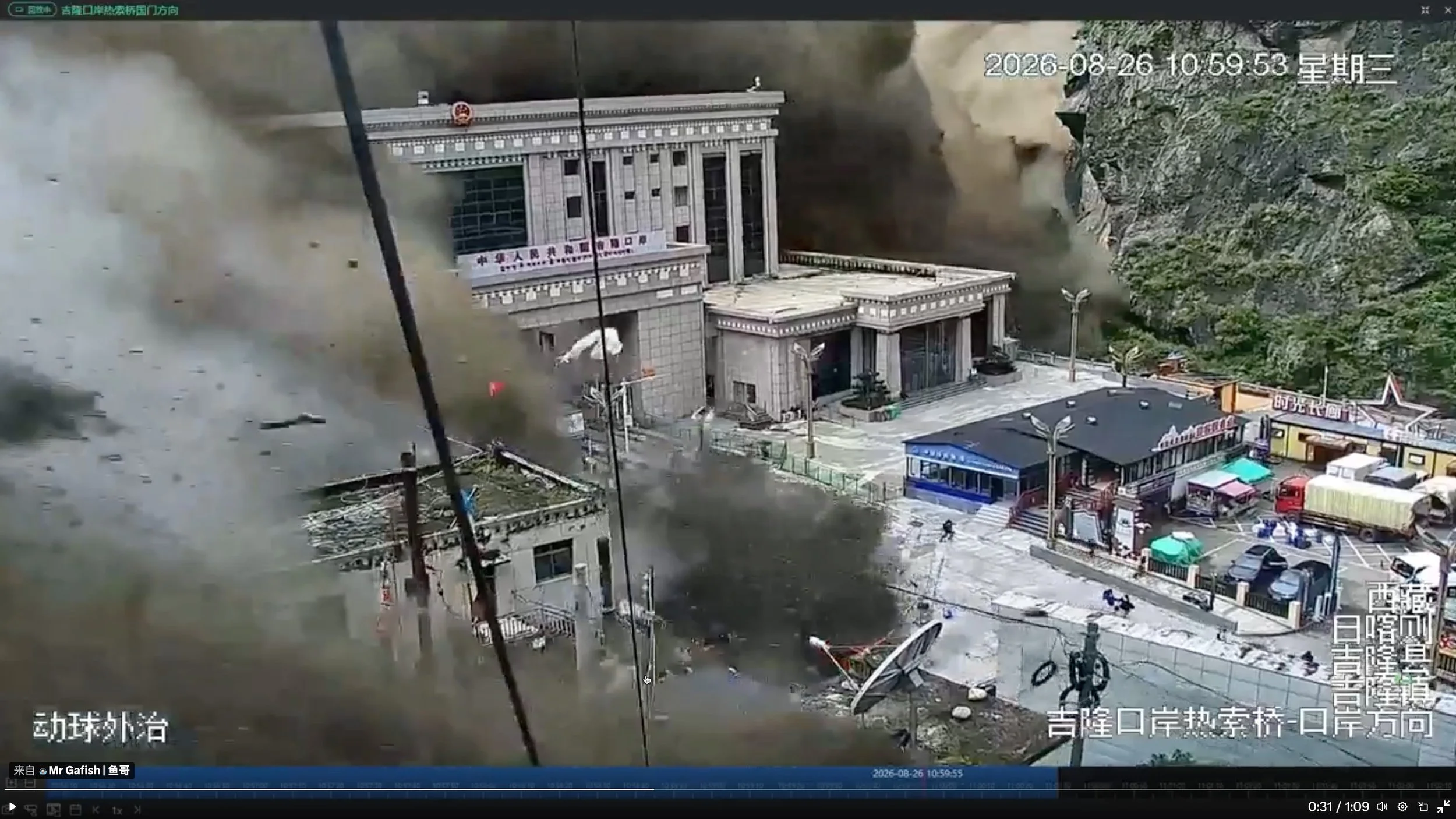
On the morning of August 26, 2026, a massive ice collapse and debris flow struck the Gyirong Valley along the China-Nepal border in the Himalayas.
Millions of cubic meters of glacial moraine, mud, rock, and ice reportedly came crashing down the valley at extraordinary speed. The torrent overwhelmed people, buildings, roads, vehicles, and critical border infrastructure, including the Resuo Bridge and the Gyirong Port inspection complex.
Videos from the scene are terrifying. People disappear almost instantly. Buildings vanish beneath the flow. Buses and trucks are swept away. Within moments, a broad section of the valley is buried under an immense volume of mud and debris.
The disaster then moved downstream.
The debris flow reportedly blocked the river, forming a temporary barrier lake that later failed. Mud-laden floodwaters rushed down the Gyirong Tsangpo and into Nepal, where the river becomes the Rasuwa. The destruction spread into Nepal’s Rasuwa region, threatening villages, roads, construction sites, and hydropower facilities downstream.
The main cross-border transportation route between China and Nepal was severed. Power and communications were disrupted. Chinese authorities subsequently imposed sweeping traffic restrictions and tight controls over access to the affected area.
But perhaps the most striking element of the disaster has been the stark contrast between the information emerging from Nepal and the information released by Beijing.
According to reports cited by the author, Nepalese authorities have acknowledged the recovery of hundreds of bodies and large numbers of missing persons while appealing publicly for assistance.
Chinese authorities, by contrast, have reported only three confirmed deaths while listing hundreds as missing.
That gap raises an obvious question: Why?
Was This Entirely a Natural Disaster?
The prevailing explanation is straightforward: climate warming destabilized high-altitude ice, triggering a catastrophic collapse and debris flow.
Climate change may indeed have played an important role.
But to attribute the entire disaster to nature without examining years of intensive construction in one of the most geologically fragile regions on Earth would be premature.
Gyirong lies within the Himalayan collision zone, where the Indian and Eurasian tectonic plates meet. The mountains are fractured, steep, unstable, and subject to enormous geological stress.
At high altitude, glaciers, moraine deposits, fractured bedrock, groundwater, and permafrost exist in a delicate mechanical relationship. Disturb one part of that system, and the effects may not remain local.
Yet this is precisely where China has pushed forward an extraordinary concentration of infrastructure projects.
Blasting, Excavation, and a Mountain Under Stress
Gyirong has become an important corridor in China’s cross-border infrastructure ambitions.
Nearby projects include the Rasuwa Bhote Koshi Hydropower Project, associated with the Shandong provincial state-owned ShuiFa Group, as well as planned or developing high-voltage transmission infrastructure linking China and Nepal.
At the same time, roads, tunnels, border facilities, settlements, and other infrastructure have expanded across high-altitude terrain.
Such projects require cutting into mountains, drilling, excavation, road building, blasting, and stabilization work.
Each individual blast may be insignificant when viewed in isolation. But years of repeated disturbance in highly fractured mountain terrain deserve scrutiny.
Repeated blasting can propagate vibration through existing joints and fissures. Deep excavation can alter local stress fields and groundwater conditions. Road construction can change drainage patterns. Vegetation removal and exposed rock surfaces can influence erosion, runoff, and freeze-thaw behavior.
None of this proves that construction caused the August 26 collapse.
But it does mean that the possibility of engineering-induced instability should not be dismissed without an independent geological investigation.
That investigation is precisely what should now be taking place.
Instead, the area is being sealed off.
The Politics of “Man Conquers Nature”
The deeper issue is not one construction project or one landslide.
It is a governing mentality.
For decades, the Chinese Communist Party has celebrated monumental infrastructure as evidence of state power and national greatness. Mountains are tunneled through. Rivers are dammed. Plateaus are crossed by highways, railways, pipelines, and power lines.
The ideological language behind such projects has often echoed an older revolutionary slogan: **“Man can conquer nature.”**
But nature is not conquered.
Engineering can manage risk. It can reduce risk. It can sometimes transform landscapes safely and productively.
What it cannot do is abolish geology.
When political deadlines, strategic objectives, or prestige projects override environmental caution, the result can be catastrophic—especially in terrain as unforgiving as the Himalayas.
A Strategic Corridor, Not Just a Border Crossing
Gyirong is also more than a commercial crossing.
It is strategically important.
Roads, tunnels, power systems, and logistics infrastructure in border areas inherently possess dual-use value. Civilian infrastructure can also support military mobility, supply, and deployment.
That gives the region significance far beyond tourism and trade.
If a major disaster were found to have been aggravated by poorly assessed infrastructure development, the consequences would not merely be technical. They would be political.
It would call into question the safety culture behind high-profile Belt and Road projects. It would raise concerns about major investments in fragile terrain. And it would undermine the image of China as an infrastructure superpower capable of mastering even the world’s most difficult environments.
That is precisely why transparency matters.
The “Asian Water Tower” and Downstream Risk
The Himalayas and Tibetan Plateau are often described as Asia’s water tower because some of the continent’s greatest river systems originate there.
China’s large-scale hydropower ambitions have made upstream development increasingly important not only economically, but geopolitically.
Projects on rivers originating in Tibet can affect countries downstream, including Nepal, India, and Bangladesh.
The lower Yarlung Tsangpo, in particular, has become the focus of one of the world’s most ambitious hydropower development strategies.
This creates an unavoidable regional question: Who bears the risk when upstream engineering decisions have downstream consequences?
In the case of a sudden flood, debris flow, landslide-dam failure, or other mountain hazard, minutes can determine whether communities survive.
If downstream populations are not given timely information, the human consequences can be devastating.
The Most Serious Question: Was Nepal Warned?
Among the most troubling allegations surrounding the disaster are reports that downstream communities in Nepal received no meaningful warning before the destructive flow arrived.
If true, this demands investigation.
Hydrological and geological information in transboundary river systems is not simply a technical matter. It is life-saving information.
China has long treated certain categories of hydrological and geographic data as sensitive. But when an imminent hazard threatens communities across an international border, secrecy can carry a human cost.
If authorities had knowledge of a landslide dam, rapidly rising water, a major upstream collapse, or other immediate danger, when did they know it?
What information did they share with Nepal?
When did they share it?
And if they did not issue a warning, why not?
Those questions should be answered publicly.
Why Call Hundreds “Missing”?
There is also the issue of casualty reporting.
In major disasters, identifying victims takes time. Initial death tolls are often incomplete. Authorities may reasonably classify people as missing until bodies are recovered or deaths can be legally confirmed.
But authoritarian systems have an additional incentive: controlling the political meaning of numbers.
A low confirmed death toll makes a disaster appear manageable.
A large “missing” category delays political impact.
By the time missing persons are gradually reclassified months later, public attention may have moved on.
This is why casualty transparency is not a minor administrative detail. It is central to public accountability.
If hundreds of people were trapped, swept away, or buried, the public deserves to know the best available estimate—not merely the narrowest number bureaucratically confirmed at a given moment.
Foreign Victims Raise the Stakes
The border crossing is used not only by Chinese and Nepalese citizens, but also by international travelers, including Hindu pilgrims heading toward Mount Kailash and tourists traveling through the Himalayan region.
Reports that large numbers of foreign nationals may be among the missing dramatically raise the diplomatic stakes.
If citizens of India, the United States, Britain, Canada, South Korea, Japan, or other countries are among the victims, their governments will naturally seek access to reliable information.
Families will demand answers.
Governments may seek to send rescue specialists or consular personnel.
International media will want to document what happened.
And independent experts will want to examine the geological and engineering causes of the disaster.
For a government highly sensitive to foreign access in Tibet and along strategically important border areas, that creates an obvious political dilemma.
Humanitarian transparency and political secrecy begin to collide.
The Dangerous Logic of Secrecy
A government that fears embarrassment can become trapped in a perverse logic.
To issue a warning may require admitting that a serious upstream hazard exists.
To request foreign assistance may require acknowledging that the disaster exceeds domestic capacity.
To permit independent investigators into the area may expose engineering failures.
To release a high casualty figure may trigger public anger and official accountability.
The political incentive, therefore, is to minimize, delay, restrict, and control.
But every hour lost to political calculation can cost lives.
Echoes of Wenchuan
China has faced similar questions before.
After the 2008 Wenchuan earthquake, public anger grew over collapsed school buildings, construction quality, missing children, and restrictions on independent investigation.
Military sensitivity, infrastructure secrecy, and information control repeatedly complicated efforts to establish a complete public record.
Wenchuan became not only a natural disaster, but also a lesson in how authoritarian governance responds when tragedy threatens to expose institutional failure.
The pattern is familiar:
First comes catastrophe.
Then censorship.
Then the narrowing of access.
Then carefully managed casualty figures.
Then propaganda emphasizing heroic rescue and national unity.
Finally, when attention fades, unanswered questions remain buried with the dead.
What Must Be Investigated Now
The Gyirong disaster should not be reduced either to a simple climate-change narrative or to an unproven claim of engineering culpability.
It requires evidence.
That means independent examination of seismic records, blasting logs, construction activity, slope monitoring, glacier movement, precipitation, temperature, groundwater conditions, satellite imagery, and the sequence of events before and during the collapse.
Investigators should determine whether infrastructure construction contributed to slope instability.
They should establish whether authorities had advance warning of the collapse or subsequent dam-break flood.
They should determine what information was communicated to Nepal, and when.
They should publish the true number of dead and missing.
And they should permit independent experts and journalists to examine the evidence.
If Beijing is confident that this was purely a natural disaster, it should have nothing to fear from transparency.
The greatest danger exposed by this catastrophe is not simply geological instability.
It is a political system in which secrecy, prestige, strategic control, and “stability maintenance” may take precedence over human life.
From the Longmenshan fault zone in 2008 to Gyirong Valley today, one principle remains unchanged:
Nature does not obey propaganda.
A mountain does not care about political deadlines.
A glacier does not recognize national ambition.
And a wall of mud does not distinguish between a government official, a truck driver, a pilgrim, a tourist, or a villager downstream.
When political power insists that it can dominate nature, suppress inconvenient evidence, and dictate the acceptable scale of tragedy, disaster acquires a second victim beyond those buried beneath the rubble.
Truth itself becomes the first casualty.
August 28, 2026, 2:38 a.m.
Translated and adapted from Sheng Xue’s original Chinese article: