Information the CCP Dare Not Disclose After Test-Firing Missiles
On July 6, the Chinese Communist Party (CCP) announced the test-launch of a submarine-launched ballistic missile into the South Pacific, drawing widespread condemnation and attention. It is reported that the CCP may have test-fired two missiles simultaneously. The CCP did not disclose the specific model, so external parties cannot determine whether the missiles were Julang-2 or Julang-3. This action by the CCP appears to be sending a signal of confrontation with the United States, but the missile’s impact point is puzzling, and its range is insufficient to threaten the U.S. mainland, actually exposing a significant gap. There is too much information that the CCP dares not disclose.
Was Only One Missile Test-Fired?
On July 7, the U.S. think tank Center for Strategic and International Studies (CSIS) published an article titled “China’s SLBM Test Underscores the Importance of a Ballistic Missile Launch Notification Agreement.”
The article analyzes that the CCP’s test-fired Julang-2 or Julang-3 submarine-launched intercontinental ballistic missile was launched from the South China Sea into the Pacific Ocean, with a flight distance of approximately 7,300 kilometers. It may have flown over parts of the Philippines and finally landed in the South Pacific nuclear-free zone. Navigation warning information shows that the CCP may have conducted two missile tests on July 6: one launched from the Bohai Sea, flying over Japan into the Pacific; the other launched from the South China Sea, possibly flying over the Philippines. It is currently unclear why only the latter scenario was observed.
The CCP only publicly admitted to test-firing one missile. This missile was likely launched by a CCP nuclear submarine from the South China Sea, landing in the sea area near many island nations in the South Pacific or the Central Pacific.
The CCP may have simultaneously prepared to launch another missile from the Bohai Sea, but it perhaps failed, so they simply did not acknowledge it. It is also possible that, due to various issues, the Bohai Sea test was suddenly canceled at the last minute. However, the CCP notified Japan a few hours before the test.
The U.S. military has not yet issued a notification regarding the CCP’s missile test, and Japan’s Ministry of Defense also did not issue a timely notification. Whether the CCP test-fired one missile or two has become a mystery for a while.
In August 2020, the U.S. military reported that the CCP had launched four ballistic missiles into the South China Sea, but the CCP only claimed to have test-fired two.
If the CCP simultaneously launched two submarine-launched ballistic missiles this time, with only one successful and the other failed, it is highly likely they would not admit to the failed launch.
Recently, information has emerged that CCP Southern Theater Navy Colonel Fang Ming and Lieutenant Shi Shaoyong died during a night flight training on June 10. The outside world suspects the two died in a plane crash in the South China Sea, and there are reports of a third victim, but the CCP has covered up the crash incident.
The CCP has always covered up such negative information. If the missile launched from the Bohai Sea failed to take off or went missing after launch, the CCP would naturally cover it up as well.
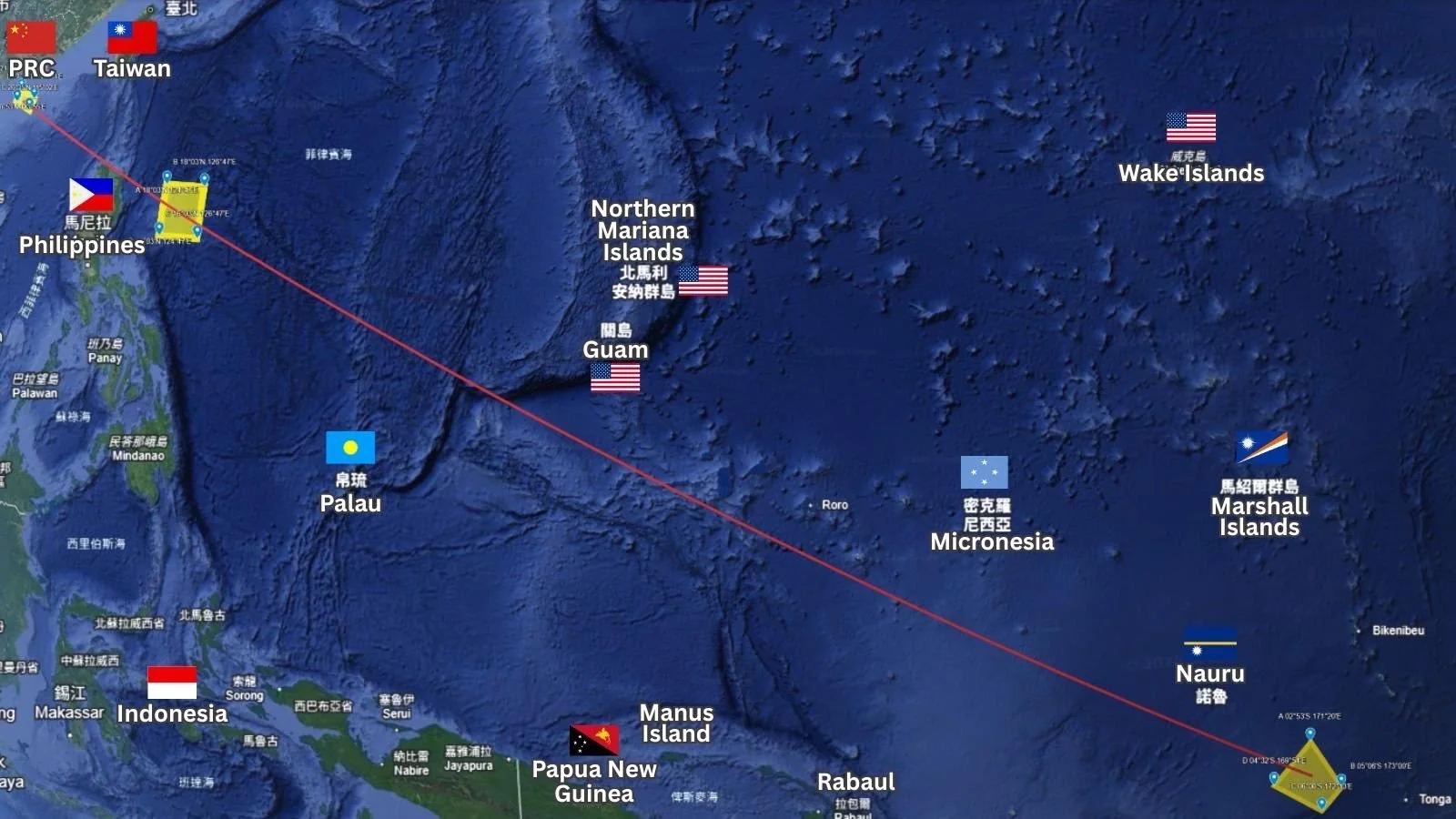
On July 6, 2026, a trajectory map of the CCP’s test-fired submarine-launched ballistic missile released by ROC National Security Council Secretary-General Wellington Wu. (Wellington Wu’s social media)
Did the Missile Launched from the South China Sea Deviate from Its Course?
After the CCP test-fired the missile, ROC National Security Council Secretary-General Wellington Wu posted a trajectory map of the CCP missile on social media. It showed the missile flying over northern Philippine airspace and the exclusive economic zones of multiple Pacific countries, finally landing in the sea area approximately 6 degrees south latitude and 174 degrees east longitude in the South Pacific, very close to the boundary of Tuvalu’s exclusive economic zone.
If this was the planned impact point for the CCP’s missile test, it was extremely risky. Generally, when countries launch ballistic missiles, they notify relevant nations in advance, clearly delineate flight and impact areas to avoid air or maritime accidents, and choose vast, uninhabited sea areas for impact points to minimize the probability of damage.
CCP missile debris often falls in areas where ordinary people live, and the CCP does not care about the safety of civilians in other countries. This time, the CCP’s missile impact point was precisely in a relatively dense area of Pacific island nations, rather than a vast uninhabited sea area. The CCP may disregard the risks its missile tests pose to civilians of various countries, but it should be concerned about the risk of leaks.
Once a CCP missile loses control and falls on an island or in nearby shallow waters, the debris could be obtained by the United States and its allies, and the CCP’s missile technical secrets would be leaked. Therefore, the CCP’s test-firing of missiles into the waters of many South Pacific island nations carries both the risk of harming people and the risk of leaking secrets. If the missile goes out of control and deviates, and the debris is recovered, the CCP will lose all face.
There should have been better options for the CCP missile’s impact point, such as the waters southwest of Hawaii and north of the equator, which have large uninhabited sea areas. If the missile were aimed at even more distant uninhabited waters in the South Pacific, it would be safer—neither harming people nor making it easy for debris to be salvaged.
However, the CCP missile was fired into a sea area with relatively dense islands and landed near the edge of Tuvalu’s exclusive economic zone. If this was deliberately planned by the CCP, it was reckless; if it was not the planned impact point, then it was very likely off-target. Yet the CCP still stubbornly claimed it was “successful.”
In August 2022, the CCP launched 11 missiles into multiple sea areas around Taiwan, with five landing in Japan’s exclusive economic zone east of Taiwan, triggering strong protests from Japan. Some analysts believe this was deliberate; others believe the CCP missiles may have been off-target.
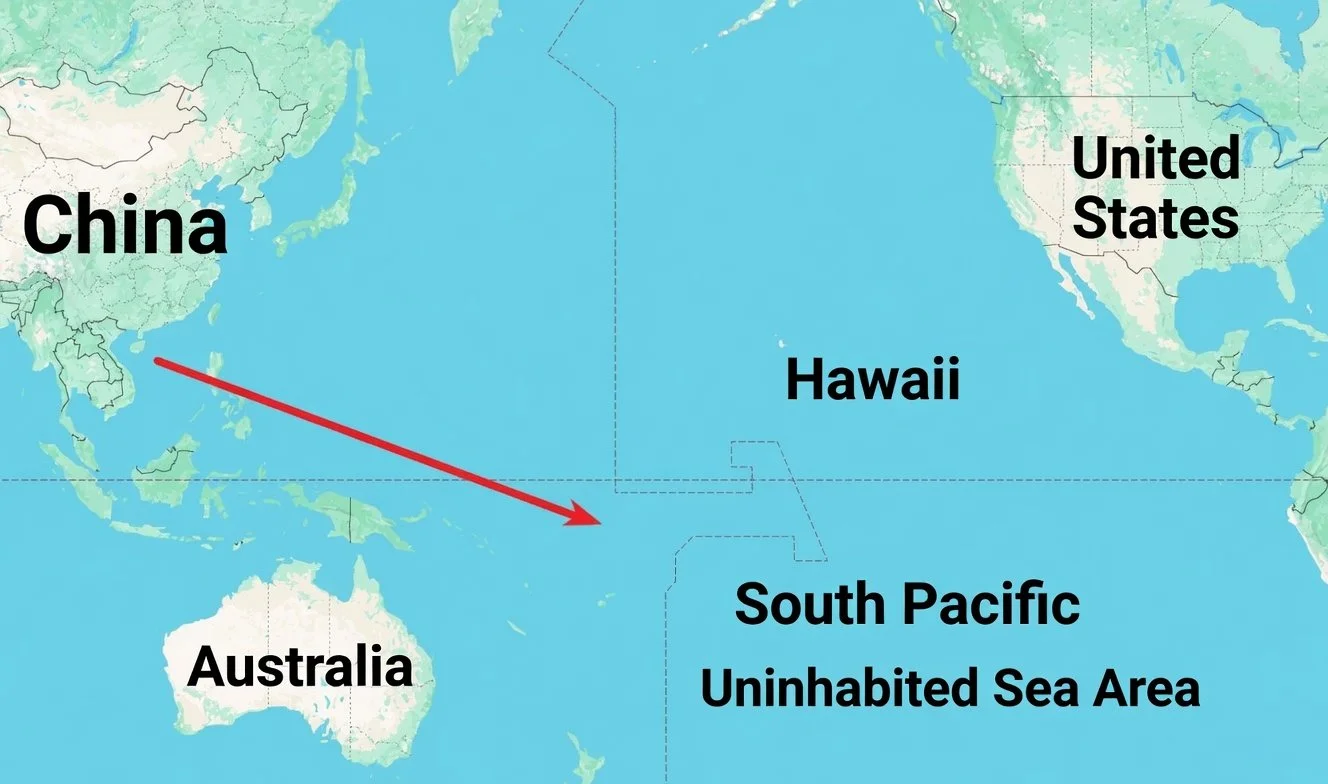
On July 6, 2026, the CCP’s submarine-launched ballistic missile test-fired from the South China Sea landed in a relatively dense sea area of South Pacific island nations.
Who Is the CCP Trying to Intimidate?
The outside world generally believes that the CCP’s missile test at this time is still intended to confront the United States and cover up the truth about internal turmoil in the CCP military. In the first half of 2026, the scale of CCP military aircraft harassing the Taiwan Strait significantly decreased, and CCP warship exercises outside the first island chain were also greatly reduced, all indicating that the CCP’s command chain has not yet returned to normal. The CCP’s missile test this time is likely an attempt to make up for this and strike a posture of continuing confrontation with the United States and its allies.
The CCP’s new Air Force commander has just been promoted to general, but the commanders of the CCP Navy and Rocket Force still seem to be in limbo. The unit responsible for this missile test should be the submarine force of the CCP Southern Theater Navy, and possibly also the submarine force of the CCP Northern Theater Navy.
If the CCP deliberately chose to fire the missile toward the South Pacific island nation region, it would be attempting to threaten the various island nations in the South Pacific, as well as Australia and New Zealand.
The CCP has been trying to compete with the United States and its allies for control of South Pacific island nations and even plans to establish military bases in the South Pacific or the Central Pacific as springboards to attack Hawaii or Australia. This is similar to the strategy Japan adopted during the Pacific War, but at that time, the Japanese army had already occupied Southeast Asia and other places. Ultimately, U.S. forces launched a counteroffensive in the Solomon Islands, and the Japanese army could only retreat step by step.
Today, the CCP has not yet controlled the Philippines, Malaysia, Guam, and other places, yet it delusionally seeks to control the South Pacific first. This is quite fantastical and shows military ignorance.
The CCP has tried to win over South Pacific island nations and create divisions. Now, these island nations are restoring cooperation with Australia. This should make the CCP angry, but threatening them by test-firing missiles looks more like a vent of frustration after losing control, appearing foolish. The consequences of the CCP’s actions will actually make it very difficult to repair relations with South Pacific island nations and will only make all countries more clearly see the CCP’s true face.
Australia, New Zealand, and various Pacific island nations have no nuclear weapons. The CCP’s use of submarine-launched ballistic missiles equipped with simulated nuclear warheads to threaten them invisibly exposes its own lies. The CCP has always claimed the so-called “no first use of nuclear weapons,” which means it cannot use nuclear weapons against non-nuclear states. However, by firing submarine-launched ballistic missiles capable of delivering nuclear weapons into the waters of South Pacific island nations, the CCP is effectively declaring that it may throw nuclear weapons at these countries at any time.
The CCP has repeatedly pretended to be peaceful in front of the world. Now that the missiles have been fired, its credibility has completely collapsed.
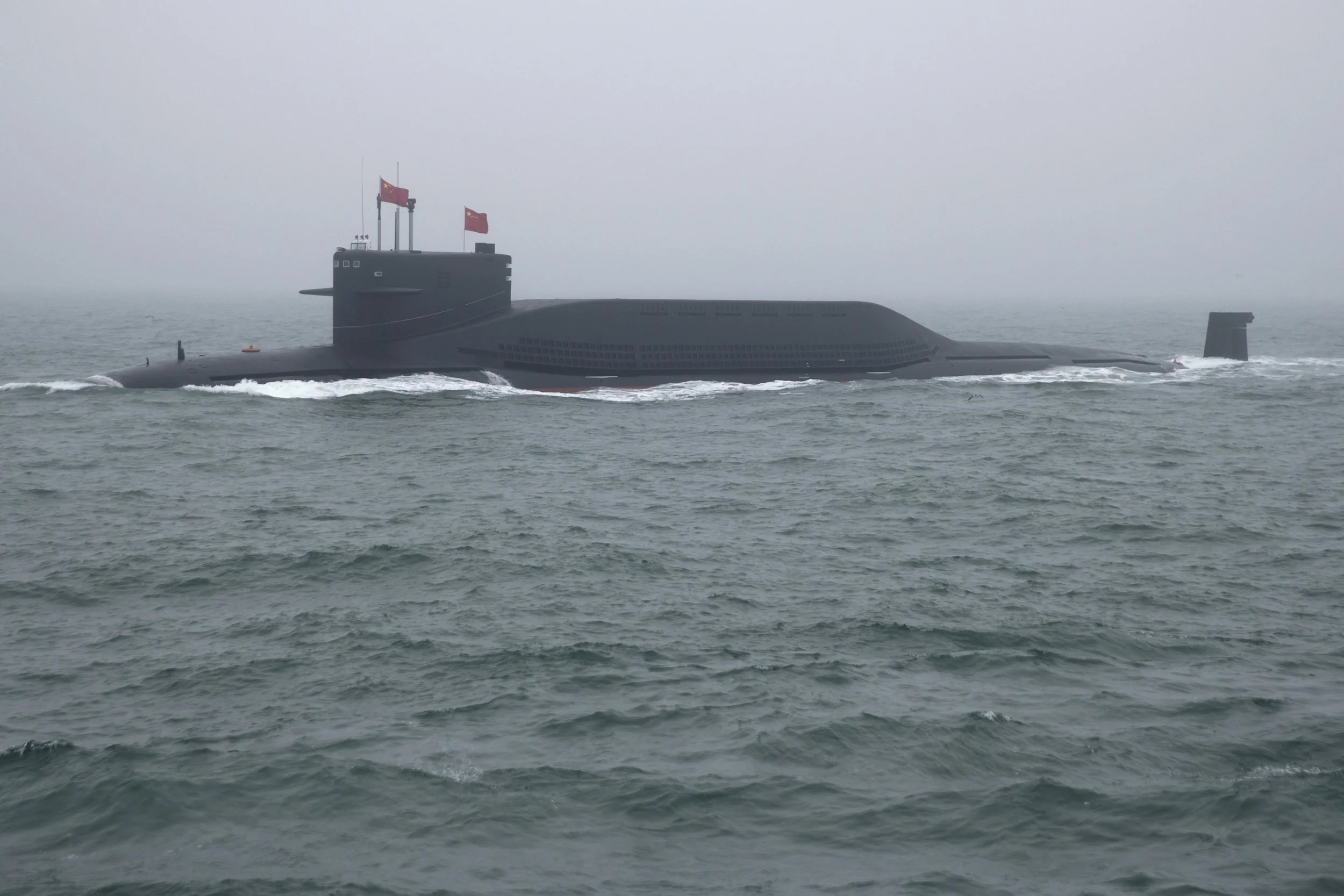
On April 23, 2019, a CCP Type 094 nuclear submarine appeared in the waters near Qingdao. To accommodate the large-volume submarine-launched ballistic missiles, the raised “turtle back” in the middle of the submarine became a reluctant design. (Mark Schiefelbein/AFP via Getty Images)
The Embarrassment of Missile Range
The CCP’s party media released photos of this missile test, but since the Julang-2 and Julang-3 missiles look similar, the outside world cannot determine which one was actually test-fired. Based solely on the flight distance of 7,300 kilometers for this test, it seems more likely that the CCP test-fired a Julang-2 missile, which is basically its maximum range.
The CCP’s Julang-2 submarine-launched missile cannot threaten the U.S. mainland and is very likely unable to reach Hawaii either.
If the CCP only test-fired the Julang-2 missile and did not test the Julang-3, it looks even more like an attempt to issue a threat without daring to directly challenge the United States.
If the CCP test-fired the Julang-3 missile but it did not fly its claimed maximum range of 10,000 kilometers or even 12,000 kilometers, then it essentially failed. It cannot be ruled out that the CCP test-fired a Julang-3 missile with a planned impact point in more distant uninhabited waters of the South Pacific, but it lost control midway and landed in the waters of a South Pacific island nation. In that case, the CCP’s attempt to threaten the U.S. mainland with a missile test would be completely humiliating.
In November 2022, former U.S. Pacific Fleet Commander Paparo stated that all six active Type 094 strategic nuclear submarines of the CCP have been equipped with Julang-3 missiles to threaten U.S. security.
If the CCP’s six Type 094 strategic nuclear submarines are all equipped with Julang-3 missiles yet still need to test-fire Julang-2 missiles, it lacks logic—unless the Julang-3 data publicly displayed in 2025 was for show, or the difference between the two is not as great as claimed. The CCP Rocket Force and military-industrial complex have seen successive corruption scandals. CCP high-level officials likely have no confidence even in the reliability of the Julang-2 missile, which is why they ordered the test.
China Aerospace Science and Technology Corporation is responsible for producing the CCP’s strategic missiles, etc. Multiple successive officials have been implicated, including former chairman Wu Yansheng, who was removed in 2023, his predecessor Lei Fanpei, the one before that, Ma Xingrui and Xu Dazhe, and general manager Yuan Jie, who was dismissed in 2024, among others.
The CCP’s test-fired missile this time flew 7,300 kilometers and landed in a relatively dense sea area of Pacific island nations. Whether it was Julang-2 or Julang-3, the result is quite embarrassing. The CCP’s “experts” were not allowed to immediately come out to cooperate with the propaganda this time, probably because there was really nothing to boast about; any forced boasting would only expose the flaws.
The Gap Between the CCP’s Submarine-Launched Missiles and Those of the United States
The CCP’s Julang-2 submarine-launched ballistic missile is the submarine-launched version of the land-based Dongfeng-31 missile. Development of both began in the mid-1980s. The first sea launch of Julang-2 occurred in 2001. After a series of test failures, it only successfully completed one test in 2012.
In December 2015, CCP Type 094 submarines began carrying Julang-2 missiles. Due to the missile’s large size, the raised “turtle back” in the middle of the submarine became a reluctant design, but each submarine can only carry 12 missiles. The Julang-2 has a maximum range of 7,200 kilometers. The subsequent Julang-2A (JL-2A) claims a maximum range of 9,000 kilometers and can carry three 250-kiloton nuclear warheads or six 40,000- to 60,000-ton nuclear warheads.
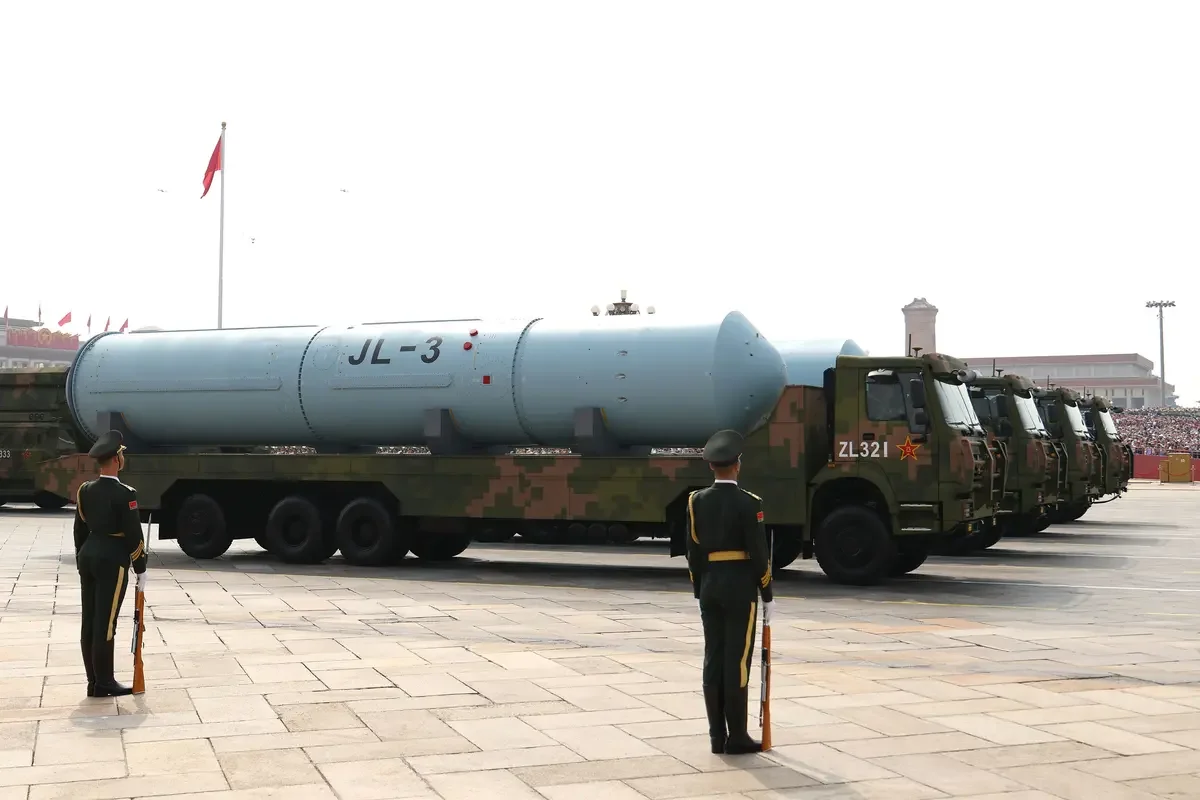
The later Julang-2B (JL-2B) claims a maximum range of 12,000 kilometers and was renamed Julang-3 (JL-3). It first appeared at the Beijing military parade in September 2025, with an appearance similar to the Julang-2. It is reported that the Julang-3 has been test-fired multiple times from the Bohai Sea, with impact points in inland target ranges in western China.
The Julang-3 was originally intended for the under-development Type 096 submarine, but the 096 submarine seems to have encountered difficulties, so it had to be retrofitted onto active Type 094 submarines. Its performance still lags significantly behind the U.S. Trident submarine-launched missile.
The U.S. UGM-133A Trident II or Trident D5 submarine-launched ballistic missile was first deployed in 1990 and remains in service after upgrades. Its maximum range is 11,520 kilometers, with a maximum speed of Mach 24. It can carry up to eight 475-kiloton nuclear warheads or twelve 90-kiloton nuclear warheads, with a far greater payload than the CCP’s Julang-3.
The U.S. has 14 active Ohio-class ballistic missile nuclear submarines, each capable of carrying 20 Trident missiles. The UK’s four Vanguard-class ballistic missile nuclear submarines each carry 16.
The most recent Trident missile test was in September 2025, successfully completing the 197th test launch. The United States issued a “Notice to Airmen” in advance, clearly defining no-fly zones, and also issued a maritime “Notice to Mariners” defining no-sail areas during the scheduled test period. The missile impacted the vast, uninhabited waters of the Atlantic. The Trident II D5 missile continues to be extended in service until the 2040s.
The CCP’s missile test this time looks more like a test they do not fully trust. They dare not disclose much information, yet they cannot hide the obvious technological gap in submarine-launched ballistic missiles, corruption scandals, and military internal turmoil. The gap between the CCP’s missile defense system and that of the United States is even greater.
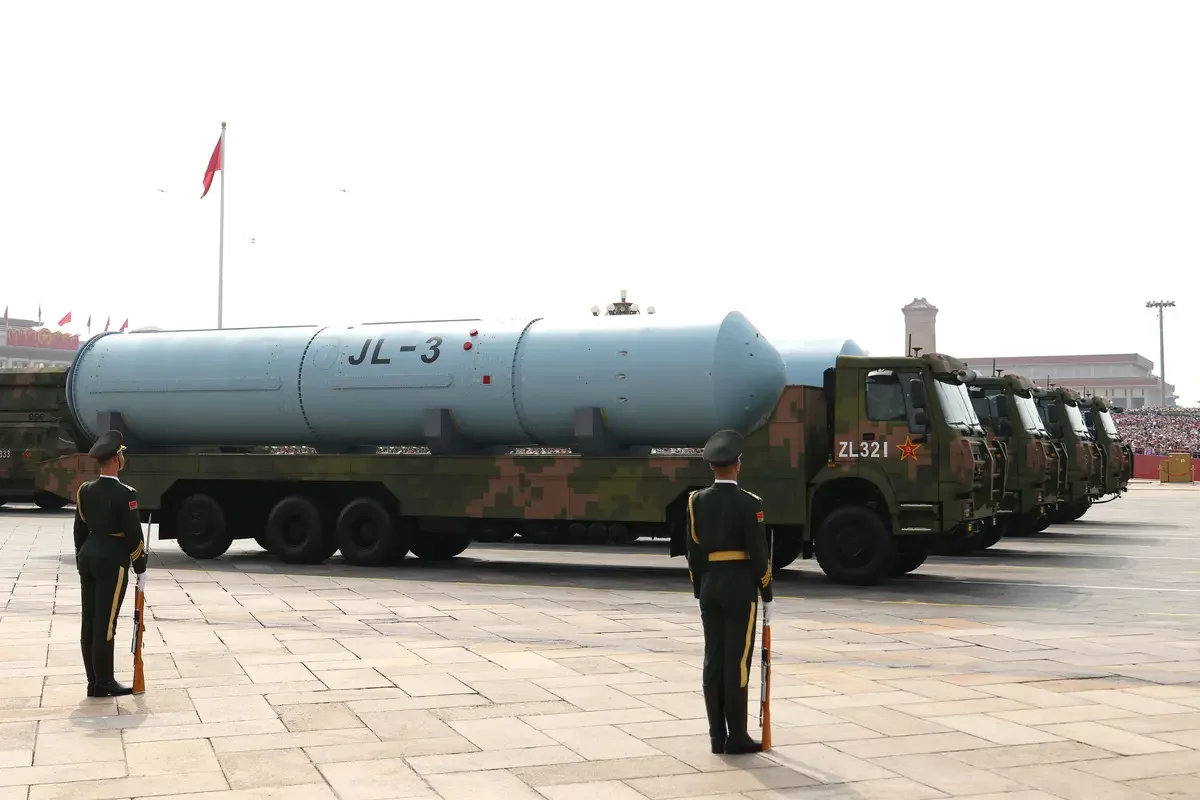
On September 3, 2025, the Chinese Communist Party’s Julang-3 (JL-3) submarine-launched intercontinental ballistic missile appeared at a military parade in Beijing. (Lintao Zhang/Getty Images)